


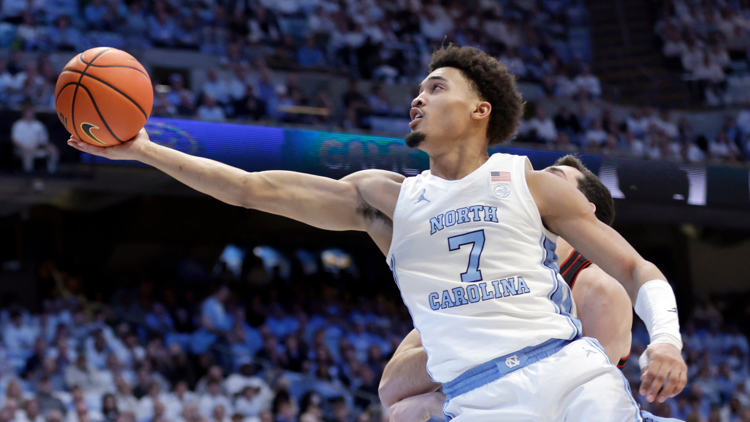
Seth Trimble’s basketball future has suddenly been thrown into uncertainty.
Just when it appeared the former North Carolina standout had finally found a path to play another season of college basketball, a major court decision has changed everything again. The Kentucky Court of Appeals has dissolved the temporary injunction that had allowed Trimble and other Class of 2022 athletes to compete during the 2026-27 season.
The immediate result is significant: Trimble is now considered ineligible to play for Louisville while the legal fight continues. But there is one extremely important detail that should not be overlooked — this is not the end of his lawsuit, and it does not mean his basketball career has suddenly ended.
For Trimble, the situation is particularly frustrating because he had already gone through several twists just to get to this point.
The former UNC guard transferred to Louisville with the expectation that he could continue his college career for another season. Because of the NCAA’s eligibility rules and the legal battle involving athletes from the high school Class of 2022, Trimble needed additional legal protection to take the court in 2026-27.
He eventually joined the Kentucky lawsuit seeking that opportunity.
In late August, Trimble filed paperwork to become part of the lawsuit challenging the NCAA’s eligibility restrictions. The case was already producing movement, and on Sept. 2, a Jefferson County Circuit Court judge granted a motion adding Trimble to the temporary restraining order. That decision allowed him to be eligible to play for Louisville while the legal proceedings continued.
At that moment, the outlook appeared much different.
Trimble could prepare for the season. Louisville could plan around him. And fans could begin imagining what the experienced guard might bring to the Cardinals.
Then came the latest twist.
On Oct. 2, a three-judge panel of the Kentucky Court of Appeals dissolved the temporary injunction. The ruling immediately removed the legal protection that had allowed Trimble and the other athletes involved in the case to compete.
That means Trimble is now back on the sidelines from an eligibility standpoint.
But the key phrase is “for now.”
The underlying lawsuit remains ongoing. The appeals court’s decision removed the temporary protection; it did not simply erase the entire legal case or declare that every question surrounding Trimble’s eligibility had been permanently settled. Reports indicate that further court proceedings are still ahead.
That distinction is extremely important for Trimble.
His immediate season is in jeopardy, but his basketball future is not automatically finished.
There is still a legal path that could potentially change his status again.
Reports indicate that another hearing in the matter is scheduled for Oct. 9, although the exact proceedings can change as the case develops.
So what happens next for Seth Trimble?
That is the question Louisville fans, UNC fans and Trimble himself are now waiting to have answered.
The first possibility is that the legal process produces another temporary order or other relief that could once again make Trimble eligible to play. Nothing about the latest ruling guarantees that outcome, but the fact that the underlying case remains active means the door has not been permanently closed.
The second possibility is that the court battle continues without Trimble being allowed to compete during the season. If that happens, the biggest impact would be on the 2026-27 season itself rather than necessarily on his entire basketball career.
That is an important distinction.
Trimble has already established himself as a college basketball player over four seasons at North Carolina. He made 129 appearances for the Tar Heels and finished his UNC career with 992 points. His decision to transfer to Louisville was tied directly to the opportunity to continue playing, develop his game and pursue another season at the collegiate level.
Now that opportunity has become uncertain because of a legal dispute surrounding eligibility rules.
It is also worth remembering that Trimble’s basketball journey does not begin and end with this one Louisville season.
Before transferring, he had already built a substantial college résumé at UNC. His experience, athleticism and defensive ability helped establish him as a player capable of contributing at a high level. His decision to pursue another season was an attempt to add another chapter to that résumé.
That is why describing the latest development as the end of Trimble’s future would go too far.
What has been placed in serious jeopardy is his opportunity to play for Louisville during the 2026-27 season.
The broader question of what happens next remains unresolved.
Trimble’s case also highlights how complicated the NCAA’s evolving eligibility landscape has become. The NCAA’s new age-based eligibility model created a major legal dispute over athletes from the Class of 2022 who had already completed four seasons in four school years. Those athletes argued for another season under the changing eligibility environment.
The Kentucky lawsuit became one of the legal avenues through which athletes attempted to secure that additional opportunity.
Trimble was not originally at the center of the case. He joined later because his own eligibility situation required protection after developments in other litigation affected athletes from his class. Reports in August and September detailed how he pursued inclusion in the Kentucky case specifically so he could have a chance to play for Louisville.
That makes the latest decision even more dramatic.
Trimble went from potentially being unable to play, to being temporarily eligible, and now back to being ineligible.
And it all happened before he could truly settle into his new chapter at Louisville.
For Louisville, the basketball consequences could be significant. Trimble arrived with experience from one of the nation’s most prominent programs and was expected to bring that experience into the Cardinals’ backcourt.
For Trimble personally, however, the consequences are much bigger than simply missing games.
He transferred with the expectation of playing.
He prepared for the season.
He went through the legal process to protect his eligibility.
He received a temporary green light.
And now another court ruling has taken that opportunity away again.
Yet there is still a reason not to close the book on this story.
The court battle is continuing.
That means the next legal development could become just as important as the ruling that arrived Friday.
For now, Trimble cannot simply assume that he will return to the floor. At the same time, it would be premature to assume that his 2026-27 season is permanently finished or that his overall basketball future has been decided.
The situation remains fluid.
And that may be the biggest storyline surrounding Trimble right now.
A player who thought he had secured another chance to play college basketball is once again waiting for the courts to determine whether that opportunity remains available.
The coming proceedings could therefore become critical for his Louisville season.
If another court order restores his eligibility, Trimble could potentially return to the Cardinals and continue the season he worked so hard to reach.
If the legal process does not provide that relief, his Louisville season could ultimately disappear despite all the preparation that went into it.
But either way, the latest decision should be viewed in the proper context.
This is an eligibility battle — not a declaration that Seth Trimble’s basketball career is over.
His immediate opportunity at Louisville is now in serious doubt. His legal case is still moving forward. And until that process reaches a final resolution, there is still another chapter to be written.
For Trimble, that may be the most important thing of all.
The question is no longer simply whether he wanted another season.
He clearly did.
The question now is whether the courts will ultimately give him the opportunity to finish what he started.
And with another major legal development potentially ahead, Seth Trimble’s story is far from finished.




