


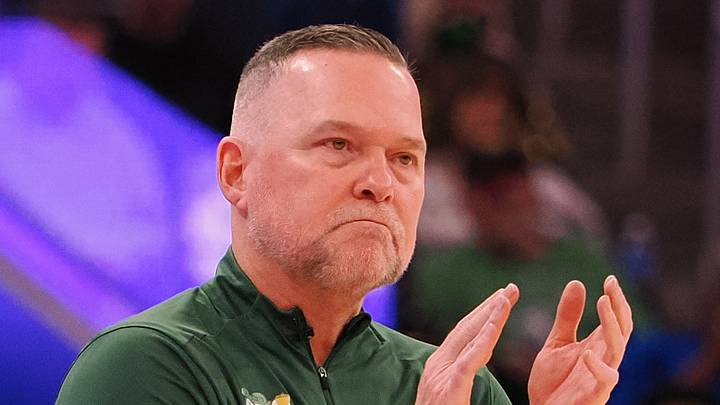
For a moment, UNC basketball fans had every reason to believe that Jordan Page could become one of the biggest recruiting wins of the Michael Malone era. The Tar Heels had made their pitch, Page had visited Chapel Hill, and because of his North Carolina roots, there was a natural belief that UNC could ultimately convince him to stay home.
But then the momentum changed.
And now, the outcome that began to feel increasingly likely has officially arrived.
Five-star 2027 prospect Jordan Page has committed to UConn, choosing Dan Hurley and the Huskies over North Carolina. The decision ends a recruitment that had become one of the more closely watched battles surrounding the Tar Heels.
For UNC fans, this one stings.
Page is not simply another name on a recruiting board. He is a highly regarded five-star prospect, listed at 6-foot-5 and capable of playing both guard and wing. He has been regarded as one of the top players in the 2027 recruiting class and has attracted significant attention from some of the biggest programs in college basketball.
And perhaps the biggest reason this one feels different is where Page comes from.
He is a Raleigh, North Carolina native.
That naturally made UNC a particularly intriguing destination throughout the recruitment. The Tar Heels had an opportunity to keep a highly talented North Carolina prospect close to home and potentially make him one of the faces of the next era of the program.
Instead, Page is heading north to Storrs.
The decision came after Page took official visits to both UNC and UConn. His visit to Chapel Hill gave the Tar Heels plenty of reason for optimism. He was able to experience the Carolina environment, spend time around the program and get a feel for what life could look like if he chose to remain in his home state.
For a while, it appeared UNC had positioned itself extremely well.
But then came the UConn visit.
And that visit changed the entire feel of the recruitment.
The momentum increasingly shifted toward Dan Hurley and the Huskies, and what had once looked like a potential homecoming for Page began to look much more uncertain from UNC’s perspective.
That is where the story gets particularly interesting.
UNC had not been casually involved in this recruitment. The Tar Heels were one of the finalists, and Page ultimately had a decision between two major programs with very different pitches.
North Carolina could offer the opportunity to return home and become part of one of the most recognizable basketball programs in the country.
UConn could offer something different: a program that has established itself as a national championship contender, a winning culture and a coach in Hurley who has developed a reputation for getting highly talented players to buy into his system.
In the end, Page chose the latter.
And that decision should get the attention of UNC fans.
Because while there has been plenty of discussion surrounding NIL and what each program could potentially offer financially, the decision appears to have involved much more than money.
Page reportedly valued UConn’s culture, championship success and player development.
That explanation matters.
Because it highlights one of the biggest realities of modern college basketball recruiting.
UNC cannot simply assume that being UNC will be enough.
The Tar Heels are one of the most recognizable brands in college basketball. They have the history, the championships, the NBA pipeline and the national attention. But the recruiting landscape has changed dramatically.
Players now have more options than ever.
And coaches have to sell recruits on a complete vision.
That includes development.
That includes playing time.
That includes NIL.
That includes winning.
And, perhaps most importantly, it includes convincing a recruit that the program has a clear plan for his future.
For Page, UConn apparently won that battle.
His decision also represents another major recruiting victory for Hurley. The Huskies are putting together an impressive 2027 class, and adding another five-star talent gives them even more momentum on the recruiting trail.
That is a significant development.
UConn is building a class capable of competing with the nation’s elite, and Page gives Hurley another versatile piece to potentially build around.
Page’s versatility is one of the reasons he generated so much interest nationally.
At around 6-foot-5, he has the physical tools to defend multiple positions and contribute in different ways. His reputation isn’t based solely on scoring. He has been praised for his athleticism, rebounding, passing, defensive versatility and ability to connect different parts of a lineup.
That type of two-way versatility is exactly what major programs want.
And it explains why UNC pursued him so aggressively.
Still, this should not be viewed as a recruiting disaster for the Tar Heels.
Missing on Page hurts, but it does not mean Malone’s recruiting strategy has failed.
Far from it.
UNC still has an extensive 2027 recruiting board, with several other highly ranked prospects receiving serious attention. The Tar Heels have other five-star targets who could potentially become major pieces of the program’s future.
And that gives Malone an opportunity to immediately move forward.
Perhaps this is where the Page decision could ultimately become more important than the commitment itself.
UNC now knows exactly what it is competing against.
The Tar Heels cannot afford to sit back and assume that a prospect’s connection to North Carolina will automatically bring him to Chapel Hill.
If another program presents a more convincing combination of culture, development, opportunity and financial resources, UNC can lose even when it appears to have every natural advantage.
Page’s decision is a reminder of that reality.
At the same time, there is still plenty of time for Malone to reshape the 2027 class.
One recruiting door has closed.
Several others remain open.
And if UNC can land some of its other priority targets, the disappointment surrounding Page could eventually become little more than a footnote.
But for now, there is no denying that this one hurts.
A North Carolina native.
A five-star prospect.
A player the Tar Heels wanted.
And ultimately, a player who chose UConn.
The momentum shifted after his UConn visit, and once it did, UNC was fighting an uphill battle.
Now comes the biggest question for UNC fans:
What does Michael Malone do next?
Because losing Jordan Page may have been disappointing, but how the Tar Heels respond could be far more important than the recruitment they just lost.
The 2027 recruiting battle is nowhere near finished.
And UNC’s next move could tell us a lot about where this new era of Tar Heels basketball is heading.




