


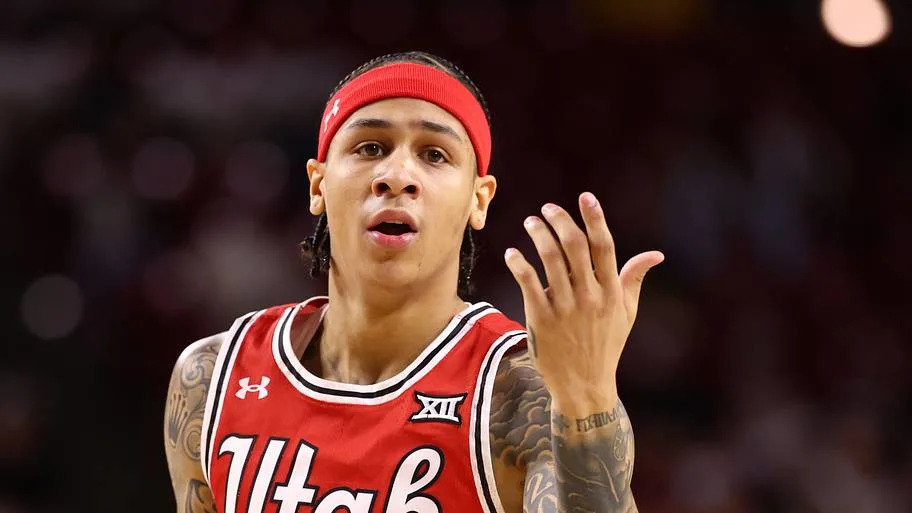
Terrance Brown did not arrive at North Carolina simply to become another scorer on a talented roster. After putting together a productive season at Utah, the veteran guard is entering a completely different environment under Michael Malone, and the expectations are considerably higher. Malone sees the ability to score, but he also wants Brown to become a more complete player — and that development could have major consequences for what UNC is capable of becoming.
Brown’s move to Chapel Hill immediately gave Carolina another experienced and talented piece in the backcourt. But his biggest challenge may not be learning a new system or adjusting to a new team. It may be discovering just how much more he can bring to the floor when scoring is no longer the only thing expected of him.
That is where Malone’s vision becomes particularly interesting.
Malone Wants More Than a Scorer
Brown has already demonstrated that he can put points on the board.
During his time at Utah, he emerged as one of the team’s most important offensive players, averaging nearly 20 points per game while also contributing as a passer. His production made him one of the more intriguing transfer additions available to UNC.
But Malone does not appear interested in simply putting the ball in Brown’s hands and telling him to score.
The new Carolina coach wants his guards to be versatile.
That means Brown could be asked to create opportunities for teammates, defend multiple types of players, rebound from the guard position and make decisions with the basketball rather than simply hunt for his own shot.
That challenge could ultimately determine just how valuable he becomes for the Tar Heels.
And it could also determine how dangerous UNC’s new system becomes.
Brown’s Next Step Could Be the Most Important One
For a player who has already proven he can score at a high level, the next stage of development is often about becoming more complete.
Brown does not necessarily need to abandon the scoring ability that made him attractive to UNC. Instead, he needs to add more layers to his game.
Imagine a Brown who can consistently punish defenses when given space, but can also create for teammates when defenders collapse on him.
Imagine a guard who can initiate the offense one possession, move off the ball the next, defend an opposing scorer and then crash the boards.
That type of player becomes much harder to scheme against.
And that appears to be the type of versatility Malone wants from his roster.
The goal isn’t simply to have five players who fit neatly into traditional positions.
The goal is to have players who can perform multiple responsibilities.
That is where Brown could become especially important.
The Positionless Idea Could Change UNC
College basketball has increasingly moved toward versatility.
Traditional labels such as point guard, shooting guard, small forward and power forward still matter, but many of the best modern teams are built around players who can do multiple things.
UNC appears to be embracing that philosophy.
Rather than relying exclusively on one traditional point guard to control everything, Malone can potentially use several players capable of initiating offense.
That creates options.
A player can bring the ball up the floor without necessarily being the team’s full-time point guard. Another player can initiate the offense from the wing. A bigger guard can exploit a smaller defender. A smaller player can attack a slower opponent.
The possibilities increase when players aren’t restricted to one role.
Brown’s skill set could make him particularly valuable in that environment.
He has enough scoring ability to attract defensive attention, and if he continues developing as a playmaker, he can punish defenses that focus too heavily on him.
That could create opportunities for UNC’s other talented players.
And that is the part of Brown’s arrival that could be bigger than his individual statistics.
Why Brown’s Development Matters So Much
A talented roster does not automatically become a great team.
Players have to understand their roles.
They have to sacrifice when necessary.
They have to defend.
They have to make the extra pass.
They have to trust one another.
Brown will be one of the players asked to help establish that identity.
His previous experience gives him an advantage, but it also raises expectations.
He has already played college basketball at a high level. He knows what it means to be responsible for significant offensive production.
Now, however, he has an opportunity to play alongside a deeper collection of talent.
That could make life easier for him.
At Utah, Brown was often one of the primary offensive options. At UNC, he does not necessarily have to carry the entire scoring burden.
That could actually unlock another level of his game.
With other capable players around him, Brown could spend more energy making the right basketball play instead of feeling obligated to manufacture offense every possession.
And sometimes, taking pressure away from a star player is exactly what allows that player to become even more effective.
The Challenge Is Clear
The biggest question is whether Brown can make that transition.
It sounds simple on paper.
Score when necessary.
Pass when the defense collapses.
Defend.
Rebound.
Play on and off the ball.
Make smart decisions.
But doing all of those things consistently against high-level competition is another matter entirely.
That is why Brown’s development will be worth watching closely.
If he continues to improve as a complete guard, UNC could have one of the most flexible backcourts in college basketball.
If he remains primarily focused on scoring, his impact could be more limited.
The difference could be enormous.
Brown Could Become the Connector
One of the most valuable players on a talented team isn’t always the player who scores the most points.
Sometimes it is the player who connects everything.
That could eventually become Brown’s role at UNC.
He could be the player who takes pressure off the primary ball-handler.
He could attack closeouts, create shots for teammates, punish mismatches and provide another experienced voice on the floor.
Those contributions may not always show up dramatically in the box score.
But they can determine whether a team functions properly.
For Malone, that versatility could be critical.
A coach building a modern roster needs players who can adjust from possession to possession.
Brown has an opportunity to become exactly that kind of player.
The Stakes Are Higher at Carolina
There is also something else working in Brown’s favor: the expectations surrounding UNC.
North Carolina is not a program where simply being competitive is enough.
The Tar Heels expect to compete for championships.
That means Brown will face pressure immediately.
Every mistake will be analyzed.
Every big performance will generate excitement.
Every stretch of inconsistent play will lead to questions.
But that pressure also creates an opportunity.
If Brown takes the next step Malone is asking for, his reputation could change dramatically.
Instead of being viewed primarily as a talented scorer who transferred to UNC, he could become one of the central pieces of Malone’s new Carolina identity.
That is a much bigger opportunity.
What Could He Unlock?
Ultimately, Brown’s UNC story will not simply be about how many points he averages.
The more fascinating question is what happens if he becomes the complete player Malone believes he can be.
If Brown can combine his scoring ability with improved playmaking, defense, rebounding and decision-making, he could give UNC something extremely valuable: flexibility.
And flexibility can be devastating in modern college basketball.
It can allow Malone to change matchups.
It can create mismatches.
It can make UNC harder to scout.
It can allow the Tar Heels to play faster or slower depending on the opponent.
Most importantly, it can give Carolina more than one way to win.
That is why Brown’s development deserves so much attention.
The talent is already there.
The scoring ability is already there.
Now comes the difficult part.
Can he expand his game enough to become the type of versatile player Malone’s system demands?
If the answer is yes, Terrance Brown could become far more important to UNC than his scoring numbers suggest.
He could become one of the players who defines the beginning of the Michael Malone era in Chapel Hill.
And if Brown truly unlocks that next level, the biggest story may not be what he does individually.
It may be what his evolution allows UNC basketball to become.




