


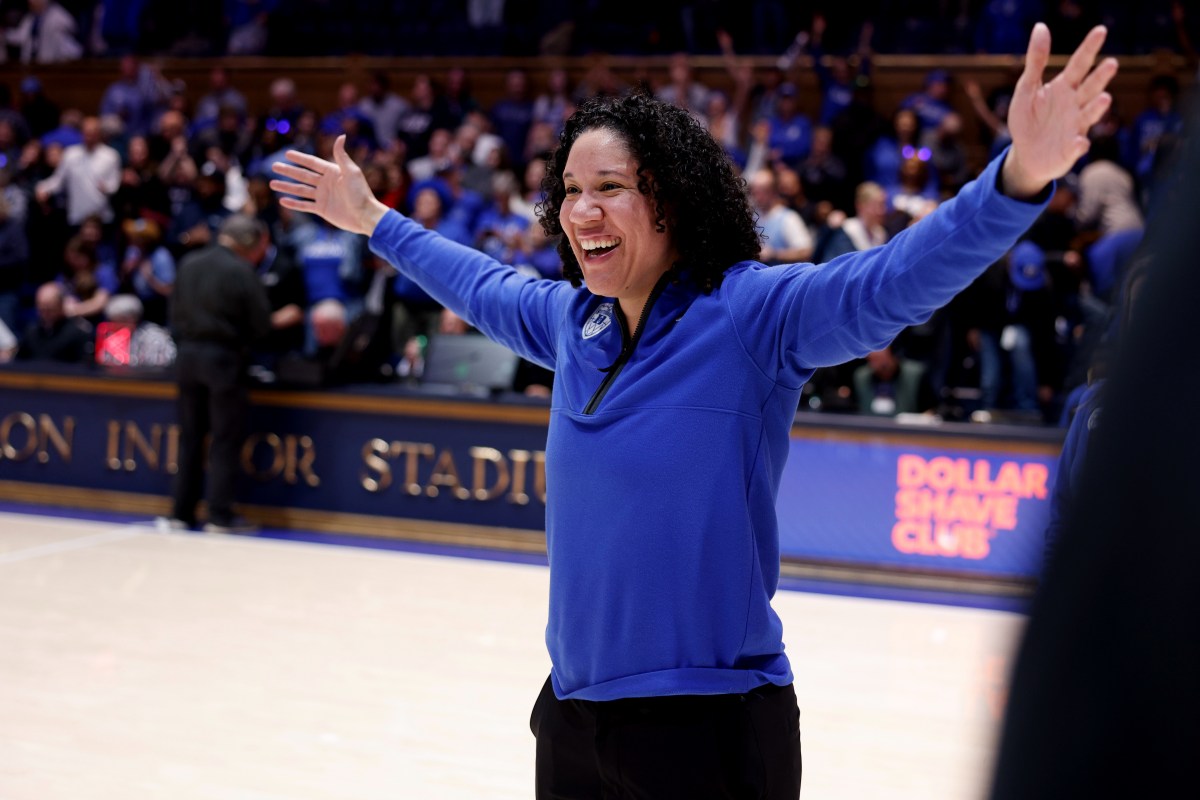
Kara Lawson has already experienced the pressure of coaching on the biggest international stage. Now, the Duke head coach is turning her full attention toward another major challenge: leading the Blue Devils back to the Final Four.
Entering her seventh season at Duke, Lawson is balancing two demanding responsibilities. She remains the head coach of Team USA while preparing the Blue Devils for another ambitious NCAA Tournament run. After guiding the United States to a FIBA Women’s Basketball World Cup gold medal this summer, Lawson is already looking ahead to the 2028 Summer Olympics in Los Angeles.
At the same time, her immediate priority is Duke, where expectations are rising after back-to-back Elite Eight appearances.
Lawson recently led Team USA to another World Cup championship in Berlin, helping the Americans overcome a 14-point deficit against France before pulling away for a 97-79 victory in the championship game. The triumph marked the fifth consecutive World Cup gold medal for the United States.
Rather than viewing her USA Basketball responsibilities as a distraction, Lawson believes the experience has made her a better coach.
“I just dedicate time each week to it,” Lawson said about managing her Team USA duties alongside her responsibilities at Duke. “So I don’t all of a sudden get close to a Team USA event and then cram every week.”
Lawson explained that she intentionally sets aside time to study Team USA opponents, watch film and think about the international program. In her view, the two jobs complement each other because both ultimately involve the same sport.
That experience could prove valuable as Duke attempts to take the next step in March.
The Blue Devils reached the Elite Eight for a second consecutive season last year, marking their deepest NCAA Tournament run since 2013. Now, with three starters returning and a talented group of contributors surrounding them, Duke has legitimate Final Four aspirations.
Lawson’s ability to handle pressure is nothing new.
Her coaching journey has included breaking barriers at multiple levels. In 2019-20, she joined the Boston Celtics as an assistant under Brad Stevens, becoming the first female coach in the franchise’s history. One season later, she became the first Black basketball coach at Duke.
Those accomplishments reflect the ambition Lawson has carried since she was a young player.
As a high school junior in Virginia, Lawson told her coach that she wanted to become an NBA coach. Years later, she accomplished that goal.
“I’ve just always had big goals, and I’ve been unafraid to voice them,” Lawson said. “I think sometimes we’re afraid to say out loud what we want to do because we’re concerned people will think it’s too big.”
Lawson’s confidence was shaped in part by her relationship with the late Pat Summitt, whom she played for at Tennessee from 1999 through 2003. Lawson reached four consecutive Final Fours during her college career under Summitt, gaining experience in the type of high-pressure environment she now hopes to navigate as a coach.
Her former WNBA coach Mike Thibault also sees Lawson as someone equipped for big moments.
“I’ve seen her play in hostile environments and just handle the pressure,” Thibault said. “I think that’s probably a good sign that you can stay calm in big basketball moments as a coach.”
That calmness will be important for a Duke team that enters the season with considerable expectations.
One of the most intriguing additions is prized transfer Aaliyah Crump, who spent one season at Texas. Crump brings experience and familiarity with Lawson, having been involved with USA Basketball for several years and winning a gold medal at the FIBA Americas Under-16 Championship.
Her previous connection with Lawson helped make her decision to transfer to Duke much easier.
Meanwhile, the Blue Devils believe their greatest advantage may be their chemistry.
Junior forward Toby Fournier emphasized how closely connected the team has become, both on and off the court.
“I think our team chemistry is incredible,” Fournier said. “Even when we’re not playing, we’re planning a dinner together or doing some activity all together. We choose to spend our time together.”
That chemistry is supported by an unusual level of roster continuity. Twelve of Duke’s 14 players have played exclusively for the Blue Devils, giving Lawson an opportunity to focus heavily on development rather than constantly rebuilding her roster.
For Lawson, that connection could ultimately become the foundation of Duke’s Final Four pursuit.
“They enjoy playing with one another,” Lawson said. “Believe it or not, they enjoy playing for me.”
The Blue Devils have already established themselves as an Elite Eight-caliber program under Lawson. The next challenge is reaching the national semifinals for the first time in two decades.
With a veteran coach, a connected roster, key returning pieces and an impactful transfer addition, Duke has the ingredients to make another deep March run.
And while Lawson’s eyes remain on the future with Team USA and the 2028 Olympics, her immediate mission is clear: turn Duke’s recent Elite Eight consistency into a Final Four breakthrough.




