


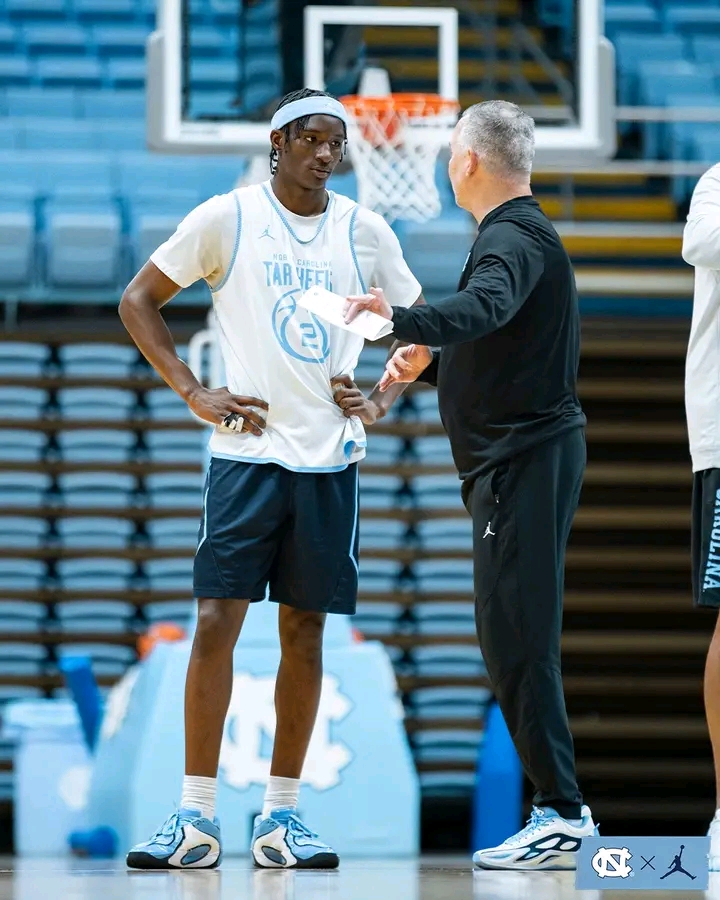
The North Carolina Tar Heels are getting closer to the start of a new era, but Michael Malone still has one major question hanging over his frontcourt.
As UNC prepares for the 2026-27 season, the Tar Heels have plenty of new faces, plenty of new expectations and plenty of reasons for optimism. But one unresolved eligibility situation could have a significant impact on how Malone builds his rotation once the regular season begins.
That uncertainty surrounds Cameron Fens.
The 7-foot, 255-pound South Dakota transfer is still waiting for a decision regarding his eligibility, leaving UNC in an unusual position just days before the team’s first preseason exhibition.
For now, Malone knows he cannot count on Fens being available.
That means the Tar Heels have to prepare for multiple possibilities.
If Fens is eventually cleared, UNC suddenly has another experienced, physically imposing option in the frontcourt.
If he remains unavailable, however, Malone will have to lean more heavily on a collection of young forwards and centers who are still adjusting to the demands of playing for North Carolina.
That uncertainty could make the frontcourt one of the most fascinating areas to watch as Malone begins his first season in Chapel Hill.
Jarin Stevenson Could Be the Key
One player who could become particularly important regardless of what happens with Fens is senior forward Jarin Stevenson.
Stevenson is UNC’s only returning starter, making him one of the most experienced and recognizable players on a dramatically reshaped roster.
He also brings something else Malone desperately needs: versatility.
At 6-foot-10, Stevenson is capable of playing multiple positions and has experience operating both inside and on the perimeter.
That flexibility could become extremely valuable if UNC has to adjust its plans because of Fens’ eligibility situation.
Malone has already challenged Stevenson to become more aggressive this season.
The Tar Heel head coach wants to see him run the floor, attack mismatches, crash the offensive glass, get into the post when appropriate and find ways to put pressure on opposing defenses.
Stevenson has already demonstrated that he can do more than simply shoot from the perimeter.
Last season, circumstances forced him into a more physical role.
After Caleb Wilson suffered a wrist injury and Henri Veesaar dealt with a lower-body issue, Stevenson had to shoulder more responsibility in the frontcourt.
Over the nine games following Wilson’s injury, Stevenson averaged 10.4 points, 6.4 rebounds and 1.2 blocks per game.
That stretch provided an important glimpse of what Stevenson can become when UNC needs him to be more aggressive.
Now Malone may need that version of Stevenson again.
UNC Has Young Big Men Waiting
The good news for the Tar Heels is that they aren’t completely dependent on one player.
UNC has assembled a frontcourt with plenty of size and different skill sets.
Among the newcomers are 7-foot-1 Sayon Keita, 6-foot-11 Alex Samodurav and 7-foot Cade Bennerman.
Each player brings something different to the table.
Keita is particularly intriguing because of his size, athleticism and defensive potential. His length could give UNC a legitimate rim-protecting presence, while his ability to finish around the basket could become increasingly important if the Tar Heels need additional interior production.
Samodurav provides a different dimension.
Despite his size, he has the ability to stretch the floor and shoot from outside. That could allow Malone to maintain spacing while still having significant size on the court.
Bennerman, meanwhile, gives the Tar Heels another large body who can potentially absorb minutes and provide physicality inside.
The presence of those players gives Malone options.
But options and proven production are two very different things.
UNC’s young frontcourt players still have to demonstrate that they can handle meaningful minutes against high-level competition.
That’s why the Fens situation matters so much.
The Eligibility Question Could Change the Rotation
If Fens is cleared, Malone suddenly has another legitimate 7-foot option to work into the rotation.
That could allow the coaching staff to use Stevenson in different positions.
Instead of asking Stevenson to spend extensive minutes at center, Malone could move him back toward the forward spots and take advantage of his ability to stretch the floor.
Fens’ presence could also allow UNC to play bigger lineups without putting as much physical responsibility on Stevenson.
But if Fens isn’t cleared, the situation becomes much more complicated.
Malone would have to decide how quickly he can trust his younger big men.
Keita could potentially receive a much larger role.
Samodurav could see increased opportunities because of his ability to shoot.
Bennerman could become an important physical presence.
And Stevenson could be asked to play even more minutes across multiple positions.
That is a significant amount of uncertainty for a team trying to establish a new identity.
Michael Malone Is Preparing for Both Scenarios
The encouraging part for UNC is that Malone appears to understand the situation.
Rather than building his entire plan around one player, the coaching staff has been preparing multiple players to contribute.
That is particularly important during the preseason.
The Tar Heels’ first exhibition game provides Malone with an opportunity to see how his available frontcourt players respond when the lights come on.
Fens will not be available for that exhibition, meaning the other big men will have an opportunity to make their case.
For young players, those opportunities can be extremely important.
A strong performance could earn additional minutes.
A player who struggles could find himself further down the rotation.
And with Malone still determining how all of his pieces fit together, the preseason could be the beginning of a major competition for frontcourt minutes.
Jarin Stevenson Isn’t the Only Player Who Could Benefit
While Stevenson is naturally going to receive much of the attention because of his experience, UNC’s situation could also create opportunities for the younger players.
Sayon Keita, in particular, could find himself in a position where he has to grow up quickly.
The freshman has the physical tools to make an impact, but college basketball is about much more than physical ability.
He has to learn defensive rotations.
He has to understand positioning.
He has to deal with stronger opponents.
He has to avoid foul trouble.
And he has to execute Malone’s system consistently.
The same applies to Samodurav and Bennerman.
The coaching staff may have envisioned certain roles for them entering the season, but Fens’ eligibility situation could force those plans to change.
That is one of the realities of college basketball.
Rotations rarely remain exactly as coaches imagine them during the offseason.
Injuries, eligibility decisions, performances and matchups can completely alter a team’s plans.
UNC is already dealing with one of those variables.
The Bigger Picture for the Tar Heels
The Fens situation isn’t simply about one player’s availability.
It could influence how UNC plays.
It could affect how much Stevenson plays at center.
It could determine which young big men receive early opportunities.
It could change the way Malone approaches certain matchups.
And ultimately, it could influence how quickly this new-look Tar Heel team finds its identity.
That’s why the upcoming exhibition is so important.
Fans will get their first meaningful look at how Malone handles his frontcourt without Fens.
They’ll see whether Keita is ready for a significant role.
They’ll see how Samodurav’s shooting fits into the offense.
They’ll see whether Bennerman can provide the physicality UNC needs.
And they’ll see just how much Malone is willing to rely on Stevenson.
There is still plenty of time for the eligibility situation to be resolved.
If Fens eventually receives good news, Malone could suddenly have considerably more flexibility.
If the decision goes the other way, UNC will have to move forward with the players already available.
Either way, Malone’s preparation during the preseason could prove crucial.
The new UNC coach has inherited a roster that has undergone significant change, and his ability to adapt may be just as important as his original plans.
For now, the Tar Heels are preparing without one of their potential frontcourt pieces.
And that means every available forward has an opportunity.
Stevenson has the experience.
Keita has the size and athleticism.
Samodurav has the shooting ability.
Bennerman has the size to provide another interior option.
The question is which players will take advantage of the opportunity.
As the first exhibition approaches, UNC fans have plenty of reasons to watch closely.
The Tar Heels aren’t simply preparing for another season.
They are preparing for the beginning of the Michael Malone era.
And with one key eligibility decision still unresolved, the shape of Malone’s frontcourt remains one of the biggest mysteries surrounding this new-look North Carolina team.
One thing is certain: when the season begins, the Tar Heels will have to be ready for whatever comes next.
And depending on the outcome of the eligibility situation, Malone’s entire frontcourt rotation could look very different from what many expected when the offseason began.




