


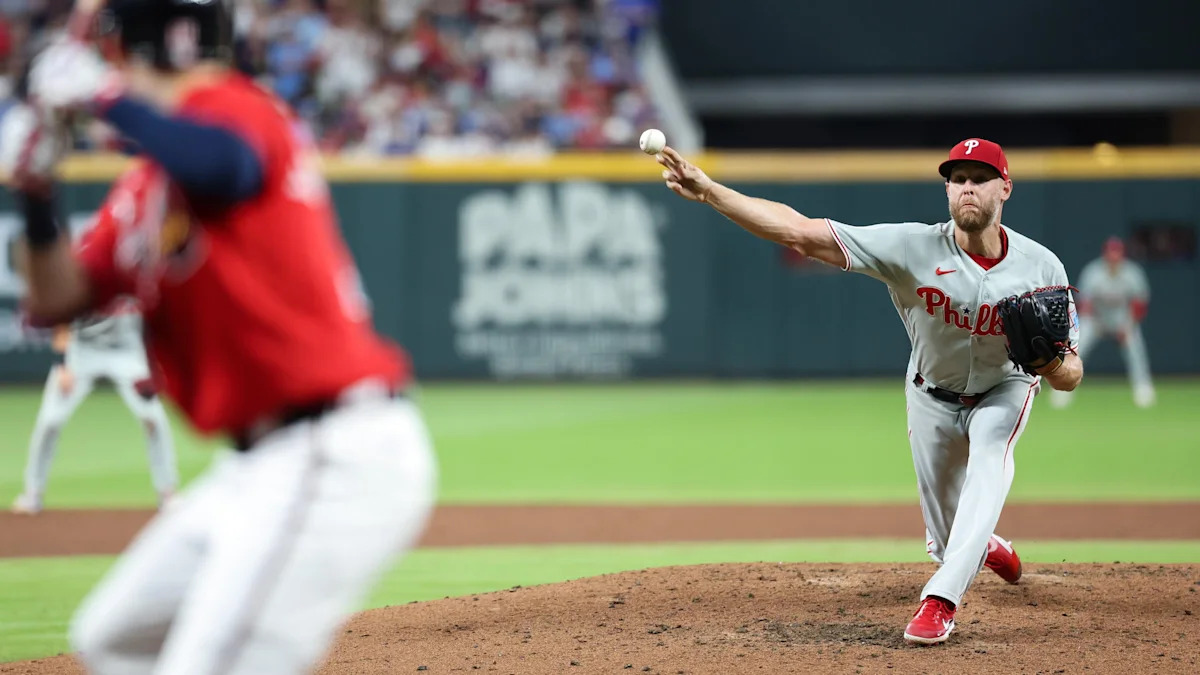
The Philadelphia Phillies could face one of their most difficult offseason decisions yet as they search for ways to strengthen an offense that has struggled to deliver consistently. With the franchise determined to remain a serious World Series contender, the front office may need to consider bold trade possibilities, including the uncomfortable idea of moving one of its three most valuable starting pitchers.
Zack Wheeler, Cristopher Sanchez, and Jesus Luzardo represent important pieces of Philadelphia’s pitching foundation. Trading any of them would create a significant void in the rotation. However, if such a move brought back an established offensive star capable of transforming the lineup, would the Phillies be willing to make that sacrifice?
It is a difficult question, but one worth considering as Philadelphia prepares for the offseason.
WHY THE PHILLIES MUST CONSIDER A BOLD MOVE
The Phillies have assembled a roster capable of competing with the best teams in baseball. However, having talented players does not automatically translate into postseason success. A team must produce consistently at the plate, capitalize on scoring opportunities, and deliver when the pressure is at its highest.
Philadelphia’s offensive concerns make the situation particularly important. If the front office believes the current lineup needs a substantial upgrade, simply bringing back familiar players and making minor additions might not be enough.
Imagine a scenario in which another team offers Philadelphia an opportunity to acquire a proven player projected to produce three to four wins above replacement (WAR) per season. The player would fill a position of need, potentially third base or the outfield, while providing the offensive production the Phillies have been searching for.
There would be one major condition: Philadelphia would have to surrender a valuable player in return.
With other teams unlikely to give away an established offensive contributor without receiving something significant, the Phillies might have to explore the most valuable assets on their roster. That could bring Wheeler, Sanchez, or Luzardo into the conversation.
THE DIFFICULT QUESTION SURROUNDING PHILADELPHIA’S ROTATION
Trading one of the Phillies’ top three starters would be a major decision, and each pitcher presents a different set of considerations.
Wheeler has established himself as a premier starting pitcher when healthy, offering experience, competitiveness, and the ability to deliver in high-pressure situations. Moving him would mean surrendering a proven leader and one of the rotation’s most dependable potential difference-makers.
Sanchez, meanwhile, has become an important part of Philadelphia’s pitching plans. His ability to provide quality innings and compete against strong opposition makes him an attractive asset. Trading him could improve the offense, but it would also remove a pitcher the organization might prefer to build around for years to come.
Luzardo presents another intriguing possibility. His talent and potential could make him valuable to a team seeking an established starting pitcher. Nevertheless, Philadelphia would have to determine whether the offensive return would outweigh the pitching production it could lose.
Ultimately, the decision would depend on the specific offer, each pitcher’s health and contract situation, and the organization’s assessment of its long-term championship window.
COULD AN OFFENSIVE STAR MAKE THE SACRIFICE WORTHWHILE?
The most important consideration is what Philadelphia would receive in return.
Trading a frontline starter simply to create roster flexibility would be difficult to justify. However, acquiring a legitimate three-to-four-WAR player who fills a major offensive need would make the discussion considerably more interesting.
Third base and the outfield could be potential areas to explore, depending on the roster’s final composition and available trade targets. An established hitter who combines consistent production with dependable defense could provide value beyond the batting statistics alone.
Such an addition could also improve the lineup’s balance. Opposing pitchers would have fewer opportunities to navigate the order comfortably, while Philadelphia’s established hitters could benefit from having another dangerous bat around them.
Still, the Phillies would need to evaluate more than projected WAR. Age, contract length, injury history, defensive ability, postseason performance, and the cost of retaining the player would all matter.
A three-to-four-WAR projection is valuable, but it does not guarantee that a player will produce at that level in Philadelphia. The front office would need confidence that the acquisition addresses a genuine weakness rather than simply exchanging one expensive asset for another.
FINDING THE RIGHT BALANCE BETWEEN PITCHING AND OFFENSE
The biggest danger in trading a frontline starter is solving one problem while creating another.
Starting pitching becomes especially important during the postseason, when teams depend on their best arms to deliver quality innings against elite opposition. Philadelphia would not want to strengthen its lineup only to discover that its rotation lacks the depth required for a deep playoff run.
For that reason, any potential trade should begin with a clear assessment of the organization’s pitching depth. If the Phillies have younger starters ready to assume larger responsibilities, moving one established pitcher could become more realistic.
The front office should also explore alternative ways to improve the offense, including free agency, trades involving prospects, and deals built around players who are not essential to the major league rotation.
Trading Wheeler, Sanchez, or Luzardo should be considered an aggressive option rather than the automatic first choice.
SHOULD THE PHILLIES PULL THE TRIGGER?
Philadelphia has a championship-caliber core, but maintaining that status requires difficult decisions. If the offense remains a concern, the organization cannot afford to ignore opportunities that could significantly improve the lineup.
Trading one of the top three starters would undoubtedly carry risks. However, if the Phillies could acquire an impact hitter who addresses a major weakness without leaving the rotation dangerously thin, the move might deserve serious consideration.
The ideal outcome would be improving the offense while preserving enough pitching depth to compete throughout a demanding season and into October.
Ultimately, the Phillies should not trade a frontline starter simply because the offense needs help. They should do it only if the return is substantial enough to improve the team’s overall championship chances.
The question is not whether Wheeler, Sanchez, or Luzardo is valuable. All three are. The real question is whether Philadelphia can turn one valuable pitching asset into an offensive upgrade that makes the entire team more dangerous.
If the right offer emerges this offseason, the Phillies may have to decide whether protecting their rotation or transforming their lineup gives them the best chance to bring another World Series championship to Philadelphia.




