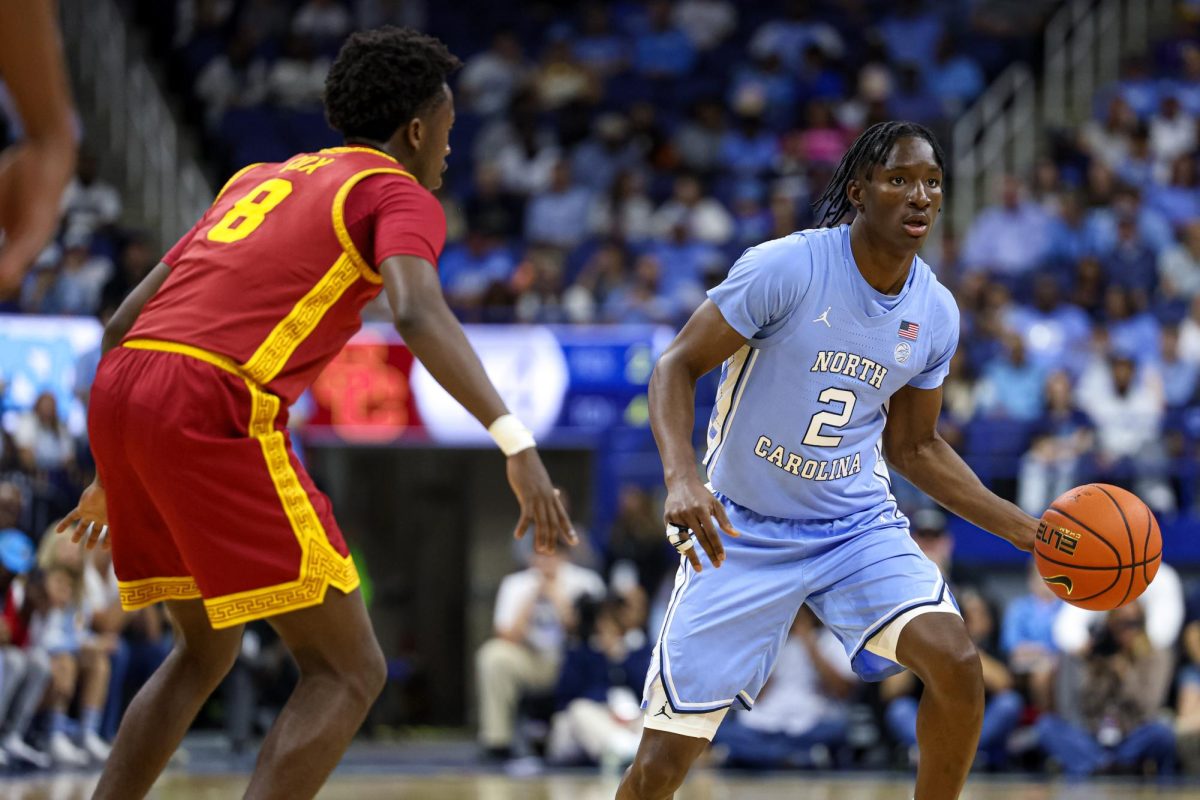
GREENSBORO, N.C. — The Michael Malone era of North Carolina men’s basketball is officially underway, and the Tar Heels delivered an encouraging first performance with an 88-70 exhibition victory over USC at First Horizon Coliseum on Friday night. In front of a crowd that provided a strong home-court atmosphere, UNC offered an early glimpse of Malone’s basketball philosophy, showcasing offensive potential, improved defensive intensity, and promising performances from several returning players.
Although the exhibition result will not count toward the official season record, the performance provided valuable insight into what fans can expect as the Tar Heels prepare for the 2026-27 campaign. Three major talking points emerged from the victory: the team’s pace of play, the progress of returning players, and the questions surrounding the frontcourt.
1. MALONE’S FAST-PACED OFFENSE SHOWS PROMISE, BUT TURNOVERS REMAIN A CONCERN
One of the biggest expectations surrounding Malone’s arrival in Chapel Hill has been his commitment to an aggressive, fast-paced style of basketball. Against USC, North Carolina demonstrated that it intends to push the tempo, move the basketball, and create opportunities through offensive pressure.
The Tar Heels recorded 74 possessions, slightly above their average from last season, offering an early indication of the faster approach Malone wants to establish. However, the transition game was not perfect. UNC managed just two fast-break points, with much of its offensive rhythm coming from ball movement rather than consistently attacking before USC could organize its defense.
Malone also made it clear that his players must become more disciplined with the basketball. North Carolina committed 18 turnovers, an area that could become problematic against stronger opponents if those mistakes continue into the regular season.
Malone’s conditioning program, however, appeared to make a difference as the game progressed. The Tar Heels looked increasingly aggressive in the second half, applying greater defensive pressure and finding ways to separate themselves from USC.
First-year forward Maximo Adams acknowledged the improvement, explaining that the team’s intensity increased significantly after halftime.
North Carolina also benefited from its depth, using 11 players in the rotation. The Tar Heels’ bench outscored USC’s reserves 35-5, giving Malone opportunities to evaluate different combinations and distribute playing time.
USC was missing several players, including KJ Lewis, Eric Reibe, and Christian Collins, so the exhibition provided an encouraging but incomplete assessment of UNC’s progress.
2. JARIN STEVENSON AND ISAIAH DENIS GIVE TAR HEELS REASONS FOR OPTIMISM
The most impressive individual performance belonged to senior forward Jarin Stevenson, who emerged as North Carolina’s leading scorer with 25 points and 10 rebounds.
Stevenson shot approximately 57 percent from the field and connected on four of seven attempts from beyond the three-point line. His combination of outside shooting, rebounding, and versatility made him one of the night’s standout performers.
Although exhibition statistics do not count toward official career records, his 25-point performance would represent a career high.
Stevenson’s ability to stretch the floor could become particularly important under Malone. The new coach wants an offense that creates space, moves efficiently, and gives players opportunities to attack defensive weaknesses. Stevenson’s shooting ability allows UNC to use different frontcourt combinations without sacrificing perimeter threats.
He also experimented with playing center, a role he did not necessarily expect to handle as frequently. With Alex Samodurov and Sayon Keita joining the roster from international basketball, Malone has several options as he determines the most effective lineup.
Sophomore guard Isaiah Denis was another major positive.
After a difficult freshman season affected by a lingering hand injury, Denis delivered an encouraging performance off the bench. He played 20 minutes, scoring 14 points and collecting four rebounds.
Denis averaged just 1.9 points across 10 appearances last season, making his exhibition showing an important step as he looks to establish himself in Malone’s rotation.
His decision to remain at North Carolina and compete for a larger role appears to be paying off. Denis credited members of the coaching staff for believing in him, while Malone acknowledged the importance of the guard’s decision to stay.
Adams and sophomore guard Neo Avdalas also reached double figures, with Avdalas finishing just one rebound short of a double-double.
Their contributions suggest that UNC has several players capable of supporting Stevenson offensively.
3. FRONTCOURT QUESTIONS REMAIN DESPITE DEFENSIVE IMPROVEMENTS
While North Carolina showed encouraging signs on the perimeter, its performance around the basket revealed areas that require attention.
Defensively, the Tar Heels made progress after halftime, allowing USC to score only six of its 31 second-half points in the paint. UNC also recorded four blocks in the second half, including a notable rejection by Samodurov.
Those numbers offered evidence that the team’s length and defensive positioning could become valuable strengths.
However, the offensive frontcourt remains a work in progress.
North Carolina converted just eight of its 20 layup attempts, highlighting difficulties finishing consistently near the rim. The Tar Heels possess several tall, versatile players, but size alone does not guarantee success against physical opponents.
Malone must determine which players can provide reliable interior scoring, protect possessions around the basket, and compete effectively against stronger frontcourts.
His offensive philosophy also places less emphasis on the midrange shot, encouraging players to create opportunities closer to the rim or beyond the three-point line.
Stevenson’s outside shooting fits that approach, but the Tar Heels will need consistent finishing and greater physicality inside to complement their perimeter production.
WHAT COMES NEXT FOR UNC?
North Carolina’s exhibition victory offered an encouraging opening chapter for Malone, with Stevenson’s all-around performance and Denis’ emergence providing particular reasons for optimism.
The faster offensive approach, promising bench production, and improved second-half defense suggest that the Tar Heels have the foundation to develop into a competitive team.
Nevertheless, the 18 turnovers, inconsistent finishing around the rim, and unanswered frontcourt questions demonstrate that significant work remains.
For Malone, the next step is turning those promising moments into consistent performances against regular-season competition.
The 88-70 victory was a positive beginning, but UNC’s real progress will depend on whether its players can maintain their intensity, protect the basketball, and execute when the games begin to count.
The message from the exhibition is clear: Malone’s Tar Heels have potential, but their development will determine how far that potential can take them in 2026-27.