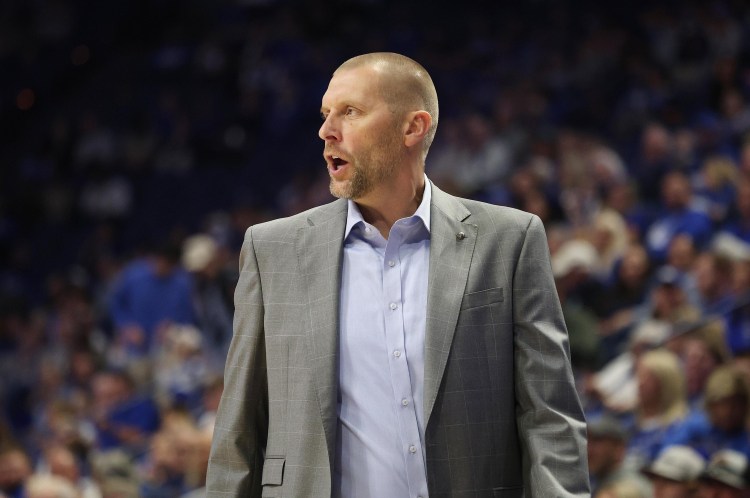
Kentucky basketball opened its preseason exhibition schedule with a 69-49 victory over Little Rock, but the final score did not tell the entire story. While the Wildcats showed flashes of their offensive potential, a series of costly turnovers and inconsistent execution made it clear that Mark Pope’s team still has work to do before the regular season begins.
For a program with high expectations and a roster expected to deliver an exciting brand of basketball, Friday night offered both encouragement and reasons for concern. Kentucky managed to secure a comfortable 20-point win, yet the Wildcats committed 19 turnovers and finished with only 12 assists. Those numbers highlighted some of the growing pains that can emerge when a team is still learning how to play together.
However, Pope was not particularly worried about the mistakes. The Kentucky head coach believes the turnovers were largely a product of the circumstances, with his players experiencing their first game-like environment under the lights. He also pointed to the team’s limited offensive preparation as another factor behind the uneven performance.
And while Kentucky’s offense did not look completely polished, there were positive signs, particularly from Milan Momcilovic, whose perimeter shooting could become an important weapon for the Wildcats this season.
Kentucky’s 19 Turnovers Raise Questions
The most concerning statistic from Kentucky’s victory over Little Rock was undoubtedly the number of turnovers.
The Wildcats gave the ball away 19 times, a figure that will attract attention regardless of the result. Turning the ball over that frequently can make it difficult for a team to establish an offensive rhythm, create quality scoring opportunities, and maintain control of a game against stronger opposition.
Kentucky also recorded just 12 assists, meaning the Wildcats struggled to consistently convert their offensive possessions into clean scoring opportunities.
Several players experienced difficulties protecting the basketball. Malachi Moreno and Alex Wilkins each committed four turnovers, while Zoom Diallo finished with three. Those mistakes contributed significantly to Kentucky’s overall total and demonstrated that some members of the roster still need time to become comfortable with their responsibilities.
Interestingly, Momcilovic was the only Kentucky player who played at least two minutes without committing a turnover.
That detail is particularly encouraging because Momcilovic was also one of the team’s most productive perimeter shooters. His ability to score without repeatedly surrendering possession offered a glimpse of the kind of offensive contribution Pope will want from him throughout the season.
Nevertheless, the turnovers cannot simply be ignored. Kentucky will eventually face opponents capable of converting those mistakes into easy points, and the Wildcats will need to improve their decision-making before those challenges arrive.
The encouraging part is that this was an exhibition game played early in October. Kentucky still has time to address its problems, establish better communication, and develop the chemistry necessary to execute its offense more consistently.
Mark Pope Explains Why He Is Not Worried
Despite the disappointing turnover numbers, Pope did not appear overly concerned after the game.
The Kentucky coach suggested that the mistakes were understandable given the circumstances surrounding the exhibition. For some of his players, Friday night represented their first experience performing together in that type of competitive environment.
“I’m not overly concerned about it. I think it was more a product of this being their first time under the lights and feeling a little bit different,” Pope explained. “Our guys have been really solid.”
Pope’s comments suggest that he views the performance as an opportunity for development rather than a reason to panic.
That perspective is understandable. Exhibition games are designed to give teams valuable experience before the results begin counting in the regular season. Coaches can evaluate rotations, identify weaknesses, and determine which aspects of their systems need additional attention.
Kentucky’s turnover problems were obvious, but they also provided Pope with useful information about how his players respond when the pace increases and the pressure becomes more noticeable.
The challenge now is ensuring that those lessons translate into improvement.
The Wildcats cannot afford to develop a habit of giving away possessions, particularly when facing opponents with the defensive discipline and athleticism to exploit their mistakes. However, there is a difference between identifying a problem during an early exhibition and dealing with the same issue repeatedly once the season is underway.
Pope appears confident that his players can make the necessary adjustments.
His comments also indicate that he is evaluating the performance within the broader context of the team’s preparation, rather than judging the offense exclusively by the mistakes recorded on the stat sheet.
Kentucky’s Limited Offensive Playbook Played a Role
Another important detail emerged when Pope discussed Kentucky’s offensive approach against Little Rock.
According to the coach, the Wildcats deliberately limited the number of offensive actions they used during the exhibition.
“We only had seven actions the whole night. We limited ourselves,” Pope said.
That admission provides important context for understanding why Kentucky’s offense sometimes looked disjointed.
Rather than unveiling an extensive offensive playbook, Pope opted for a simplified approach. Limiting the number of actions allowed Kentucky to focus on a smaller collection of offensive concepts while giving the players an opportunity to experience game conditions.
However, a limited playbook can also create challenges. When a team has fewer established actions available, players must rely heavily on timing, spacing, communication, and individual decision-making to generate quality opportunities.
If those elements are not yet fully developed, possessions can become complicated, passes can arrive at the wrong time, and players may struggle to identify the best option.
Kentucky’s 19 turnovers suggest that execution remains an area requiring attention.
Still, Pope’s explanation offers a reason to avoid drawing sweeping conclusions from one exhibition. The Wildcats were not necessarily displaying the full range of offensive options they intend to use once the regular season begins.
As Kentucky introduces additional actions and players become more familiar with their teammates’ movements, the offense could become more fluid.
The key will be how quickly the team develops that understanding.
## Milan Momcilovic Emerges as an Encouraging Offensive Weapon
While Kentucky’s overall offensive performance was inconsistent, Momcilovic provided one of the night’s most encouraging individual performances.
The forward connected on four three-pointers, demonstrating the kind of perimeter shooting that could help Kentucky create space for its other offensive players.
His most memorable moment came late in the second half, when he used a behind-the-back dribble before pulling up for a three-pointer in traffic.
The sequence offered a glimpse of his confidence and creativity. It was the type of play that can energize a crowd while reminding opponents that Kentucky possesses players capable of producing difficult shots.
Momcilovic’s contribution was particularly significant because outside shooting can be an important part of an effective modern college basketball offense.
When a team has reliable perimeter threats, opposing defenses must extend farther from the basket. That can create driving lanes, open passing angles, and additional opportunities for teammates operating inside.
For Kentucky, developing that balance could become especially important as Pope continues to refine his offensive system.
Momcilovic’s ability to knock down multiple three-pointers gives the Wildcats another potential scoring option. His turnover-free performance also made his showing more impressive, considering the difficulties experienced by several of his teammates.
Of course, one exhibition does not establish how consistently he will perform throughout the season. Opponents will have opportunities to study his strengths, and Kentucky will need other players to contribute offensively.
Nevertheless, his shooting display was a positive development for a team still searching for its best offensive rhythm.
If Momcilovic can maintain that level of perimeter production, he could become an important part of Kentucky’s scoring attack.
First-Half Struggles Followed by Better Shooting
Kentucky’s shooting statistics further illustrate the uneven nature of the performance.
The Wildcats struggled to find their rhythm during the first half, making just 10 of 28 attempts from the field and four of 13 attempts from beyond the three-point line.
Those numbers reflected an offense that had difficulty consistently producing efficient scoring opportunities.
However, Kentucky improved after halftime and finished the game shooting 43.9 percent from the field. The Wildcats also made 12 of their 28 three-point attempts, giving them a respectable overall result from beyond the arc.
The improved shooting was an encouraging sign, although the team will need to become more consistent across both halves.
A strong second half can help a team recover from a slow start, but Kentucky cannot always depend on its shooting percentage improving as games progress.
Against more challenging opposition, a poor opening period combined with repeated turnovers could create a deficit that becomes difficult to overcome.
That makes offensive consistency one of the most important areas for Pope to address during the remaining preseason preparations.
Kentucky needs to establish better offensive flow from the opening minutes, move the basketball with purpose, and avoid possessions that end before the team can generate a worthwhile scoring opportunity.
The talent is there to produce points. The next step is ensuring that the players execute their responsibilities with greater precision.
What the Little Rock Exhibition Means for Kentucky
Ultimately, Kentucky’s 69-49 victory should be viewed as a useful early assessment rather than a definitive statement about the team’s offensive ceiling.
The Wildcats won comfortably, demonstrated their ability to make perimeter shots, and showed flashes of the ball movement Pope wants to establish. At the same time, the turnover total and first-half shooting struggles revealed weaknesses that must be addressed.
The most important question is whether those mistakes are temporary products of an early exhibition or signs of issues that could persist into the regular season.
Pope’s explanation suggests that he believes the former is more likely. He has confidence in his players and appears to believe that the limited offensive approach and unfamiliar game environment contributed to the performance.
That confidence will need to be supported by improvement on the court.
Moreno, Wilkins, Diallo, and the rest of Kentucky’s roster must become more comfortable making decisions under pressure. Better ball security and stronger communication will be essential if the Wildcats want to maximize their offensive potential.
Momcilovic’s shooting provides another reason for optimism, but Kentucky’s success will ultimately depend on the entire roster functioning together.
The Wildcats must turn promising individual performances into a reliable team offense.
The Verdict: Kentucky Has Work to Do, but There Is Reason for Optimism
Kentucky’s victory over Little Rock was not perfect, and the 19 turnovers will rightly remain a major talking point. The Wildcats also struggled to shoot efficiently during the first half, while their limited offensive playbook prevented them from showing everything Pope may have planned for the season.
Yet the broader picture is not entirely negative.
The team improved its shooting after halftime, Momcilovic delivered an encouraging perimeter performance, and Pope made it clear that he is not ready to overreact to early mistakes.
Most importantly, the Wildcats still have time to improve before the games begin to count.
Pope will need to find ways to reduce the turnovers, improve offensive execution, and help his players develop a stronger understanding of their roles. If Kentucky can accomplish those objectives, Friday night’s mistakes could become valuable lessons rather than recurring problems.
For now, the message from the Little Rock exhibition is straightforward: Kentucky has plenty of offensive potential, but that potential must translate into cleaner possessions and more consistent execution.
Momcilovic could become a significant part of that process, particularly if his three-point shooting continues to stretch opposing defenses.
The Wildcats have reasons to be encouraged, but the real test will come when the regular season begins and the margin for error becomes much smaller.