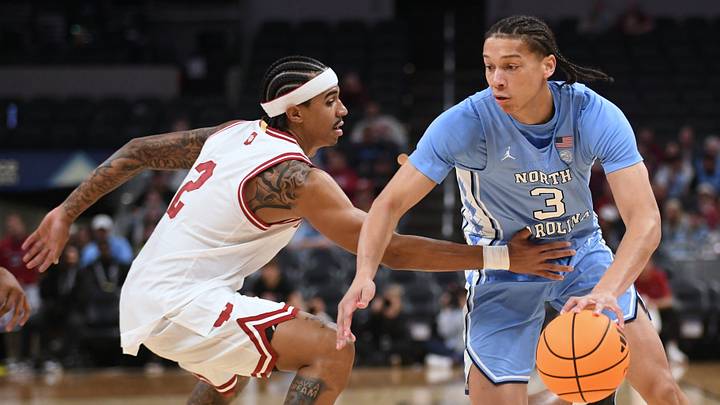
The North Carolina Tar Heels suffered a disappointing 76-58 defeat against the Indiana Hoosiers in their second exhibition game, giving head coach Michael Malone and his coaching staff plenty to evaluate before the regular season begins. After showing encouraging signs in their previous outing against USC, UNC struggled to maintain its momentum on Sunday night, exposing several weaknesses that could become significant concerns if they are not addressed.
Although exhibition games do not determine a team’s regular-season fate, performances like this can reveal important lessons about rotations, defensive execution, rebounding, and decision-making under pressure. For Malone, the defeat offers an opportunity to identify what is working, what needs improvement, and which players can provide the consistency North Carolina needs.
There were individual bright spots, including Matt Able’s improved performance, but the overall result was a reminder that the Tar Heels still have work to do. From a major rebounding disadvantage to costly turnovers and an inconsistent offensive performance, several storylines stood out.
Here are five instant observations from North Carolina’s 76-58 exhibition loss to Indiana.
1. Michael Malone Is Already Experimenting With His Starting Lineup
One of the most interesting developments was Malone’s decision to make an adjustment to the starting lineup after UNC’s exhibition against USC.
After opening the previous game with Sayon Keita, the 55-year-old head coach opted to move Jarin Stevenson to center and introduce Maximo Adams into the starting group. The adjustment demonstrated that Malone is willing to experiment early rather than wait until the regular season to determine which combinations work best.
That approach makes sense during the exhibition period. Coaches need opportunities to evaluate how players complement one another, particularly when building a rotation that must handle different matchups throughout the season.
Keita, however, showed some encouraging signs during the first half against Indiana. The former Barcelona center recorded seven points, four rebounds, and three blocks in the opening 20 minutes. His ability to protect the rim offered a glimpse of what he could contribute defensively.
Nevertheless, North Carolina struggled on the boards during that same period, getting outrebounded 27-14. That difference highlighted the potential cost of the lineup adjustment.
Keita returned to the starting lineup in the second half, while Adams moved back to the bench. Although one exhibition game is not enough to determine the ideal starting five, Malone’s willingness to make changes suggests that the coaching staff is still searching for the most effective combination.
The challenge will be finding a lineup that balances rim protection, offensive production, mobility, and rebounding. UNC has several options to consider, but the Indiana game showed that finding the right balance will be essential.
2. Matt Able Delivers an Encouraging Bounce-Back Performance
While the overall result was disappointing, Matt Able provided one of the more positive individual storylines for North Carolina.
The transfer from North Carolina State endured a difficult debut against USC, failing to score a point. That performance left him with plenty to prove heading into Sunday’s matchup.
Against Indiana, however, Able responded with a much-improved offensive display.
The 6-foot-5, 200-pound guard finished with 11 points, shooting 4-of-7 from the field and 3-of-5 from three-point range. His ability to knock down perimeter shots was an encouraging development for a UNC team that needs dependable scoring options.
Able’s performance was particularly important because shooting can help create more space for the rest of the offense. When opposing defenses must respect a guard’s ability to score from beyond the arc, driving lanes can become more accessible, and teammates may find better opportunities to attack.
Of course, one productive exhibition does not guarantee that Able will maintain the same level throughout the season. Consistency will be the next step, especially against opponents capable of putting greater pressure on the perimeter.
Still, his performance against Indiana was a meaningful improvement from his debut.
For Malone, Able’s response also provides a reminder of why preseason experimentation matters. Players need opportunities to adjust, regain confidence, and demonstrate what they can contribute in different situations.
If Able can build on Sunday’s performance, he could become a useful scoring option as North Carolina continues to develop its rotation.
3. UNC’s Fast Tempo Is Creating Costly Turnovers
North Carolina wants to play quickly, push the pace, and create opportunities before opposing defenses become fully organized. That approach can be effective, but the defeat against Indiana demonstrated how easily an aggressive tempo can turn into careless basketball.
The Tar Heels committed 15 turnovers, with Neoklis Avdalas and Terrence Brown among the players who struggled to protect possession. Several sequences featured rushed decisions and inaccurate passes that allowed Indiana to capitalize.
The consequences were significant: the Hoosiers scored 19 points off North Carolina’s turnovers.
Those points represented a major problem for the Tar Heels, particularly in a game where their offense was already struggling to establish consistent production.
Playing fast requires more than speed. Players must understand where their teammates are moving, make decisions quickly, and maintain control even when the defense applies pressure.
When those elements are missing, an attempt to generate easy scoring opportunities can instead give the opposition valuable possessions.
Malone will likely want to see better communication and improved decision-making as the team continues preparing for the regular season. Avdalas, Brown, and the other ball handlers must find the right balance between attacking aggressively and protecting the basketball.
UNC does not necessarily need to abandon its preference for an up-tempo style. Instead, the team must learn how to execute that approach without giving away possessions.
Reducing turnovers could make a substantial difference, particularly against opponents who are capable of converting mistakes into points quickly.
4. Jarin Stevenson Struggles After an Impressive Previous Performance
Jarin Stevenson entered Sunday’s matchup following an outstanding performance against USC, where he recorded 25 points and 10 rebounds for a double-double.
Naturally, there was interest in seeing whether the 6-foot-10, 220-pound forward could maintain that level of production against Indiana.
Unfortunately for North Carolina, Stevenson struggled to make a similar impact.
He finished with just three points and three rebounds, shooting 1-of-7 from the field, including 1-of-3 from three-point range.
The contrast between his previous performance and Sunday’s showing was striking. However, it is important not to draw sweeping conclusions from a single exhibition game.
Basketball performances fluctuate, and even talented players can experience difficult nights when shots fail to fall or opponents disrupt their rhythm.
The bigger question for Stevenson is how he responds to this setback.
North Carolina needs players who can contribute consistently, particularly in the frontcourt, where rebounding and interior defense remain important concerns. Stevenson’s size and ability to contribute offensively could make him a valuable part of the rotation if he can find greater consistency.
His performance against USC demonstrated his potential, while the Indiana game highlighted the work that remains.
For Malone and his staff, the priority should be evaluating how Stevenson fits into the team’s preferred lineup combinations and how he can remain effective when his outside shot is not falling.
If he can contribute through rebounding, defense, movement, and smart decisions on offense, he can still influence games without necessarily reproducing his scoring numbers from the previous exhibition.
The Tar Heels will need a more complete contribution from their frontcourt as the season approaches.
5. Rebounding Remains a Serious Concern for North Carolina
Perhaps the most concerning statistic from Sunday’s defeat was the difference on the glass.
Indiana outrebounded North Carolina 53-31, a 22-rebound advantage that exposed a major weakness for the Tar Heels.
The frontcourt had already been viewed as an important area to monitor during the offseason, and the performance against the Hoosiers reinforced those concerns.
Rebounding is about more than a player’s height or physical strength. It requires positioning, anticipation, communication, and a willingness to make contact and compete for the ball.
When a team consistently loses the rebounding battle, it can struggle to finish defensive possessions and create additional scoring opportunities for itself.
Indiana’s advantage meant North Carolina had difficulty controlling that important aspect of the game. Combined with the turnovers, the rebounding deficit made it harder for the Tar Heels to establish momentum.
Cameron Fens remains ineligible to play in games, according to the supplied report. His availability and potential role in the rotation are therefore important considerations for the coaching staff, although the team cannot rely on an unavailable player to solve its immediate problems.
More broadly, UNC must find ways to improve its collective rebounding.
That responsibility cannot fall on one center or forward alone. Guards must also help secure defensive rebounds, while frontcourt players need to establish better positioning and pursue the ball with greater consistency.
If North Carolina hopes to compete effectively against physically imposing opponents, improving on the boards must become a priority.
What Must UNC Improve Before the Regular Season?
The loss to Indiana should not be treated as a definitive prediction of North Carolina’s season. Exhibition games provide opportunities to experiment, and the coaching staff still has time to evaluate personnel and make adjustments.
Nevertheless, the performance highlighted several areas that deserve immediate attention.
First, Malone must determine which lineup offers the best combination of scoring, defense, and rebounding. His willingness to experiment is encouraging, but the team will eventually need a dependable rotation.
Second, the Tar Heels must protect the basketball more effectively. An aggressive offense can create advantages, but those benefits disappear when rushed passes lead to easy points for the opposition.
Third, North Carolina needs greater consistency from its frontcourt. Stevenson’s production, Keita’s role, and the team’s collective rebounding will all be important factors to monitor.
Finally, individual players must learn to respond to difficult performances. Able demonstrated how a player can bounce back after a disappointing outing, and UNC will need similar resilience throughout the season.
Final Thoughts
North Carolina’s 76-58 exhibition loss to Indiana was a disappointing result, but it also provided Michael Malone with valuable information about his team.
Matt Able’s improved shooting offered encouragement, while the changes to the starting lineup showed that the coaching staff is willing to explore different options. At the same time, the turnover problems, Stevenson’s quiet performance, and the 53-31 rebounding disadvantage exposed weaknesses that cannot be ignored.
The next step is turning those lessons into improvement.
UNC does not need to solve every problem overnight, but it must show progress in the areas that had the greatest impact against Indiana. Better ball security, stronger rebounding, and more consistent performances from the frontcourt could help the Tar Heels become a more balanced team.
The exhibition defeat is a warning rather than a verdict. How Malone and his players respond will tell supporters much more about the team’s readiness for the challenges ahead.