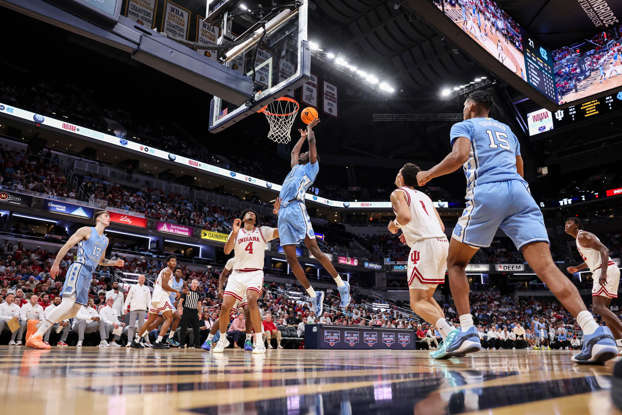
North Carolina basketball suffered a disappointing 76-58 defeat against Indiana in its second exhibition game, but the result was not without a few encouraging signs. While the Tar Heels struggled to handle Indiana’s physicality, protect the basketball, and generate consistent offense, freshman center Sayon Keita emerged as one of the biggest bright spots of the night.
The 7-foot-1 freshman delivered an impressive performance, finishing with 12 points, nine rebounds, and five blocks. His ability to score around the basket, challenge shots, and protect the rim offered a glimpse of what he could bring to North Carolina throughout the upcoming season.
However, Keita’s promising display could not hide the team’s broader problems. Indiana dominated the rebounding battle, Bryce Lindsay produced a devastating offensive performance, and several Tar Heels struggled to find their rhythm. With the regular season approaching, head coach Michael Malone has several important questions to address.
The exhibition defeat should not be treated as a final judgment on UNC’s season, but it has provided a valuable look at the team’s strengths and weaknesses.
Here are the biggest takeaways from North Carolina’s loss to Indiana.
1. Sayon Keita Emerges as a Major Bright Spot for UNC
If North Carolina supporters were searching for a reason to remain optimistic after the defeat, Keita’s performance offered one.
The freshman center started the game with an emphatic dunk that resulted in a three-point play, immediately making his presence felt around the basket. He continued to contribute throughout the contest, finishing with 12 points, nine rebounds, and five blocks.
Those numbers demonstrate his potential to become an important part of North Carolina’s frontcourt rotation.
Keita’s rim protection was particularly encouraging. Recording five blocks against Indiana showed that he could challenge opponents near the basket and potentially make it more difficult for them to finish inside.
His size also gives UNC an interior presence that could become increasingly valuable as the Tar Heels face teams with physically imposing frontcourts.
Of course, one exhibition performance does not guarantee that Keita will immediately become an elite college center. He will need to continue developing his positioning, rebounding technique, defensive awareness, and ability to handle different offensive matchups.
Nevertheless, his performance against Indiana was a positive sign for a team still working to establish its identity.
Perhaps the most encouraging aspect was that Keita managed to produce despite North Carolina’s overall struggles. His contribution suggests that he could provide the Tar Heels with a valuable combination of interior scoring and defensive protection.
If he continues to develop and earns a consistent role, Keita could become one of the players worth watching as UNC’s season unfolds.
2. Indiana Exposes UNC’s Serious Rebounding Problem
While Keita delivered an encouraging individual performance, North Carolina’s overall rebounding numbers told a very different story.
Indiana outrebounded the Tar Heels 53-31, creating a 22-rebound advantage that played a major role in the outcome.
Even more concerning was Indiana’s ability to collect 20 offensive rebounds and convert those extra opportunities into 17 second-chance points.
Those numbers reveal how difficult it was for North Carolina to finish defensive possessions.
A team can force an opponent into a missed shot and still fail defensively if it cannot secure the rebound. Every offensive rebound creates another opportunity for the attacking team, putting additional pressure on the defense and potentially changing the momentum of a game.
Indiana repeatedly took advantage of that situation.
The problem cannot be blamed exclusively on UNC’s centers and forwards. Rebounding requires contributions from the entire lineup, including guards who must recognize opportunities to help secure the ball.
Malone will need to emphasize positioning, physicality, and collective responsibility as the Tar Heels continue preparing for the regular season.
North Carolina is also adjusting to a frontcourt landscape shaped by the departures of Caleb Wilson and Henri Veesaar to the NBA, according to the supplied report. Finding the right combination of players to replace their contributions is therefore an important challenge.
Keita’s performance provides encouragement, but the team’s overall rebounding struggles demonstrate that one player’s effort cannot solve everything.
If UNC hopes to compete against stronger opponents, improving its work on the boards must become a priority.
3. Bryce Lindsay Gives Indiana a Major Offensive Advantage
Another significant storyline was Indiana guard Bryce Lindsay’s outstanding performance.
Lindsay finished with a game-high 26 points, including 18 in the first half, helping the Hoosiers establish a lead they never relinquished.
North Carolina struggled to find an effective defensive response, particularly when dealing with ball screens and Indiana’s experienced guards.
Lindsay’s ability to score consistently placed pressure on the Tar Heels and made it difficult for them to recover momentum.
His performance also demonstrated how quickly an individual scorer can change the complexion of a game. When a guard repeatedly finds opportunities to attack, the opposing defense must make adjustments, potentially opening opportunities for other players.
Indiana received additional contributions from Duke transfer Darren Harris and Notre Dame transfer Markus Burton, who each scored 11 points.
That supporting production made the Hoosiers even more difficult to contain.
For UNC, the challenge extends beyond defending one player. The Tar Heels need better communication, sharper rotations, and a clearer understanding of how to respond when opponents use screens to create advantageous matchups.
Those improvements will be particularly important against experienced backcourts capable of recognizing defensive mistakes.
Lindsay’s performance was a reminder that defensive breakdowns can become costly when opponents have the confidence and ability to exploit them.
4. Jarin Stevenson Must Find Greater Consistency
Jarin Stevenson’s quiet performance was another concern for North Carolina.
The forward had entered the game after an impressive exhibition against USC, where he recorded 25 points and 10 rebounds.
Against Indiana, however, he struggled to reproduce that level of production.
Stevenson did not score until the final four minutes of the game and missed his first six shots before eventually connecting from three-point range.
The contrast between his two performances highlights the challenge facing a team that needs dependable contributions from its key players.
North Carolina does not necessarily need Stevenson to score 25 points every night. However, the Tar Heels will benefit from having him contribute consistently, whether through scoring, rebounding, defense, or creating opportunities for teammates.
When a player who demonstrated considerable offensive potential struggles to find his rhythm, the rest of the team may have to take on additional responsibilities.
That can become particularly difficult when the opponent is already dominating the rebounding battle and forcing turnovers.
Stevenson’s next opportunity will be important because the coaching staff needs to determine how he can remain effective when his shots are not falling.
His previous performance against USC suggests that he is capable of making a substantial contribution. The key is developing the consistency needed to help North Carolina compete over the course of a long season.
5. Matt Able Shows Promise, but UNC’s Backcourt Still Needs Work
There were also encouraging signs from Matt Able, the North Carolina State transfer who improved after a disappointing performance against USC.
Able finished with 11 points against Indiana, scoring eight in the first half. His perimeter shooting and defensive versatility could become valuable assets for North Carolina as the team continues developing its rotation.
The Tar Heels need players who can knock down outside shots, defend multiple positions, and contribute without requiring the offense to revolve around them.
Able’s improved performance was a positive step, although he will need to demonstrate that he can produce consistently.
Meanwhile, Terrence Brown and Neo Avdalas endured more difficult outings.
Brown, a transfer from Utah, finished with seven points on 3-of-9 shooting, along with three assists and three turnovers. His performance suggested that he is still adjusting to his new team and working to become more comfortable within the system.
Avdalas also struggled, recording six points on 11 shots and committing four turnovers.
The Tar Heels cannot afford to give away possessions at such a high rate, particularly against opponents capable of turning mistakes into easy scoring opportunities.
North Carolina recorded 15 turnovers against Indiana while producing only 14 assists. It was the second consecutive exhibition in which the Tar Heels finished with more turnovers than assists.
That statistic highlights a need for better decision-making, communication, and offensive organization.
The team must find ways to create quality shots without rushing possessions or forcing difficult passes.
If Brown and Avdalas can settle into their roles and improve their ball security, North Carolina could become more effective offensively.
6. UNC’s Offense Struggles to Create Quality Shots
Beyond the individual performances, North Carolina’s offensive execution was a major concern.
The Tar Heels shot just 35% from the field and recorded approximately 0.806 points per possession. They also converted only 10 of their 21 layup attempts.
Those numbers suggest that UNC struggled to generate efficient scoring opportunities, even when it managed to get close to the basket.
Taking contested jump shots can become a problem when the offense fails to create enough movement or force defensive rotations.
The Tar Heels need to improve their ability to generate open looks through ball movement, screening, cutting, and decisive drives toward the basket.
Their difficulties at the free-throw line added another concern. North Carolina made just five of 11 attempts, a 45% conversion rate that represented another missed opportunity to add points.
Free throws are often among the most manageable scoring opportunities in basketball. While every player can have an off night, the Tar Heels will need to improve their overall efficiency from the line.
The offensive struggles also demonstrate why ball security matters so much. Turnovers prevent teams from getting shots, while poor shot selection can waste possessions even when the ball remains in their hands.
Malone will need to help his players find a better balance between playing quickly and making smart decisions.
7. Jaydon Young Provides a Useful Spark Off the Bench
One additional positive for North Carolina came from returning player Jaydon Young.
Young scored 10 points off the bench, including two three-pointers, providing some offensive energy during a difficult night for the Tar Heels.
His contribution was particularly useful because North Carolina needed additional scoring options beyond its starting group.
A reliable bench can help teams maintain their competitiveness when starters struggle or need rest. It can also provide different offensive skills that allow coaches to adjust their approach depending on the matchup.
Young’s performance does not guarantee a larger role, but it gives the coaching staff another encouraging development to consider as it evaluates the rotation.
Combined with Able’s improved outing and Keita’s interior production, his contribution shows that UNC did have individual positives to take from the defeat.
The next step is turning those flashes into consistent performances.
Isaiah Denis’ Absence Adds Another Detail to Monitor
Sophomore guard Isaiah Denis missed the game and was listed as day-to-day by North Carolina, according to the supplied report.
His status is worth monitoring as the Tar Heels approach their final preseason game.
However, no further conclusion should be drawn about his availability without an updated announcement from the program.
With the regular season approaching, UNC will want its players healthy and prepared, while also ensuring that those available can establish a reliable rotation.
The coaching staff must continue evaluating its options and determining which combinations give the team the best chance to compete.
Final Thoughts: Can UNC Turn These Lessons Into Progress?
North Carolina’s 76-58 loss to Indiana exposed several areas that need attention, but it also provided encouraging signs for the future.
Sayon Keita’s 12 points, nine rebounds, and five blocks stood out as one of the most positive developments of the night. Matt Able improved offensively, and Jaydon Young provided a useful scoring contribution from the bench.
At the same time, the rebounding deficit, Lindsay’s scoring outburst, the turnover problems, and the team’s poor shooting efficiency demonstrated how much work remains.
The immediate priority should be improving the fundamentals: securing rebounds, protecting possession, defending ball screens, and generating better shots.
North Carolina’s final preseason game against Charlotte, listed in the supplied report for October 17 at 7:30 p.m. on ACC Network Extra, was identified as the Tar Heels’ last opportunity to fine-tune their approach before the regular season. The date in that report should be verified against the current schedule.
For UNC supporters, the Indiana defeat was frustrating, but Keita’s emergence offers a reason for optimism.
The freshman center has shown that he can make an impact around the basket. Now the challenge for Malone and the Tar Heels is to build a more balanced team around that promise.
If North Carolina can address its rebounding and offensive issues while developing greater consistency from its guards and forwards, this exhibition loss could become a valuable learning experience rather than a defining setback.