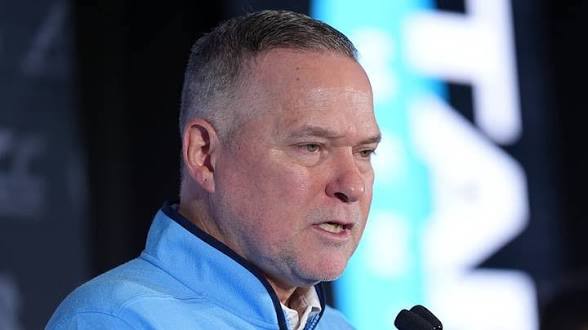
North Carolina basketball head coach Michael Malone did not hide his disappointment after the Tar Heels suffered a frustrating 76-58 exhibition defeat against Indiana on Sunday night. The loss exposed several areas that need immediate attention before the regular season begins, but Malone also identified an encouraging development that could become increasingly important for the program: the impressive performance of freshman center Sayon Keita.
Playing at Gainbridge Fieldhouse in Indianapolis, North Carolina struggled to match Indiana’s physicality, lost the rebounding battle by a considerable margin, and committed costly turnovers that allowed the Hoosiers to maintain control. Despite shooting percentages that were relatively close, the difference in extra possessions and second-chance opportunities proved decisive.
Following the game, Malone spoke candidly about his team’s shortcomings, the offensive problems that prevented UNC from establishing a rhythm, and the improvements he expects before the Tar Heels return to action.
However, the first-year head coach also made it clear that the defeat would not divide the locker room. Instead, he wants his players to study the film, accept responsibility, and use the experience to become a better team.
His comments offered an honest assessment of where North Carolina stands, why the Indiana performance was so disappointing, and why Keita’s emergence could provide a valuable reason for optimism.
## Malone Delivers a Blunt Assessment of UNC’s Rebounding Problems
The most significant concern for Malone was North Carolina’s inability to compete effectively on the boards.
Indiana outrebounded the Tar Heels 53-31, recording 20 offensive rebounds and converting those opportunities into 17 second-chance points. For a North Carolina team attempting to establish itself ahead of the regular season, those numbers were particularly troubling.
Malone explained that rebounding had been a major point of emphasis during preparations for Indiana. The coaching staff understood that the Hoosiers possessed considerable size and physical strength in the frontcourt, yet the Tar Heels struggled to respond.
“We got outrebounded 53-31. That’s a crazy number,” Malone said, according to Inside Carolina.
He also expressed disappointment with the team’s overall effort on the glass, emphasizing that the responsibility could not be placed entirely on the frontcourt players.
“To be manhandled, to be outworked on the glass was disappointing, and that’s not just on our bigs, that’s on everybody to make sure we’re rebounding. We did a really poor job of that.”
Those comments highlight an important issue for North Carolina. Rebounding is a collective responsibility, requiring guards and forwards to help finish defensive possessions rather than leaving the work to the centers alone.
Malone also pointed out that the Tar Heels’ defensive performance was not entirely negative. Indiana shot approximately 36% from the field, suggesting that North Carolina did a reasonable job of making shots difficult.
However, forcing misses means little if the defense cannot secure the rebound afterward.
“I felt our defense, to be very honest, was really good,” Malone explained. “We held that team to 36% from the field. That’s a very good number, but you have to finish the possession.”
That final point captures one of the biggest lessons from the defeat. North Carolina must learn to turn defensive stops into completed possessions, especially against opponents capable of generating second chances through physical play.
## Turnovers and Second-Chance Points Prove Costly
Although rebounding was a major problem, Malone identified another issue that contributed significantly to the loss: turnovers.
North Carolina finished with 15 turnovers against 14 assists, allowing Indiana to score 19 points from those mistakes. When combined with the Hoosiers’ 17 second-chance points, the damage became even more apparent.
Malone explained that the team’s struggles on the glass often prevented it from getting out in transition, forcing the Tar Heels to attack against an organized Indiana defense.
“Once again, I’ll go back to our inability to rebound, which led to us playing against a set defense a lot, and that’s not how we want to play,” he said.
The coach added that the Tar Heels needed to do a better job of creating opportunities to attack before their opponents could establish their defensive positions.
North Carolina’s offensive problems extended beyond turnovers. The team frequently struggled to generate clean looks in the half court, and several possessions ended with rushed decisions or excessive dribbling.
Malone acknowledged the combined impact of the mistakes, explaining that North Carolina could not expect to win difficult road games while giving away so many opportunities.
“So if you couple these 17 points off the glass and you couple the 19 points off turnovers, that’s 36 combined points. You’re not going to beat anybody on the road if you do that.”
It was a straightforward assessment of what went wrong.
The Tar Heels did not necessarily need to shoot dramatically better than Indiana to remain competitive. They needed to protect the basketball, secure defensive rebounds, and avoid giving the Hoosiers additional scoring opportunities.
Those are areas Malone will expect his players to address as they prepare for the next challenge.
## Malone Refuses to Panic After the Disappointing Defeat
Despite the disappointing result, Malone emphasized that North Carolina would remain united and use the loss as an opportunity to improve.
The contrast between the Tar Heels’ first exhibition and their performance against Indiana illustrated how quickly preseason evaluations can change. A victory can create optimism, while a difficult defeat can expose weaknesses that require immediate attention.
Malone acknowledged that emotional contrast while making it clear that his team needed to respond constructively.
“So, the great thing is, after game one, everybody’s excited. We won a game. Tonight, we got blown out. We got our butts kicked,” he said.
Rather than allowing the defeat to become a source of division, Malone said the Tar Heels would stay together, review the game film, and challenge themselves to improve before their final exhibition.
That approach is particularly important for a team still developing its chemistry and determining the best roles for its players.
Exhibition games provide coaches with valuable opportunities to identify weaknesses before the results begin to count in the regular season. The challenge is ensuring that the lessons learned translate into better performances.
Malone’s comments suggest that he expects accountability from his players, but he also understands that improvement requires a willingness to work through difficult moments.
For North Carolina supporters, the important question is how the Tar Heels respond when they next step onto the court.
## Indiana’s Physical Defense Exposes UNC’s Offensive Struggles
Another topic Malone addressed was Indiana’s defensive approach, particularly its use of size, physicality, and pressure.
Both teams shot relatively poorly from the field, with North Carolina finishing around 35% and Indiana at approximately 36%. However, the Hoosiers were more effective at creating additional possessions and disrupting UNC’s offensive rhythm.
Malone explained that Indiana adjusted its defensive approach depending on which players were on the floor.
With its larger starting lineup, Indiana played differently than it did when its biggest center left the game. The Hoosiers could become more aggressive in the gaps and apply additional pressure to the basketball.
North Carolina struggled to adjust consistently.
Malone pointed to possessions in which his players dribbled excessively, held the ball too long, or picked up their dribble without a clear next move.
“I felt like tonight that we just had so many examples of us just dribbling too much, pounding the air out of the ball, picking that dribble up, and there were some really poor offensive possessions,” he said.
Those problems prevented the Tar Heels from creating the quality opportunities needed to build offensive momentum.
The solution will require improved movement away from the ball, quicker decisions, stronger communication, and greater composure when opposing defenses apply pressure.
North Carolina does not need to abandon its preferred style of play, but it must become more effective at executing its offense against physical opponents.
Malone Sees Improvement From Terrence Brown and Matt Able
Although the overall performance was disappointing, Malone also identified encouraging developments from individual players.
He specifically noted that Terrence Brown and Matt Able performed better against Indiana than they had in North Carolina’s opening exhibition against USC.
That improvement matters because the Tar Heels need multiple players capable of contributing consistently throughout the season.
Brown is still adjusting to his role with the program, while Able is expected to provide perimeter shooting and defensive versatility.
Neither player needs to produce a spectacular performance every night, but both must become dependable contributors if North Carolina hopes to develop a balanced rotation.
Malone also discussed the contrasting performances of Jarin Stevenson.
Stevenson had delivered an outstanding performance against USC, recording 25 points and 10 rebounds. Against Indiana, however, he struggled to reproduce that production and did not make his first field goal until late in the game.
Malone credited Indiana for making things difficult, including the impact of Aiden Sherrell, whom he described as one of the leading shot blockers in the SEC during the previous season.
For Malone, the larger issue is consistency.
A team cannot depend on every player producing the same numbers in every game, but it needs players to find ways to contribute even when their shots are not falling.
The coach believes the problems exposed against Indiana can be addressed through film study, practice repetitions, accountability, and a greater commitment to improvement.
“We’ll watch the film. We’ll rep it out, hold guys accountable, and try to demand the improvements that we need to make,” Malone said.
He also delivered a message that could become an important principle for the team moving forward: “Because if you’re not getting better, you’re getting worse.”
Sayon Keita Emerges as Malone’s Seven-Foot Silver Lining
While much of Malone’s postgame assessment focused on the team’s weaknesses, his comments about Sayon Keita provided the most encouraging takeaway for North Carolina supporters.
The freshman center finished with 12 points, nine rebounds, and five blocks, delivering an impressive performance against a physically imposing Indiana frontcourt.
Keita’s combination of size, rim protection, and activity around the basket gave North Carolina a defensive presence it could build upon.
Malone explained that Keita’s performance reflected the progress he had shown during the second half of the previous exhibition game.
The coaching staff had spent considerable time discussing Indiana’s size, physicality, rebounding, and shot-blocking ability. Rather than shrinking from that challenge, Keita responded with a performance that stood out.
“I felt that Sayon, for a young kid, a freshman, he took that challenge, had 12 points, nine rebounds, five blocks,” Malone said.
The coach then offered a memorable description of the freshman’s contribution.
“So you’re always looking for silver linings, and I felt that Sayon Keita was a seven-foot silver lining, if you will, tonight.”
Malone also praised Keita’s defensive impact, describing him as the anchor of North Carolina’s defense.
For a team that struggled to contain Indiana’s physical play, Keita’s ability to challenge shots and protect the rim was particularly encouraging.
His performance does not erase the team’s rebounding problems, but it offers evidence that North Carolina has a young center capable of making meaningful contributions.
Malone Explains What Makes Keita So Promising
Malone’s confidence in Keita extends beyond the freshman’s statistics against Indiana.
The coach explained that he had traveled to Spain to watch Keita play when he was 17 or 18 years old. During that time, Malone identified several qualities that made the young center an intriguing prospect.
Those strengths include rim protection, shot-blocking, screening, rolling toward the basket, and pursuing offensive rebounds.
Malone said Keita demonstrated those abilities against Indiana, giving the coaching staff a clearer picture of what he could contribute.
However, the coach also made it clear that Keita’s development remains a work in progress.
North Carolina must continue adding to his game and helping him develop into a more complete player.
Malone emphasized that the program wants to invest in Keita’s long-term improvement, ensuring that his time in Chapel Hill helps him reach his potential.
That is an encouraging message for UNC supporters. Keita has already demonstrated that he can affect a game defensively, and his ability to contribute offensively gives the coaching staff a foundation on which to build.
The next step will be consistency, particularly against opponents that test his strength, positioning, and decision-making.
If Keita continues developing, he could become an important component of North Carolina’s frontcourt rotation.
Final Thoughts: UNC Has Work to Do, but Keita Offers Hope
Michael Malone’s postgame comments made one thing clear: North Carolina cannot afford to ignore the problems exposed against Indiana.
The 76-58 defeat highlighted significant weaknesses in rebounding, ball security, and half-court offense. Giving up 20 offensive rebounds and committing 15 turnovers created too many opportunities for the Hoosiers.
However, Malone also identified areas of progress and expressed confidence that the problems could be addressed through preparation and accountability.
Terrence Brown and Matt Able showed improvement, while Sayon Keita delivered a performance that offered genuine encouragement.
The freshman center’s 12 points, nine rebounds, and five blocks made him one of the most notable bright spots of the evening. Malone’s description of him as a “seven-foot silver lining” captured the importance of that performance.
North Carolina’s next challenge is turning the lessons from this defeat into tangible progress.
The Tar Heels must improve their rebounding as a team, reduce costly turnovers, and become more effective against physical defenses. They also need greater consistency from their key players as Malone continues evaluating his rotation.
The exhibition loss was disappointing, but it does not determine how the entire season will unfold.
For now, Malone’s message is simple: acknowledge the mistakes, remain united, and get better.
And if Keita’s performance against Indiana is an indication of what he can become, North Carolina may have discovered an important building block for the future.