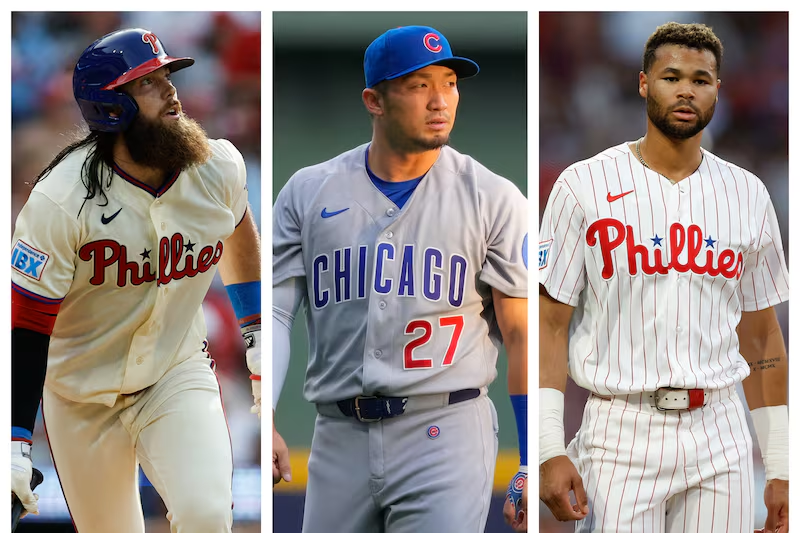
The Philadelphia Phillies are approaching a potentially transformative offseason, with significant decisions looming across the roster as the organization looks to strengthen its championship ambitions heading into the 2027 MLB season.
Several familiar faces could depart through free agency, while substantial money coming off the books may provide the front office with greater financial flexibility. However, despite the possibility of major changes elsewhere, one persistent problem remains unresolved: the Phillies still lack a dependable everyday corner outfielder who can consistently deliver offensively and defensively.
For a franchise determined to remain competitive in the National League, addressing that weakness must be among the organization’s biggest priorities this offseason.
ANOTHER SEASON, ANOTHER OUTFIELD PROBLEM
The Phillies have spent several seasons searching for a reliable solution in the outfield, but their attempts to address the position through short-term contracts have repeatedly produced disappointing results.
Last season, the organization took a chance on Max Kepler, hoping the veteran could establish himself as a productive everyday option. That experiment failed to deliver the consistency Philadelphia needed.
The club subsequently turned to Adolis García on another one-year prove-it deal, hoping the former Texas Rangers slugger could rediscover his offensive production and provide a significant power boost.
Unfortunately, the results again fell short of expectations, leaving the Phillies searching for answers as the trade deadline approached.
Rather than making another conventional move for an outfielder, Philadelphia explored an alternative approach by acquiring second baseman Luis Arraez. The move created an opportunity for Bryce Harper to return to right field, temporarily addressing the team’s outfield concerns without bringing in another traditional corner outfielder.
However, the strategy was never intended to represent a permanent solution.
When Arraez suffered an ankle sprain in September, the plan became more complicated. Philadelphia was once again reminded of how difficult it can be to build a dependable roster when important positional decisions rely on temporary adjustments.
Harper is expected to return to first base in 2027, leaving another opening in the outfield and forcing the front office to confront a familiar problem.
FREE AGENCY COULD PROVIDE THE ANSWER
With the offseason approaching, free agency could offer the Phillies an opportunity to finally secure the everyday outfielder they have struggled to find.
Rather than relying exclusively on one-year contracts for players hoping to rebuild their careers, Philadelphia could consider investing in a more established option capable of providing sustained production.
The ideal target would combine consistent offensive contributions with dependable defense, giving the lineup another threat while reducing the need for constant positional adjustments.
Power remains an important consideration, particularly for a team that wants to maintain its ability to compete with the National League’s strongest clubs. However, the Phillies should also prioritize players who can reach base regularly, contribute against different pitching styles, and remain productive throughout a demanding season.
The organization must also determine how much financial flexibility it wants to preserve for other roster needs. Although additional spending could help address the outfield, committing substantial money to one player would require careful evaluation of the team’s broader priorities.
The challenge is finding a player who offers a meaningful upgrade without creating another long-term problem.
THE COLLECTIVE BARGAINING AGREEMENT COULD CHANGE EVERYTHING
This offseason also carries unusual uncertainty because Major League Baseball’s current collective bargaining agreement is scheduled to expire on December 1.
With a labor dispute looming, teams could face pressure to complete important transactions before a potential lockout begins.
Free agency is expected to open following the conclusion of the World Series, creating the possibility of an unusually active period as clubs attempt to strengthen their rosters before negotiations reach a critical stage.
If a lockout begins after the agreement expires, transactions would be frozen until a new deal is reached. Players would also be unable to communicate with teams during the work stoppage.
That possibility could significantly influence Philadelphia’s approach to the market.
The Phillies may need to identify their preferred targets early, establish their financial limits, and move decisively when opportunities emerge. Delaying major decisions could leave the organization facing additional uncertainty if negotiations between MLB and the players’ union deteriorate.
For a team with an obvious roster weakness, preparation could prove just as important as financial resources.
PROSPECTS COULD SHAPE THE LONG-TERM PLAN
While free agency and trades offer potential solutions, Philadelphia must also evaluate its internal options.
Developing outfield prospects could provide a more affordable path toward building a sustainable roster, particularly if young players demonstrate the ability to handle major-league pitching and contribute defensively.
However, prospects require patience, and the organization cannot assume that an unproven player will immediately become an everyday contributor.
The Phillies must assess which young outfielders could realistically compete for major-league opportunities in 2027 and which players would benefit from additional development time.
That evaluation should influence their external spending decisions. If a prospect appears ready to assume a meaningful role, Philadelphia could pursue a complementary veteran rather than committing substantial resources to multiple outfield positions.
Conversely, if the organization determines that its internal options are not ready, the need to acquire an established everyday player becomes even more pressing.
Balancing immediate competitiveness with long-term development will be essential to avoiding another offseason built around temporary fixes.
PHILADELPHIA CANNOT AFFORD ANOTHER TEMPORARY FIX
The Phillies have repeatedly attempted to solve their outfield concerns through short-term arrangements, but the lack of a dependable everyday corner outfielder continues to complicate roster construction.
With Harper expected to return to first base, Philadelphia must identify a more permanent answer before the 2027 season begins.
Free agency could provide the most direct route, while trades and emerging prospects offer alternative ways to strengthen the position. The final decision will depend on the available talent, financial considerations, and the organization’s assessment of its championship window.
The looming labor uncertainty adds another layer of urgency, potentially rewarding teams that prepare early and act decisively.
Ultimately, the Phillies need more than another temporary experiment. They need an outfield plan that delivers consistent production, strengthens the overall roster, and gives the team a dependable foundation for the future.
After multiple unsuccessful attempts to address the position, the 2027 offseason represents another important opportunity for Philadelphia to get the decision right.