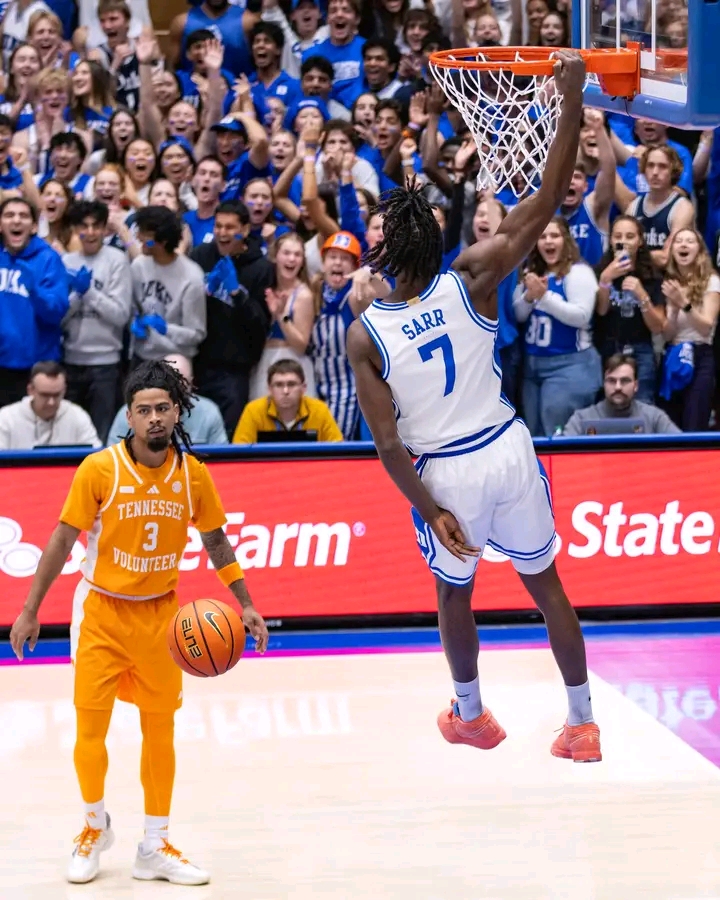
Duke basketball has just delivered a statement performance that will have college basketball fans paying attention, and the most intriguing part of the Blue Devils’ latest victory may be what it reveals about their potential this season.
Jon Scheyer’s squad demolished No. 8 Tennessee 103-64 in an exhibition matchup at Cameron Indoor Stadium on Tuesday, October 20, producing a 39-point victory that showcased the team’s defensive intensity, offensive firepower and impressive roster depth.
The second-ranked Blue Devils did not need a dramatic finish to make their point. They seized control almost immediately, overwhelmed Tennessee during the opening minutes and maintained their advantage throughout the contest.
But was this simply an impressive preseason performance, or did Duke reveal something that could make it a serious threat to the rest of college basketball?
There are reasons to believe the Blue Devils have plenty of potential. Their defensive performance was exceptional, their backcourt delivered impressive production, and several young players demonstrated that they could make important contributions.
Of course, exhibition games must be viewed with perspective. Tennessee was dealing with injury problems, and Duke still has areas to refine before the regular season begins. Nevertheless, a performance of this magnitude provides plenty of reasons for optimism in Durham.
Here are three major takeaways from Duke’s emphatic victory over the Volunteers.
OBSERVATION NO. 1: DUKE’S DEFENSE COULD BECOME A NIGHTMARE FOR OPPONENTS
If there was one aspect of Duke’s performance that stood out immediately, it was the team’s defensive intensity.
The Blue Devils entered the preseason with considerable expectations, and their performance against Tennessee suggested that their defensive potential could be just as important as their offensive talent.
Duke forced Tennessee to miss its first five field-goal attempts and quickly transformed those defensive stops into a commanding lead.
The Blue Devils opened the contest with a 15-0 run, putting the Volunteers under enormous pressure before the game had properly settled.
Tennessee struggled to find its rhythm, while Duke looked comfortable dictating the pace and making life difficult for the opposition.
That early dominance was not simply about scoring. It demonstrated how defensive pressure can influence an entire basketball game.
When opponents struggle to generate clean looks, they can become increasingly dependent on difficult shots. That makes it harder to establish an offensive rhythm, particularly against a team that can quickly turn defensive rebounds and turnovers into transition opportunities.
Duke also demonstrated the value of having players with the length and athleticism to challenge opponents across multiple positions.
A versatile defense gives a coach more options when preparing for different offensive systems. It can make switches easier, complicate passing lanes and force opposing players to work harder for every possession.
The numbers from the Tennessee game were striking. Duke shot 54.5 percent from the field, while the Volunteers managed just 33.9 percent.
The Blue Devils also established control inside the paint, where their size and physical presence helped them maintain their advantage.
However, the true test will come against opponents who can consistently handle defensive pressure and punish mistakes. Duke will need to maintain its discipline and avoid allowing teams to create easy opportunities.
Still, the early signs are encouraging.
If Scheyer’s players can reproduce this level of intensity against regular-season opponents, Duke could develop into one of the most difficult teams in college basketball to score against.
And that possibility should excite Blue Devil supporters.
OBSERVATION NO. 2: DUKE’S BACKCOURT DEPTH COULD BE A HUGE PROBLEM FOR RIVALS
The second major takeaway from the victory was the impressive production Duke received from its guards.
One of the biggest questions entering a new season is whether a team has enough dependable contributors to survive injuries, difficult matchups and the demands of a long schedule.
Duke offered an encouraging answer against Tennessee.
Caleb Foster was unavailable because of an ankle injury, but the Blue Devils still found plenty of offensive production from their other guards.
Freshman Deron Rippey Jr. led the way with a game-high 21 points, delivering one of the most impressive performances of the night.
Rippey shot nine-of-12 from the field and added three steals, showing that he could influence the game on both ends of the court.
His scoring efficiency was particularly encouraging. Rather than needing a large number of attempts to accumulate points, he consistently found ways to convert his opportunities.
For a young player, performances like this can provide valuable confidence as he adjusts to the speed and physicality of college basketball.
John Blackwell also delivered an excellent performance, finishing with 18 points while shooting six-of-eight from the field, including four-of-six from three-point range.
His ability to contribute from the perimeter gave Duke another scoring option and helped demonstrate the variety of offensive threats available to Scheyer.
Cayden Boozer provided a different kind of contribution. Although he scored only two points, he recorded six assists and helped facilitate the offense.
That distinction matters.
A successful backcourt needs more than players who can score. It also needs ball handlers who can make smart decisions, distribute effectively and create opportunities for teammates.
Duke’s performance suggested that it could receive valuable contributions from players with different strengths.
Patrick Ngongba II added 13 points, while Sebastian Wilkins and Joaquim Boumtje Boumtje each finished with 11.
Six Blue Devils reached double figures, demonstrating how effectively the team distributed its scoring.
That balance could become one of Duke’s biggest advantages.
When multiple players can threaten the defense, opponents cannot concentrate exclusively on stopping one scorer. Defenses must account for different shooting threats, driving lanes and interior options.
There is still work to do. Scheyer must determine the most effective rotations, and Duke’s young players will need to demonstrate consistency against tougher opposition.
But the potential is unmistakable.
If the Blue Devils continue receiving this kind of production from different parts of their roster, their offensive depth could become a major problem for opponents.
OBSERVATION NO. 3: DAME SARR COULD BE HEADING TOWARD A BREAKOUT SOPHOMORE SEASON
The third development concerns Dame Sarr, whose performance provided another encouraging sign for Duke’s coaching staff.
The 6-foot-8 wing finished with 15 points on six-of-nine shooting, demonstrating his ability to contribute efficiently within an offense filled with talented players.
However, the most interesting part of Sarr’s development is the possibility that he can become more than a scorer.
His physical profile gives him the potential to make a difference defensively, while his athleticism and size allow him to attack the basket and contribute in transition.
Those qualities are particularly valuable in a system that benefits from players who can perform multiple roles.
Sarr does not necessarily need to become Duke’s leading scorer to establish himself as an important part of the team’s plans.
He can make a difference by defending opposing wings, finishing opportunities around the basket, moving intelligently without the ball and taking advantage of defensive attention directed toward his teammates.
His performance against Tennessee offered encouraging signs of progress.
The next step will be maintaining that production when opponents have more time to prepare for him and the regular-season competition becomes more demanding.
Consistency will determine how significant his role becomes.
Nevertheless, his development is worth watching because players who can contribute on both ends of the floor often become particularly valuable during the most important stretches of a season.
Sarr also has an opportunity to strengthen his long-term professional prospects through continued improvement. His progress throughout the campaign could help shape how NBA evaluators view his potential.
For now, the priority is helping him become a more complete and reliable college basketball player.
If he continues developing, Duke could have another versatile contributor capable of changing the game without needing to dominate the ball.
That would be excellent news for Scheyer.
WHY THIS VICTORY HAS DUKE FANS DREAMING BIG
The most encouraging aspect of Duke’s 103-64 victory was the combination of strengths displayed throughout the contest.
The defense established control early. The guards provided efficient scoring and playmaking. Several players contributed offensively, and Sarr continued to show why his development could be important to the team’s success.
Those elements could complement one another as the season progresses.
A strong defense can generate turnovers and transition opportunities. A deep backcourt can sustain offensive pressure. Versatile wings can help connect the different parts of a lineup.
When those qualities come together, a team becomes much harder to prepare for.
However, Duke must avoid allowing one exhibition result to create unrealistic expectations.
Tennessee was not at full strength, and the Blue Devils will encounter opponents capable of testing their weaknesses. There will be difficult nights, adjustments to make and stretches when the offense does not operate as smoothly as it did against the Volunteers.
The real measure of Duke’s progress will be its ability to maintain its standards when the regular season begins.
The Blue Devils have another exhibition against Kansas scheduled for October 25, providing an additional opportunity to evaluate the team before its season opener against Army on November 2.
That matchup should offer another useful test of Duke’s readiness.
THE BIG QUESTION: CAN JON SCHEYER TURN THIS POTENTIAL INTO SOMETHING SPECIAL?
Duke has given its supporters plenty to discuss after dismantling Tennessee by 39 points.
The defensive performance was impressive, the backcourt depth was encouraging, and Sarr provided another glimpse of his potential.
Those three developments do not guarantee a championship, but they offer reasons to believe the Blue Devils could be a formidable opponent this season.
Scheyer’s challenge now is to turn those promising signs into consistent performances.
Duke must continue improving defensively, find the right balance in its rotations and help its young players develop throughout the campaign.
If the team succeeds, its combination of talent, depth and defensive versatility could make it a serious contender.
For now, the victory over Tennessee has delivered an emphatic early statement.
But the biggest story may not be the 39-point margin itself. It may be the possibility that Duke is only beginning to discover how good this team can become.
Big Blue Devil fans have every reason to be excited. The real test, however, is just around the corner.