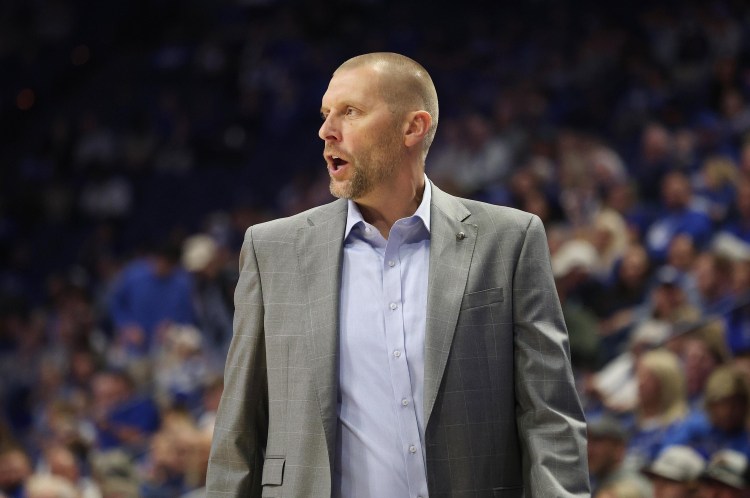
The pressure is building in Lexington, and Kentucky basketball fans have another major storyline to follow heading into the 2026–27 college basketball season.
Mark Pope, the head coach of the Kentucky Wildcats, has reportedly been placed on ESPN’s hot-seat watch list, putting his position under the spotlight as one of college basketball’s most demanding programs prepares for another season with enormous expectations.
For a program with Kentucky’s championship history, a disappointing season rarely goes unnoticed. Every loss is analyzed, every recruiting decision is debated, and every March Madness run is measured against the standards established by generations of Wildcats legends.
Now, after Kentucky finished the previous campaign with a 22–14 record and exited the NCAA Tournament in the Round of 32, ESPN’s assessment has added another layer of pressure to Pope’s third season in Lexington.
But there is a twist that Kentucky fans should not overlook.
Despite the concerns surrounding last season’s results, ESPN’s Jeff Borzello also acknowledged that Pope recovered from some offseason recruiting disappointments to assemble a roster with top-25 potential. The Wildcats have an opportunity to silence their critics, and the coming campaign could determine how the national conversation surrounding their head coach develops.
So, is Pope genuinely in danger of losing his job, or could the 2026–27 season become the campaign that changes everything for Kentucky?
ESPN Puts Mark Pope Under the Microscope
The hot-seat discussion is an uncomfortable development for a Kentucky program accustomed to competing among the nation’s elite.
Pope arrived in Lexington with the enormous responsibility of leading one of college basketball’s most recognizable brands. The Wildcats are not an ordinary program, and their supporters do not judge success solely by the number of games won during the regular season.
Kentucky fans expect their team to compete for SEC championships, secure a strong NCAA Tournament position, and make a serious push toward the Final Four.
That is the environment Pope accepted when he took charge of the Wildcats.
Being included on a hot-seat watch list does not mean ESPN has announced that Kentucky intends to dismiss its coach. Instead, it indicates that his performance is attracting attention and that the coming season carries significant consequences for his reputation.
Nevertheless, the timing makes the discussion particularly interesting.
Kentucky enters the new campaign looking to improve on a 22–14 season that ended earlier than supporters had hoped. Although the Wildcats experienced some positive moments, their Round of 32 exit left questions about whether the team had done enough to meet expectations.
For a program that regularly attracts national attention, another season without a deep tournament run could intensify scrutiny.
Pope now has an opportunity to change that narrative.
A strong start, improved consistency, and a successful NCAA Tournament campaign would give him powerful arguments against the criticism. On the other hand, another disappointing finish could make the debate surrounding his future even louder.
The 22–14 Record That Changed the Conversation
One of the central reasons Pope is facing increased scrutiny is Kentucky’s 22–14 record from the previous season.
On paper, 22 victories represent a respectable total for many college basketball programs. But Kentucky operates under different expectations, and the context surrounding those results matters.
The Wildcats are expected to compete with the strongest teams in the country. Supporters invest emotionally in the program because they believe Kentucky should be fighting for the biggest prizes in college basketball.
That means a season’s evaluation involves more than the final number of wins.
How did the team perform against quality opposition? Did the roster develop as expected? Was Kentucky capable of making a serious postseason run? And did the results justify the resources invested in assembling the squad?
Those are the questions surrounding Pope as he prepares for another year.
The Round of 32 exit is particularly significant because March Madness is where Kentucky’s ambitions are ultimately tested. A team can put together an impressive regular season, but its tournament performance often shapes how the entire campaign is remembered.
Kentucky’s early elimination left supporters wanting more.
The Wildcats did not achieve the kind of extended tournament run that could have quieted concerns about the team’s direction. As a result, Pope enters the next season knowing that improving the final outcome will be essential.
However, it would be premature to conclude that one disappointing postseason automatically determines his future. College basketball programs experience roster changes, difficult matchups, injuries, and other challenges that can influence results.
The important question is whether Kentucky can demonstrate meaningful progress in 2026–27.
Roster Budget Adds Another Layer of Pressure
Another issue contributing to the discussion is the reported size of Kentucky’s roster budget.
In the modern college basketball landscape, financial resources have become an increasingly important part of building competitive teams. NIL opportunities, revenue-sharing arrangements, transfer portal recruiting, and player retention have transformed how programs approach roster construction.
Kentucky is among the sport’s most prominent destinations, with a passionate fan base and substantial expectations surrounding its basketball operation.
Consequently, supporters naturally want to see a strong return on the resources invested in the program.
If a team reportedly operates with one of the largest roster budgets in the country but finishes 22–14 and exits the NCAA Tournament in the second round, questions are inevitable.
Still, financial investment does not guarantee championships.
Coaches must identify the right players, build chemistry, establish effective defensive and offensive systems, and ensure that individuals perform well together. A collection of talented players does not automatically become a championship-caliber team.
Pope’s challenge is to demonstrate that Kentucky’s roster construction can translate into consistent results.
The Wildcats need to show that their talent can compete with the strongest programs in the SEC and across the country. They also need to become a team capable of handling the pressure of postseason basketball.
For Pope, the objective is straightforward: turn expectations into results.
ESPN Also Recognizes Pope’s Chance to Bounce Back
While the hot-seat discussion has attracted attention, the assessment was not entirely negative.
Borzello also recognized that Pope recovered from some offseason recruiting misses and assembled a roster with top-25 potential.
That detail matters because it suggests the upcoming season should not be viewed exclusively through the lens of last year’s disappointment.
Roster construction is one of the most difficult responsibilities facing a modern college basketball coach. Recruiting targets can choose other schools, transfer portal plans can change unexpectedly, and programs must continually adjust to departures and new opportunities.
Pope has faced those challenges while attempting to build a competitive Kentucky team.
The ability to respond to recruiting setbacks could prove important as the Wildcats prepare for another demanding campaign.
A roster with top-25 potential gives Kentucky a foundation on which to build. However, preseason expectations and actual results are two different things.
The Wildcats must develop chemistry, establish their identity, and demonstrate that they can compete consistently against elite opposition.
They also need to prove that their talent can translate into success when the pressure is at its highest.
If Pope can bring those elements together, the conversation surrounding his job security could change dramatically.
A deep NCAA Tournament run would be especially valuable. Reaching the second weekend, or advancing even further, would give Kentucky supporters a compelling reason to believe that the program is moving in the right direction.
For a coach under increased scrutiny, winning is the most convincing response.
Kentucky Is Not the Only SEC Program Facing Questions
Pope is not the only SEC head coach appearing on ESPN’s hot-seat watch list.
South Carolina’s Lamont Paris and Oklahoma’s Porter Moser were also included, illustrating that coaching pressure extends beyond Lexington.
The SEC has become an increasingly competitive basketball conference, with programs investing heavily in recruiting and pursuing greater success on the national stage.
Coaches must contend with difficult schedules, talented opponents, and supporters who expect their teams to compete at a high level.
In that environment, maintaining a strong position requires consistent results.
For Kentucky, however, the scrutiny carries a particular weight because of the program’s history and national profile.
The Wildcats are one of college basketball’s most recognizable brands. Their supporters expect more than occasional stretches of success, and the program’s championship tradition inevitably shapes the standards against which every coach is judged.
Pope understands that reality.
The challenge is not simply to win games. It is to build a team capable of competing for the biggest prizes while restoring confidence that Kentucky can consistently perform at an elite level.
That is why the upcoming season could become such an important chapter in his tenure.
Is the 2026–27 Season Make-or-Break for Mark Pope?
This is the question Kentucky fans will debate throughout the season.
With the Wildcats entering the campaign ranked No. 23 nationally, expectations remain high. The ranking suggests that Kentucky has the potential to compete, but it also places the team under immediate pressure to deliver.
Pope must now turn that potential into tangible results.
A successful season could begin with consistent performances against SEC opponents, improved execution in close games, and a team that develops into a legitimate threat in the NCAA Tournament.
Kentucky does not necessarily need to win every game to satisfy its supporters. What matters is whether the team demonstrates progress and competes at the level expected of a program with its resources and reputation.
A deep March Madness run would be the clearest way to strengthen Pope’s position.
Conversely, another season marked by inconsistency and an early tournament exit would likely intensify the criticism. The hot-seat discussion could become a much bigger storyline if the Wildcats fail to meet expectations again.
Still, no confirmed decision to fire Pope has been established, and his inclusion on ESPN’s watch list should not be mistaken for an announcement about his employment.
The coming season will provide more evidence about the direction of the program.
For now, Pope has a roster with potential, a passionate fan base behind him, and an opportunity to answer his critics on the court.
## Big Blue Nation Is Waiting for Answers
The pressure surrounding Mark Pope is real, but so is the opportunity in front of him.
Kentucky’s 22–14 record and Round of 32 elimination have created legitimate questions about the team’s progress. ESPN’s hot-seat watch list has brought those concerns into the national spotlight, ensuring that Pope’s next campaign will attract considerable attention.
Yet the story is far from finished.
The Wildcats have the opportunity to prove that last season was a setback rather than a sign of a deeper problem. With a roster viewed as capable of competing among the nation’s top teams, Kentucky has a chance to turn the conversation in its favor.
Pope’s challenge is to deliver the results that supporters expect from one of college basketball’s most prestigious programs.
If Kentucky makes a deep NCAA Tournament run, the hot-seat debate could quickly lose momentum. If the Wildcats struggle again, the scrutiny could become even more intense.
One thing is certain: Big Blue Nation will be watching closely.
Will Mark Pope silence ESPN’s hot-seat critics and lead Kentucky back into national championship contention, or could the 2026–27 season bring even more pressure to Lexington?
BBN, what do you think? Does Mark Pope deserve to be on the hot seat entering this season, or should he be given more time to build his Kentucky program?