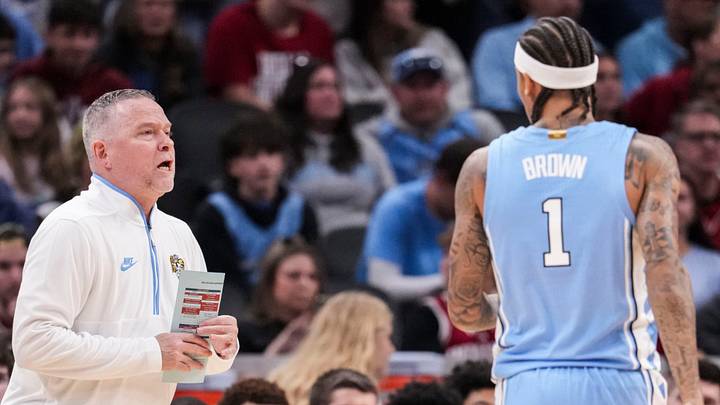
The North Carolina Tar Heels need more from one of their most important offseason acquisitions, and Terrence Brown’s difficult start to the preseason has raised some early questions about what he can bring to Michael Malone’s team.
When North Carolina entered the transfer portal this offseason, the program needed to assemble a competitive roster while adjusting to a significant coaching change. Malone’s arrival coincided with the opening of the transfer portal window, leaving the Tar Heels with a different timeline from many of their competitors.
Despite those challenges, North Carolina managed to pursue several talented players, with Brown emerging as one of the most intriguing additions to the backcourt.
The former Utah guard arrived in Chapel Hill with an impressive scoring reputation and the kind of athleticism that could make him an important part of Malone’s offensive plans. However, his performances through the first two exhibition games against USC and Indiana have not quite matched those expectations.
Although two preseason games are far too small a sample to determine how a player will perform over an entire season, Brown’s early struggles have highlighted several areas that require improvement.
From his shooting efficiency to his decision-making in a fast-paced offensive system, the guard has work to do before North Carolina can confidently rely on him as one of its primary offensive weapons.
The question now is whether these performances are simply early adjustment difficulties or a warning sign that Brown needs to make significant changes to his game.
Terrence Brown’s Scoring Production Has Taken a Concerning Dip
Brown’s reputation as a scorer was one of the main reasons North Carolina pursued him so aggressively during the offseason.
During the 2025 season at Utah, the 6-foot-3, 180-pound guard averaged 19.9 points per game while shooting 45.3 percent from the field and 32.7 percent from three-point range.
Those numbers demonstrated his ability to shoulder a substantial offensive responsibility. Brown was capable of creating his own shot, attacking defenders off the dribble, and putting pressure on opposing defenses through his scoring.
That is precisely the kind of production North Carolina hopes to receive from a marquee transfer acquisition.
However, the early exhibition numbers tell a different story.
Across the two contests, Brown has made just five of his 14 field-goal attempts while averaging 6.0 points per game. He has also converted only one of four attempts from the free-throw line.
The difference between his previous scoring production and his preseason output is noticeable.
Of course, nobody should expect Brown to average nearly 20 points immediately in a new program, particularly when he is learning a different offensive system and adjusting to unfamiliar teammates. Exhibition basketball also serves as an opportunity for coaches to experiment with rotations, combinations, and responsibilities.
Nevertheless, the Tar Heels need to see signs that Brown can consistently turn his individual talent into efficient offensive production.
His ability to score could become particularly important when North Carolina encounters opponents capable of disrupting its offensive sets. If the team’s primary actions break down, Malone will need guards who can create quality opportunities without forcing difficult shots.
Brown has demonstrated that scoring ability previously. The challenge is rediscovering it in Chapel Hill.
Shooting Efficiency Is the Biggest Question Mark
One of the most important concerns surrounding Brown is his shooting efficiency, particularly from inside the three-point line.
Although perimeter shooting has not traditionally been his greatest strength, Brown has shown that he can contribute offensively in other ways. His ability to attack the basket, operate in the midrange, and use his athleticism to create separation gives him several potential routes to becoming a productive scorer.
However, those strengths become less effective when defenders are comfortable allowing him space on the perimeter.
Through the first two exhibition games, Brown has attempted just two three-pointers. That limited sample does not establish whether his outside shooting has improved or declined, but it illustrates why his perimeter threat remains an important area to monitor.
Opposing defenses can make life difficult for a guard when they do not believe he is a consistent threat from beyond the arc.
Defenders may retreat slightly, crowd driving lanes, and position themselves to prevent penetration. That approach can make it harder for Brown to reach the basket, where his athleticism and ability to attack off the dribble could be most dangerous.
This creates a difficult situation for both the player and the offense.
If Brown cannot consistently punish defenders for leaving him open, North Carolina could find it more difficult to use his speed and ball-handling skills effectively.
Improving his outside shooting would force defenders to close out more aggressively, creating additional opportunities to drive past them or draw help defenders away from teammates.
A three-point percentage in the 35-to-36-percent range would be a valuable target if Brown can develop that consistency over the course of the season. However, the more immediate priority is demonstrating that defenses cannot comfortably ignore his perimeter shot.
He does not necessarily need to become an elite three-point shooter overnight. He simply needs to provide enough of a threat to keep opponents honest.
Michael Malone’s Fast-Paced System Is Creating Another Challenge
Brown’s early difficulties are not limited to shooting.
Malone assembled his roster with the intention of playing at a high tempo, emphasizing athleticism, versatility, playmaking, and the ability to create scoring opportunities before opposing defenses become fully organized.
Those characteristics appeared to make Brown an attractive addition.
His speed off the dribble and ability to operate both on and away from the basketball give North Carolina options in transition and in half-court situations. When he is playing confidently, Brown has the potential to pressure defenders and create advantages for himself and his teammates.
However, playing quickly is not the same as playing effectively.
Through the exhibition games against USC and Indiana, Brown has recorded five assists and five turnovers. Those figures suggest that while he has contributed to the creation of scoring opportunities, he has also struggled to consistently protect possession.
Turnovers are not unusual for guards operating in a new system, especially one that encourages quick decisions and aggressive playmaking. Still, Malone will need Brown to find the right balance between speed and control.
When a team plays at a high tempo, players must recognize opportunities almost immediately. A hesitation can allow the defense to recover, but a rushed pass or an ill-advised drive can produce an unnecessary turnover.
Brown appears to be experiencing some of those adjustment challenges.
At times, the game can look as though it is moving too quickly for him. Rather than allowing offensive actions to develop naturally, he can appear rushed in his decisions.
That is an issue that improved familiarity with his teammates and Malone’s system could help address.
As Brown becomes more comfortable with the players around him, he should develop a better understanding of their movements, preferred passing angles, and reactions when an offensive play breaks down.
That familiarity could help him make quicker decisions without sacrificing control.
Why Brown’s Development Matters So Much to UNC
North Carolina did not pursue Brown simply because it needed another player in the rotation. The Tar Heels brought him in because his previous production suggested that he could become a significant offensive contributor.
That distinction matters.
With a revamped roster, Malone needs multiple players capable of creating offense rather than depending on one individual to carry the scoring burden.
Brown has the tools to help provide that balance. His scoring background, athleticism, and ability to handle the ball could make him a valuable option alongside the other guards in North Carolina’s rotation.
However, the team must determine how to use those strengths most effectively.
If Brown becomes a more reliable perimeter shooter, he could force defenders to respect his entire offensive game. If his decision-making improves, he could become more effective at exploiting defensive openings without giving away possessions.
And if his shooting efficiency increases, North Carolina would have another player capable of contributing consistently when its primary offensive options are unavailable.
Those improvements would benefit the entire roster, not just Brown.
A guard who can threaten defenses in multiple ways creates opportunities for teammates. Defenders cannot focus exclusively on the primary scorer, and the offense becomes more difficult to predict.
For Malone, getting Brown comfortable and productive could therefore be an important part of establishing the team’s overall offensive identity.
The Verdict: Should Tar Heels Fans Be Worried?
Brown’s preseason performances have not been particularly encouraging, but it would be premature to conclude that North Carolina has a major problem with its offseason acquisition.
The numbers identify genuine areas of concern: five field goals made on 14 attempts, only one free throw converted in four attempts, and five turnovers alongside five assists across two exhibition games.
Those figures suggest that Brown needs to improve his efficiency and decision-making.
However, they must also be considered within the context of a new team, a new coaching staff, and an offensive system that places considerable demands on its guards.
The fact that programs such as Kansas and Kentucky pursued Brown during the offseason reflects the level of interest his talent generated. That interest does not guarantee success at North Carolina, but neither should two exhibition games erase the reasons he became an attractive transfer target.
The next step is translating his potential into consistent production.
Brown needs to show that he can make open shots, attack the basket without forcing the issue, and make sound decisions when North Carolina pushes the tempo. Those improvements would give Malone greater confidence in his role and make the Tar Heels more dangerous offensively.
The coaching staff also has a responsibility to help him find the right balance within the system, placing him in situations where his athleticism and scoring instincts can flourish.
Ultimately, the preseason has raised questions, not delivered a final verdict.
North Carolina needs more from Brown, and his performances deserve attention as the regular season approaches. But the opportunity remains for him to turn this difficult beginning into a productive season.
If he develops into a more consistent perimeter threat and learns to control the pace without losing his aggressiveness, Brown could still become one of Malone’s most valuable backcourt players.
For now, Tar Heels fans have reason to watch closely. The talent that made Brown such an intriguing addition has not disappeared. The real challenge is determining how quickly he can turn that talent into the kind of performances North Carolina needs.