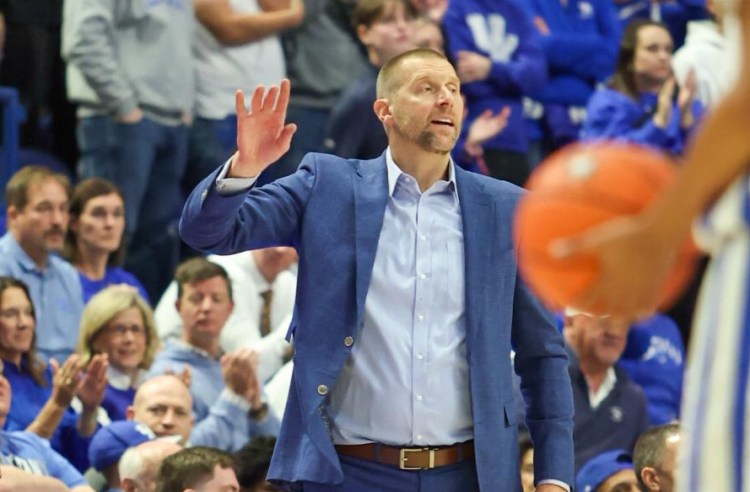
Kentucky basketball fans are used to seeing Mark Pope spread minutes across his roster, but the Wildcats’ exhibition win over Texas Tech offered an intriguing change that could reveal something important about his plans for the upcoming season.
For a coach who has consistently emphasized analytics, player energy, and short bursts of high-intensity basketball, Pope’s decision to lean more heavily on his core players has raised an interesting question: Could Kentucky be preparing to approach the new season differently?
The answer remains to be seen, but the minutes distribution against Texas Tech certainly gives Big Blue Nation something worth watching.
Mark Pope Takes a Different Approach Against Texas Tech
One of the most noticeable aspects of Kentucky’s exhibition matchup against Texas Tech was Pope’s willingness to rely on a tighter rotation rather than distributing playing time evenly across the roster.
Pope has generally been associated with a substitution pattern that allows players to operate in shorter bursts. The philosophy is understandable. Basketball requires constant movement, defensive intensity, and the ability to make quick decisions under pressure. Keeping players fresh can help a team maintain its energy throughout a game.
However, the approach against Texas Tech appeared to place a greater emphasis on continuity and giving the primary players extended opportunities to work together.
That is particularly interesting during exhibition season, when coaches often use games to evaluate different combinations, experiment with lineups, and determine which players can contribute when the regular season begins.
Rather than treating the matchup as an opportunity to distribute minutes as widely as possible, Pope appeared more focused on developing his leading group.
The distinction may seem small, but it could become significant if Kentucky continues using a similar rotation once the games begin to count.
A Clear Contrast With Last Season
Kentucky fans have seen Pope take a very different approach in previous exhibition games.
During the second exhibition game last season against Georgetown, the Wildcats distributed playing time across a much larger portion of their active roster. Nine players received between 14 and 28 minutes, and no player exceeded the 30-minute mark.
That kind of rotation is common during exhibition games because it allows a coaching staff to evaluate players without placing too much responsibility on a small group.
It also provides valuable information about the depth of the roster. Coaches can examine how reserves perform in meaningful stretches, identify promising combinations, and determine which players might be ready for larger roles.
The Texas Tech exhibition presented a different picture.
With starters reportedly playing 34 and 35 minutes, Pope appeared more comfortable allowing his leading players to remain on the floor for extended periods.
That decision naturally stands out because exhibition games generally provide more freedom to experiment than regular-season contests.
There is little reason to treat one game as definitive evidence of a permanent coaching change, but the contrast is enough to make Kentucky supporters pay attention.
Could Pope be placing greater importance on establishing his best lineup early? Is he attempting to build chemistry before the regular season arrives? Or was the decision simply a response to the players available?
Those are important questions, and the upcoming games should provide more clarity.
Injuries May Be Playing a Major Role
There is an important factor that must be considered before drawing conclusions about Pope’s rotation: Kentucky’s injury situation.
The Wildcats entered the exhibition period without Jerone Morton, Trent Noah, and Kam Williams, creating additional pressure on the players who were available.
Losing multiple rotation options can force a coaching staff to make difficult decisions. Even a coach who prefers to distribute minutes across the roster may have limited flexibility when several players are unavailable.
In that situation, relying on the most experienced or best-prepared players can become a practical necessity rather than a deliberate change in philosophy.
Kentucky’s coaching staff must balance several priorities. The team needs to develop chemistry, prepare its starters for the demands of the regular season, and give available reserves opportunities to demonstrate what they can contribute.
At the same time, the staff must consider workload and avoid placing unnecessary physical demands on important players before the schedule becomes more demanding.
The absences of Morton, Noah, and Williams therefore provide meaningful context for the minutes distribution against Texas Tech.
It would be premature to conclude that Pope has abandoned his preference for shorter playing stretches simply because several starters received extended minutes in one exhibition.
Still, the way Kentucky handles its rotation when more players become available will be worth monitoring.
Pope Could Be Prioritizing Chemistry Over Experimentation
Beyond the injury situation, there is another possible explanation for Kentucky’s approach.
Pope may be placing greater emphasis on building chemistry among the players he expects to shoulder the biggest responsibilities this season.
Chemistry is particularly important for a team with postseason ambitions. Players need to understand one another’s movements, recognize defensive assignments, communicate effectively, and develop trust in high-pressure situations.
Those qualities do not always emerge when lineups change every few minutes.
Giving a core group more time together can help players establish a rhythm and become more comfortable with their responsibilities. It can also help the coaching staff evaluate how its preferred lineup responds to difficult stretches.
For Kentucky, the exhibition schedule provides an opportunity to establish those habits before the pressure of regular-season competition arrives.
If Pope believes his primary players need more time together, a tighter rotation would make sense.
However, that approach also comes with risks. Extended minutes can increase fatigue, and a team that depends too heavily on a small group may struggle when injuries or foul trouble force adjustments.
The challenge will be finding the right balance between continuity and depth.
What This Could Mean for Kentucky’s Regular Season
The most important question is whether Pope carries this approach into the regular season.
If the Wildcats continue to rely on a smaller group of players, it could represent a meaningful adjustment from the broader minute distribution Kentucky fans have come to associate with his coaching style.
A tighter rotation could help the Wildcats establish a clear hierarchy. Starters would have more opportunities to develop consistency, while the coaching staff could place greater responsibility on the players it trusts most.
That might prove especially valuable in close games, when coaches often prefer experienced players who understand the system and can execute under pressure.
However, a shorter rotation would not automatically make Kentucky a better team.
Depth remains essential throughout a long college basketball season. The Wildcats will face opponents with different styles, challenging road environments, and stretches when fatigue can become a major factor.
Having dependable contributors beyond the starting lineup could be just as important as establishing a strong first unit.
Pope must also determine how the returning players and injured Wildcats fit into the rotation when they are ready to contribute. Their availability could change the balance of the lineup and give the coaching staff more options.
For that reason, the Texas Tech exhibition should be viewed as an intriguing early indication rather than confirmation of a permanent strategy.
Big Blue Nation Should Watch the Next Few Games
For Kentucky supporters, the biggest takeaway is not necessarily the number of minutes played by individual starters. It is the possibility that Pope is using the exhibition schedule to establish a more defined core before the season begins.
The Wildcats still have questions to answer, particularly regarding player availability, lineup combinations, and the roles of the reserves.
The next few games should help reveal whether the Texas Tech rotation was an isolated response to injuries or an indication that Pope wants his leading players to carry more responsibility.
If Kentucky continues to give its starters extended minutes even as more options become available, the possibility of a broader shift in approach will become more interesting.
If the rotation expands again, the Texas Tech game may simply have reflected the circumstances surrounding that particular matchup.
Either way, the decision offers an early glimpse into how Pope is evaluating his roster and preparing his team for the challenges ahead.
For now, Kentucky fans have reason to pay attention. Pope has built his approach around energy, analytics, and getting the most out of his players. Whether a tighter rotation becomes part of that philosophy remains an open question.
One exhibition game is not enough to declare a major change, but it has created a storyline worth following as the Wildcats move closer to the regular season.
The real test will come when the games count, the competition intensifies, and Pope must decide how much he trusts his starters compared with the depth available on his bench. That is when Big Blue Nation will discover whether
the Texas Tech exhibition was simply a temporary adjustment or the beginning of a different approach to Kentucky basketball.