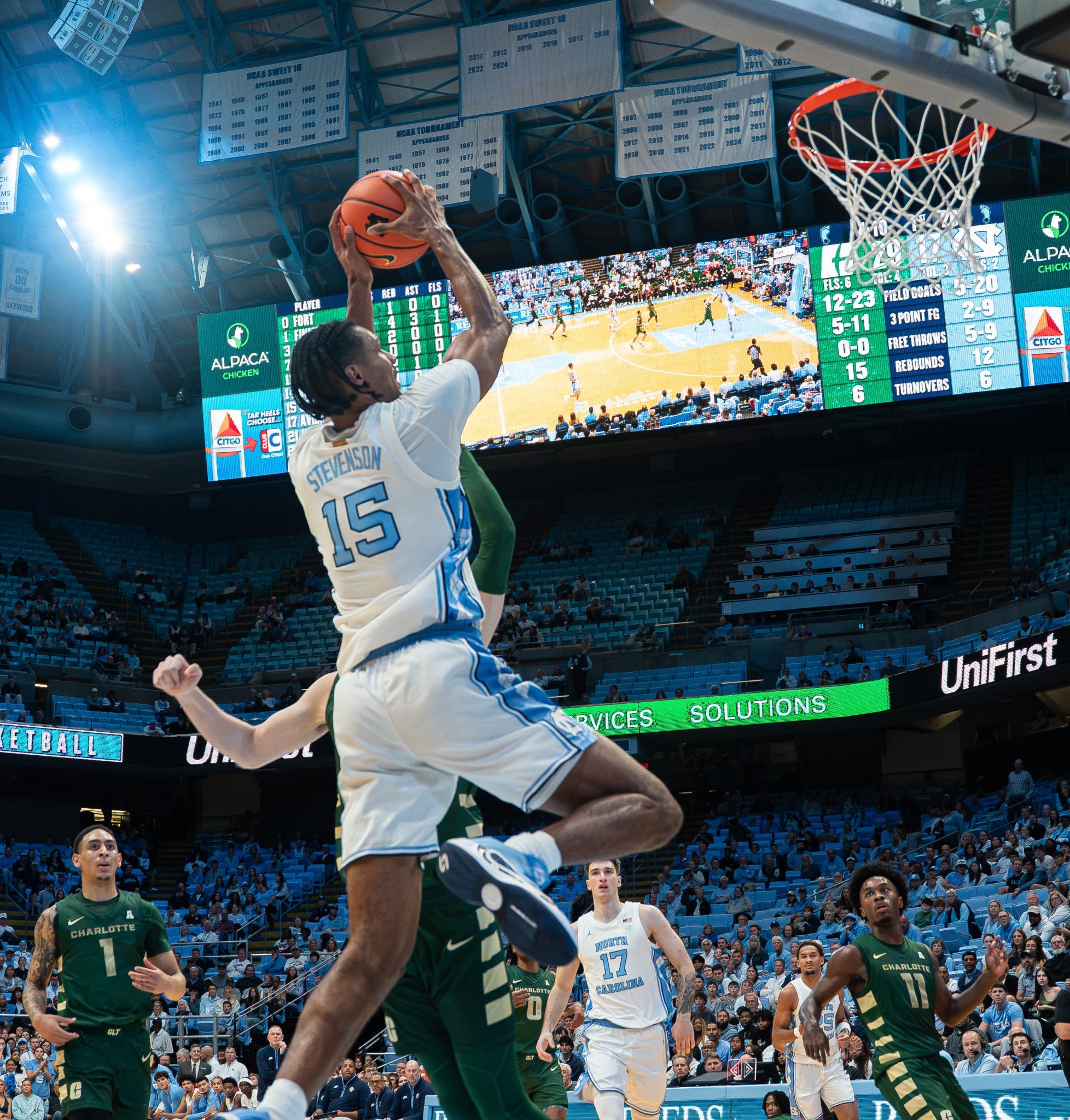
North Carolina is beginning to show encouraging signs under new head coach Michael Malone, with three exhibition games providing an early look at the Tar Heels’ strengths, weaknesses, and potential heading into the 2026–27 college basketball season.
Across victories over Southern California and Charlotte, alongside a defeat against Indiana, UNC has demonstrated offensive versatility, encouraging perimeter shooting, and several individual performances that could prove important throughout the campaign. However, the numbers also highlight areas that Malone must address if his team is to compete consistently against the strongest opponents in college basketball.
The Tar Heels opened their exhibition schedule with an 88–70 victory over USC in Greensboro on October 9. They subsequently suffered a 76–58 defeat against Indiana in Indianapolis on October 18 before returning home to beat Charlotte 89–82 on Tuesday.
UNC finished the three contests with an average of 78.3 points per game, narrowly outscoring its opponents, who averaged 76 points. The results offer an encouraging foundation, although the Indiana loss demonstrated that the team still has work to do before the games begin to count.
STEVENSON LEADS UNC’S OFFENSE AS BROWN AND AVDALAS DELIVER
One of the most encouraging developments for Malone has been the emergence of several players capable of shouldering the offensive responsibility.
Stevenson leads the Tar Heels with 13.3 points per game across the three exhibitions. He has converted 13 of his 30 field-goal attempts, shooting 43.3 percent, while connecting on eight of his 17 attempts from beyond the arc.
His 47.1 percent three-point shooting stands out as a particularly positive development. Stevenson has demonstrated that he can provide scoring from the perimeter, potentially giving UNC an important offensive weapon when opponents concentrate on limiting opportunities inside.
Brown has also made a strong impression, averaging 13 points in 26.7 minutes per game. He has shot 43.8 percent from the field and recorded eight assists, establishing himself as another important contributor.
Meanwhile, Avdalas has averaged 12.3 points and 6.7 rebounds per game. His 20 rebounds and 13 assists illustrate his ability to contribute beyond scoring, while his 12 successful free throws from 16 attempts show that he can generate opportunities at the line.
Together, Stevenson, Brown, and Avdalas have provided Malone with three dependable offensive options. Their continued development could be crucial to UNC’s hopes of establishing a balanced attack rather than relying on a single leading scorer.
KEITA PROVIDES AN INTERIOR PRESENCE
Keita has emerged as another important performer during the exhibition schedule.
The forward has averaged 10.7 points and 5.7 rebounds in 27 minutes per game, converting 11 of his 17 field-goal attempts for an impressive 64.7 percent shooting percentage.
He has also recorded eight blocks and four steals, giving him a significant defensive presence. His ability to protect the rim and finish efficiently around the basket could help UNC establish greater control in the paint.
Keita’s contributions become even more valuable when considering the team’s overall rebounding numbers. North Carolina has collected 36 rebounds per game, compared with 40.7 for its opponents.
The Tar Heels have also surrendered an average of 14.7 offensive rebounds per game. Improving their defensive rebounding will be an important priority for Malone, particularly against teams that excel at creating second-chance opportunities.
Young has offered additional support, averaging 8.7 points while shooting 42.9 percent from three-point range. His six successful three-pointers on 14 attempts suggest that he could become a valuable perimeter option as the season progresses.
Adams, meanwhile, has averaged 6.3 points and 4.7 rebounds per game. Although his scoring has been relatively modest, his six offensive rebounds demonstrate his willingness to contribute physically.
THREE-POINT SHOOTING OFFERS REASONS FOR OPTIMISM
UNC’s perimeter production has been one of the more encouraging features of its opening exhibitions.
The Tar Heels have made 30 of 82 attempts from three-point range, shooting 36.6 percent. Their opponents have connected on 27 of 82 attempts, converting 32.9 percent.
That difference gives Malone reason to be optimistic about his team’s ability to stretch opposing defenses. Consistent outside shooting can create more space for Keita and other interior players while opening driving lanes for the guards.
UNC has also averaged 13 assists per game, exceeding its opponents’ average of 11.7. Avdalas leads the team with 13 assists, while Brown has contributed eight.
However, ball security remains a concern. The Tar Heels have committed 47 turnovers across three games, an average of 15.7 per contest. Their opponents have recorded 45 turnovers.
Reducing those mistakes will be essential against more disciplined defenses. Better decision-making could help UNC convert its offensive opportunities into points more consistently.
MALONE MUST ADDRESS REBOUNDING AND SECOND-CHANCE POINTS
Despite the encouraging offensive statistics, UNC’s defensive numbers reveal several potential weaknesses.
The Tar Heels have been out-rebounded by 14 across the three exhibitions, collecting 108 rebounds compared with 122 for their opponents.
The difference becomes particularly concerning when examining second-chance points. UNC has scored 27, while opponents have accumulated 48.
That 21-point disadvantage highlights the cost of allowing opponents additional possessions. Malone will need his players to improve their positioning, box out more consistently, and finish defensive possessions with rebounds.
There are positives on the defensive end, however. UNC has averaged nine steals per game, slightly above its opponents’ 8.7. The Tar Heels have also scored 31.3 points in the paint per game, compared with 24 for their opposition.
Those figures suggest that the team can generate pressure defensively while maintaining an effective interior attack.
A PROMISING FOUNDATION AHEAD OF THE REGULAR SEASON
UNC’s three exhibition games have provided a mixture of encouraging performances and important lessons.
Stevenson’s scoring and perimeter efficiency, Brown’s offensive production, Avdalas’ all-around contributions, and Keita’s interior presence give Malone several reasons to believe his team can develop into a competitive unit.
The 36.6 percent three-point shooting also offers a positive foundation, although turnovers, defensive rebounding, and second-chance points remain clear areas for improvement.
Ultimately, exhibition results are only an early indication of what a team might accomplish. The regular season will provide a much tougher test, with opponents looking to expose every weakness.
For Malone and North Carolina, the objective is clear: build on the offensive promise, improve defensive discipline, and develop greater consistency across all areas of the game.
If the Tar Heels can translate their encouraging individual performances into a more complete team effort, their opening exhibitions could prove to be an important stepping stone toward a successful 2026–27 campaign.