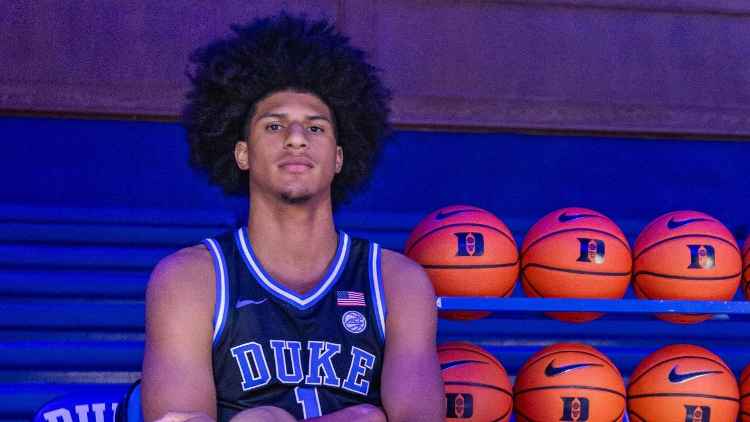
For months, the recruitment of Asa Montgomery felt like a slow-building storm. Then on Wednesday, October 28th, it all broke at once. The five-star forward from Powder Springs, Georgia, ended one of the most closely followed recruitments in the 2027 class by announcing his commitment to Duke.
But the story of his decision day is not just about the final announcement at 1:30 p.m. ET. It is about how the last 72 hours unfolded, how the momentum shifted weeks earlier, and why Durham always felt like the destination.
The Morning of Decision Day
Montgomery woke up on Wednesday knowing exactly what he was going to do. For those around him, that clarity had been there for more than a week, but he kept it close. He wanted decision day to be clean, respectful, and final.
By mid-morning, his inner circle was in place at Hillgrove High School. Family, coaches, and a few teammates gathered as he prepared to go public. There was no elaborate hat ceremony, no last-minute drama with five hats on a table. Montgomery had cut his list to five finalists – Duke, North Carolina, UConn, LSU, and Georgia Tech – weeks earlier, and by decision morning, the other four staffs had already been informed of his choice.
The announcement itself was simple and direct. Montgomery thanked his family, his high school coaches, his AAU program, and every college that had recruited him. Then he said the words many had expected since early October: he was committing to Duke.
The Visit That Changed Everything
To understand why decision day felt so inevitable, you have to go back to his official visit schedule.
Montgomery took a methodical tour. He started with LSU, then checked out the hometown option at Georgia Tech. He went north to see UConn and Dan Hurley, then made the trip to Chapel Hill for an official visit to North Carolina on September 25th.
His final official visit was Duke on October 2nd, and that is where everything shifted.
He arrived in Durham for the program’s Countdown to Craziness event. Cameron Indoor Stadium was loud, the student section was full, and the energy was different. For a kid who grew up dreaming about Duke since he was eight years old, being in that building as the priority recruit hit differently.
During that visit, Jon Scheyer did not sell him on a fantasy. He spent time breaking down film, pointing out small details in Montgomery’s game, showing him exactly how he would be used. The staff compared his projection to a versatile, switchable wing in the Dame Sarr mold – someone who could guard multiple positions, attack off the bounce, hit the three, and thrive in a winning structure.
Montgomery later described that visit as having a different feeling. He called Duke a dream school and said everything felt right. From the moment he left Durham, the recruitment had a clear leader.
In the days that followed, two previously scheduled visits to other high-major programs were canceled. Crystal ball predictions began to flood in for Duke. By the time he set a decision date for October 28th, most recruiting insiders had already penciled him to the Blue Devils.
Why Duke Won
There were three reasons Duke won this recruitment.
First, relationship and trust. Scheyer had been straightforward with Montgomery from the day Duke offered him on August 12th. He did not promise a guaranteed starting spot or inflated stats. He promised hard practices, honest coaching, and a chance to win at the highest level. For a player who had just come off winning a gold medal with the USA U17 team at the FIBA World Cup and who prides himself on playing with confidence and humility, that message landed.
Second, fit and development. At 6-foot-7 and around 215 pounds, Montgomery is not just an athlete. This past junior season at Hillgrove he averaged 18.9 points and 10.3 rebounds, up from 16.7 and 8.7 as a sophomore. But his biggest leap came in the summer EYBL circuit, where he averaged 27.9 points on 54 percent shooting, along with 10.2 rebounds, 3.0 assists, 1.9 blocks and 1.4 steals. He showed he could knock down threes, cut backdoor, switch onto guards and bigs, and impact winning without forcing shots. Duke presented a clear plan for how that versatility translates to college and beyond.
Third, culture. Montgomery called the Duke campus beautiful and crazy for basketball. That combination matters for a top-10 player who had 28 total offers. He wanted a place that lives and breathes the sport, where every game matters, and where he would be pushed daily by other elite prospects.
What His Commitment Means
Montgomery is ranked as the No. 8 overall prospect nationally in the composite rankings, the No. 3 small forward, and the No. 2 player in Georgia. Some services have him as high as No. 7 nationally. He is the third commitment in Duke’s 2027 class, joining four-star wing Kager Knueppel and Australian guard Luke Paul.
His pledge pushed Duke to the top of the national team rankings for 2027 and extends Duke’s streak to seven consecutive recruiting classes landing a top-10 prospect. More importantly, it gives Scheyer a switchable, modern forward who can play alongside Knueppel and complement whatever else Duke adds in this cycle.
For Montgomery, the decision is also personal. He grew up wanting to play for Coach K, and now he gets to play for the coach who succeeded him. The dream did not change, it just evolved.
On decision day, there was no suspense in the room because the work had already been done. The visits, the film sessions, the conversations, and that final trip to Durham all pointed to the same conclusion. By 1:30 p.m., the rest of the basketball world finally caught up to what Montgomery had known since early October.