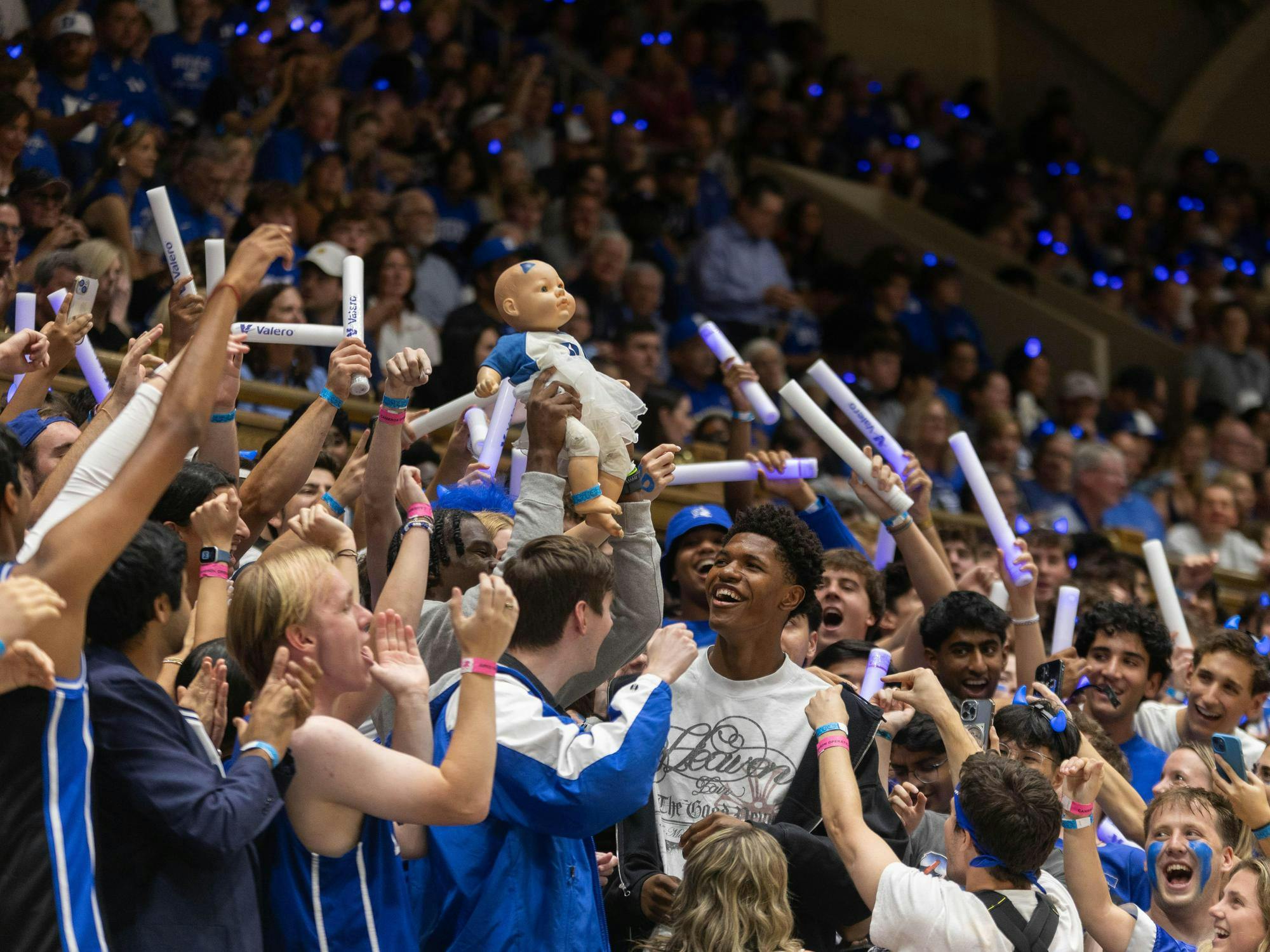
Duke men’s basketball has established itself as one of the most powerful brands in college sports, attracting elite recruits, commanding enormous national attention and maintaining a level of popularity that few programs can match. While financial resources and Name, Image and Likeness (NIL) opportunities have become increasingly important in modern college basketball, the Blue Devils’ recruiting success under head coach Jon Scheyer suggests that their appeal extends far beyond money.
On August 31, Duke Athletics announced a partnership with American financial services company Edward Jones, naming the organization the official wealth management partner of Duke Basketball. The agreement also introduced the company’s logo to the playing surface at Cameron Indoor Stadium for the duration of the partnership.
The announcement generated mixed reactions among supporters, particularly those concerned about commercial advertising appearing on the court of one of college basketball’s most recognizable venues. However, the agreement reflects Duke’s willingness to embrace new commercial opportunities as the financial landscape of college athletics continues to evolve.
The Edward Jones partnership is not the only significant business arrangement involving the Blue Devils. In April, Duke also announced an agreement with Amazon Prime Video, which will stream three of the program’s nonconference games during the 2026-27 season.
Although some fans may dislike the increasing commercialization of college basketball, these agreements demonstrate how major programs are finding new ways to generate revenue, expand their audiences and strengthen their positions in an increasingly competitive environment.
The introduction of NIL opportunities and revenue-sharing arrangements has fundamentally changed roster construction. Recruiting is no longer simply about identifying talented players and convincing them to join a program. Schools must also demonstrate that they can provide the resources, exposure and professional development opportunities necessary to help athletes achieve their ambitions.
Duke has become particularly effective in navigating this new environment.
With Scheyer continuing to assemble highly competitive rosters featuring elite freshmen and experienced transfers, the Blue Devils are regularly mentioned among the leading contenders for major championships. It would be reasonable to assume that their recruiting success is primarily driven by having one of the largest financial commitments in the sport.
However, that assumption does not tell the complete story.
According to reporting from CBS Sports, Duke is not among the highest-spending programs in the top financial tier, where annual roster valuations exceed $20 million. There have even been instances in which the Blue Devils secured highly regarded players despite competing programs offering substantially more money.
That raises an important question: If Duke is not always prepared to outspend its competitors, what makes the program such an attractive destination?
One significant answer is the strength of its national brand.
Duke has developed an enormous following across social media and other major platforms, with approximately 6.7 million followers. That figure reportedly places the basketball program ahead of other major college sports brands, including Alabama football, which ranks second in the comparison highlighted in the original report.
Such visibility provides players with opportunities that extend beyond their performances on the court. Representing Duke means competing under a nationally recognized name, attracting significant media attention and becoming part of a program with an established connection to professional basketball.
The Blue Devils’ history of developing NBA talent also strengthens their recruiting pitch. For young players with professional ambitions, the opportunity to develop under a coaching staff with access to elite competition and national exposure can be just as important as the financial package being offered.
Another major part of Duke’s identity is its association with exclusivity.
Cameron Indoor Stadium has only 9,314 seats, making it one of the more intimate venues in major college basketball. Despite its relatively small capacity, demand for tickets has historically been extraordinary.
A 2019 report by SLAM Magazine placed Duke’s average secondary-market asking price at approximately $670, almost three times the figure recorded by the next most expensive college basketball program at the time.
Access to games is also carefully structured. Fans seeking eligibility to request single-game tickets must contribute at least $120 annually to the Iron Dukes athletic fund. Meanwhile, securing a pair of season tickets requires a minimum donation of $8,000 over three seasons, although making that contribution does not guarantee tickets.
Duke students enjoy a different arrangement, with undergraduate students receiving free admission. However, gaining admission to the university itself remains extremely competitive, with its acceptance rate reportedly falling as low as 4.7% in 2026.
These circumstances reinforce the perception that Duke basketball represents something special. The program combines a prestigious university, an iconic home arena and a fan experience that many supporters across the country would love to enjoy.
Interestingly, Duke’s national appeal may also be connected to its lack of a traditional regional identity.
Unlike programs such as Kentucky, Kansas and North Carolina, Duke is not explicitly tied to a particular state or city through its name. Those universities naturally attract substantial support from their surrounding communities and state populations.
Duke’s relatively small alumni network and highly selective admissions process mean that its supporters are not necessarily concentrated around Durham or even North Carolina.
Instead, the Blue Devils have developed a following that stretches across the United States and beyond.
This allows Duke basketball to operate as a national sporting identity rather than a program primarily supported by one geographical community.
Notre Dame football offers a possible comparison, although its religious heritage and historical achievements give it a different foundation for national support.
Duke’s five NCAA national championships, tied for fifth-most in college basketball history, provide another important part of its appeal. Its sustained presence in major conversations surrounding the sport has helped the program remain relevant across different generations.
Ultimately, Duke’s recruiting advantage is built on more than financial resources. Its national recognition, NBA development reputation, prestigious university identity, historic success and enormous fan following combine to create an environment that few programs can replicate.
As NIL opportunities and commercial partnerships continue to reshape college basketball, the Blue Devils appear determined to remain ahead of the changing landscape.
For Scheyer, that powerful combination provides a significant advantage when competing for the nation’s best talent. And while other programs may occasionally offer bigger financial packages, Duke continues to demonstrate that its name alone carries considerable weight in college basketball.