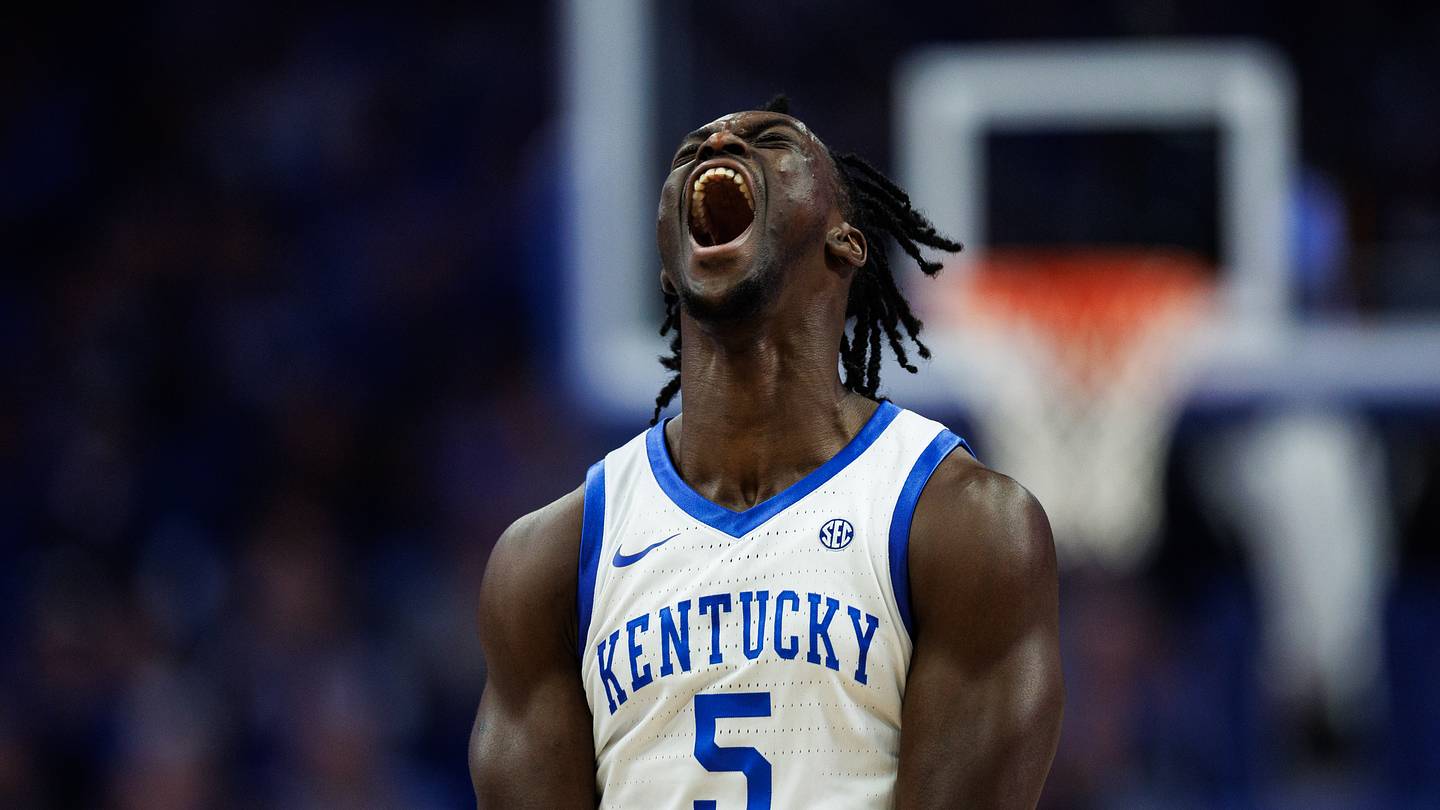
Kentucky has maintained its unbeaten start to the 2026–27 college basketball season, but the Wildcats received an important reminder that victories will not always come easily. After overcoming a difficult first half against James Madison, Mark Pope’s team must quickly address its defensive concerns before facing a significantly tougher challenge against Kansas in the Champions Classic.
The 23rd-ranked Wildcats improved to 2–0 with an 89–80 victory over James Madison at Rupp Arena on Friday night. Although Kentucky eventually found enough offensive firepower to secure the result, the performance was far from comfortable. The Dukes consistently challenged the Wildcats with their aggressive perimeter shooting, exposing defensive weaknesses that could become more costly against elite competition.
With Tuesday’s showdown against Kansas approaching, Kentucky cannot afford to overlook the lessons from its latest performance. The Wildcats demonstrated impressive offensive depth, balanced scoring and composure during important moments, but their inability to control the contest defensively for extended stretches remains a concern.
JAMES MADISON EXPOSES KENTUCKY’S DEFENSIVE VULNERABILITIES
James Madison entered Rupp Arena determined to challenge Kentucky from beyond the three-point line, and the Dukes executed that strategy throughout the evening.
They attempted 45 three-pointers, tying the record for the most attempted by a Kentucky opponent. Tennessee previously established the same mark in January 2025.
The aggressive approach created considerable problems for Pope’s team. Rather than allowing Kentucky to establish complete control, James Madison repeatedly used its perimeter shooting to remain within striking distance.
The first half demonstrated just how competitive the matchup had become. Both teams entered halftime tied at 39–39 after nine lead changes and three ties. Kentucky struggled to create meaningful separation, while the Dukes consistently responded whenever the Wildcats appeared ready to establish momentum.
James Madison continued applying pressure after halftime, forcing Kentucky to rely on its offensive execution to protect its advantage.
Although the Wildcats eventually secured the victory, the defensive performance will give Pope and his coaching staff plenty to examine.
Kentucky dominated the points-in-the-paint battle 40–20, demonstrating its ability to create opportunities around the basket. However, that advantage was not enough to prevent James Madison from making the contest uncomfortable.
Against Kansas, Kentucky will face another level of offensive talent. Defensive communication, perimeter pressure and the ability to close out shooters will become particularly important.
KENTUCKY’S OFFENSIVE DEPTH PROVIDES THE ANSWER
Despite the defensive concerns, Kentucky received encouraging contributions from several players, particularly those coming off the bench.
Zoom Diallo and Alex Wilkins led the Wildcats with 16 points apiece, while Justin McBride added 13 points against his former team.
Mason Williams contributed 12 points off the bench, and Braydon Hawthorne finished with 10. Their performances gave Kentucky five players in double figures and demonstrated the importance of having multiple offensive options.
That balance could become one of the Wildcats’ biggest strengths as the season progresses.
Rather than depending on one individual to carry the scoring responsibility, Pope has several players capable of making meaningful contributions. The production from the reserves was especially valuable against James Madison because it allowed Kentucky to maintain offensive pressure when the game became difficult.
One of the most important stretches arrived with the score tied at 56.
Wilkins, McBride and Ousmane N’Diaye connected on consecutive three-pointers, creating a 65–56 Kentucky advantage. The sequence shifted the momentum and gave the Wildcats the breathing room they had struggled to establish earlier.
Kentucky continued building its advantage when Mason Williams and McBride knocked down additional three-pointers, extending the lead to 79–68.
The Wildcats eventually had enough separation to withstand James Madison’s final attempt at a comeback.
Kentucky also demonstrated efficiency from the field, shooting 50.8 percent overall and making 10 three-pointers. The Wildcats have now reached double figures in three-point baskets in consecutive games.
Their performance at the free-throw line was another encouraging development. Kentucky converted its final 10 free throws of the second half and finished 15 of 19 from the charity stripe.
Those contributions proved essential in a contest that remained competitive longer than expected.
KANSAS PRESENTS A MUCH BIGGER CHALLENGE
Kentucky’s attention now turns to Kansas, with the two programs scheduled to meet Tuesday night in Chicago as part of the Champions Classic.
The game will take place at the United Center, with tipoff scheduled for approximately 9:30 p.m. ET on ESPN.
Unlike James Madison, Kansas presents a considerably more demanding examination of Kentucky’s overall quality. The Jayhawks possess the talent, physicality and experience to punish defensive mistakes, making this an important early opportunity for Pope’s team to demonstrate its progress.
Kentucky will need more than offensive depth to compete successfully.
The Wildcats must improve their defensive rotations, communicate more effectively and prevent opposing shooters from finding comfortable opportunities beyond the arc. Allowing Kansas to establish the same offensive rhythm James Madison enjoyed could make Tuesday’s contest extremely difficult.
Pope will also want his players to maintain the offensive balance that helped them survive Friday’s challenge. Diallo, Wilkins and McBride have already demonstrated their scoring abilities, while the contributions of Kentucky’s reserves provide additional flexibility.
The Champions Classic represents an opportunity to measure those strengths against a nationally respected opponent.
MARK POPE’S WILDCATS MUST TAKE THE NEXT STEP
Kentucky’s victory over James Madison should not be viewed as a major setback. Winning a competitive game requires composure, execution and the ability to respond when circumstances become uncomfortable.
The Wildcats displayed those qualities, particularly during the second-half scoring run that ultimately decided the contest.
However, the performance also highlighted an important reality: Kentucky cannot expect its offense to rescue it every time the defense struggles.
With Kansas waiting, Pope’s team faces an immediate opportunity to demonstrate that it can correct those problems against stronger competition.
An unbeaten 2–0 record provides a positive foundation, but the upcoming matchup will offer a much clearer indication of Kentucky’s potential.
The Wildcats survived their first significant scare. Now, they must prove they are ready for a much bigger test.