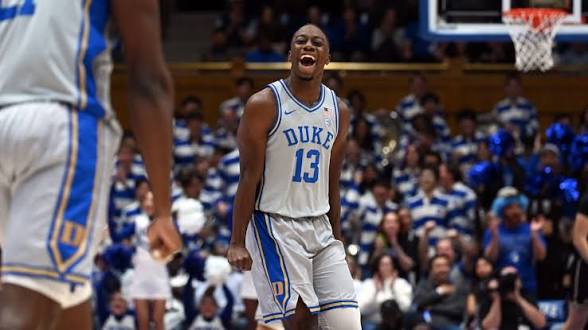
Duke entered the Champions Classic looking like one of the most dangerous teams in college basketball. But Michigan State delivered a 79-73 reality check that exposed several areas the Blue Devils must address if they want to compete for a national championship. Despite the disappointing result, there is an important reason for optimism: this young Duke team has plenty of room to grow, and Tuesday night’s defeat may have revealed exactly what it needs to improve.
The No. 2 Duke Blue Devils suffered their first major setback of the 2026-27 campaign on Tuesday night, falling 79-73 to No. 5 Michigan State in the State Farm Champions Classic.
After opening the season with victories over Army and Coastal Carolina, Jon Scheyer’s team finally encountered the kind of opposition capable of testing its strengths and exposing its weaknesses.
And Michigan State took full advantage.
The Spartans delivered an impressive defensive performance, forced costly turnovers, and made Duke work extremely hard for its offensive opportunities. The Blue Devils struggled to establish the same rhythm that had made them look so dominant during the preseason and their first two regular-season games.
However, this defeat should not automatically change the way people view Duke’s potential.
The Blue Devils remain one of the most talented teams in college basketball. What Tuesday night demonstrated is that talent alone will not be enough. If Scheyer wants his team to become a genuine national championship contender, there are important details that must improve.
Here are four major observations from Duke’s 79-73 defeat to Michigan State.
1. DUKE’S TRANSITION DEFENSE HAS BECOME A MAJOR AREA OF CONCERN
One of the biggest lessons from Tuesday night’s contest was the importance of Duke’s transition defense.
The Blue Devils are an extremely difficult team to attack when they have enough time to organize their defense. Their size, athleticism, and ability to protect the paint make scoring against them a difficult assignment for opposing offenses.
But there is a potential weakness that opponents can exploit.
When teams move the basketball quickly and attack before Duke’s defenders are properly positioned, the Blue Devils can find themselves in uncomfortable situations.
Michigan State understood that opportunity and made the most of it.
Rather than allowing Duke to establish its defensive structure on every possession, the Spartans looked to push the tempo and capitalize on opportunities in transition.
Players such as Jeremy Fears Jr. and Coen Carr give Michigan State important weapons in that area. Their ability to attack quickly and create problems for opposing defenses makes the Spartans particularly dangerous when they find space in the open floor.
This is something Duke must take seriously moving forward.
The Blue Devils cannot expect every opponent to attack them through slow, organized half-court possessions. Strong teams will look for opportunities to turn defensive stops, rebounds, and turnovers into quick scoring chances.
Kansas also demonstrated during the preseason that attacking Duke before its defense becomes fully organized can be an effective approach.
For Scheyer, the challenge is making sure his players understand the importance of getting back quickly, communicating, and identifying opposing threats before they reach dangerous positions.
If Duke wants to establish itself as one of the best defensive teams in the country, its transition defense must be just as impressive as its half-court defense.
2. TURNOVERS ARE STILL DUKE’S BIGGEST OFFENSIVE PROBLEM
If there was one issue that stood out throughout Duke’s early performances, it was the team’s tendency to give away possession.
Unfortunately, that problem followed the Blue Devils into their matchup with Michigan State.
Duke had already committed 28 turnovers across its first two regular-season games. Although the team managed to win those contests, the numbers suggested that ball security was something the coaching staff needed to address.
Against the Spartans, the consequences became much more expensive.
Michigan State’s defensive pressure created difficult situations for Duke’s players, and the Spartans were extremely effective at turning those mistakes into points.
Ten of Michigan State’s first 11 points came following five Duke turnovers.
The problem continued throughout the opening half, with the Spartans scoring 13 points off nine Blue Devil turnovers.
Those numbers help explain why Duke struggled to control the game.
Every unnecessary turnover represents more than just a lost offensive possession. It can also give the opposition an opportunity to attack in transition, build confidence, and put additional pressure on the defense.
Michigan State deserves considerable credit for the way it defended. Its players were aggressive, disciplined, and effective at recognizing opportunities to disrupt Duke’s offensive rhythm.
However, the Blue Devils must also take responsibility for their mistakes.
A team with championship ambitions cannot afford to repeatedly give opponents easy scoring opportunities.
Scheyer will likely want to see better decision-making, stronger communication, and more composure when his players face intense defensive pressure.
Duke has enough offensive talent to create quality scoring opportunities. The challenge is making sure those possessions end with a shot rather than an avoidable turnover.
3. THE OFFENSIVE GLASS AND FREE-THROW LINE COULD BECOME DUKE’S BIGGEST ADVANTAGES
Despite struggling to find a consistent offensive rhythm, Duke managed to remain competitive because of two important areas: offensive rebounding and opportunities at the free-throw line.
This is where the Blue Devils’ size becomes particularly valuable.
Duke possesses one of the biggest frontcourts in college basketball, and that physical advantage can create problems for opponents throughout the season.
When the initial offensive possession does not produce a good scoring opportunity, offensive rebounds can provide another chance to attack.
Those extra possessions are especially important against teams that defend well and make it difficult to score in the half court.
Against Michigan State, Duke needed every available opportunity to stay within reach.
The ability to attack the offensive glass and get to the free-throw line helped the Blue Devils remain competitive even when their usual offensive flow was missing.
This could become an important part of Duke’s identity moving forward.
The Blue Devils should not rely exclusively on perimeter shooting or complicated offensive actions to generate points. Their size gives them the opportunity to create advantages near the basket, challenge opposing big men, and earn trips to the foul line.
However, those advantages must be used consistently.
Offensive rebounding requires effort, positioning, anticipation, and physical commitment. Getting to the free-throw line also requires players to attack the basket with confidence rather than settling for difficult shots.
If Duke can turn its size into a consistent source of second-chance points and free-throw opportunities, it will become even more difficult for opponents to defend.
4. THIS DEFEAT SHOWED THAT DUKE IS STILL A TEAM IN DEVELOPMENT
Perhaps the most important observation from the Champions Classic is that Duke is still learning how to function as a complete team.
During the preseason and the opening two regular-season games, the Blue Devils looked almost unstoppable at times.
Their combination of talent, size, athleticism, and depth created the impression that they could overwhelm nearly every opponent.
Michigan State provided a different kind of challenge.
The Spartans forced Duke to deal with defensive pressure, difficult offensive possessions, and situations where the Blue Devils could not simply rely on their physical advantages.
That is an important experience for a team with championship ambitions.
Even the best college basketball programs encounter difficult nights. What separates the strongest teams from the rest is their ability to identify weaknesses, learn from mistakes, and respond positively in subsequent games.
For Scheyer, the defeat offers valuable information.
His team must improve its ball security, become more disciplined in transition defense, and find ways to maintain offensive efficiency against physically demanding opponents.
The good news is that these are areas that can improve with coaching, practice, and greater chemistry.
Duke does not suddenly become an ordinary team because of one defeat.
Instead, Tuesday night’s game should serve as a reminder that the Blue Devils still have another level to reach.
WHAT DOES THIS MEAN FOR DUKE’S NATIONAL CHAMPIONSHIP AMBITIONS?
The 79-73 defeat to Michigan State will undoubtedly disappoint Duke supporters, especially after the excitement generated by the team’s opening performances.
However, the result should also be viewed in the context of a long college basketball season.
November is still an early stage of the campaign, and there is considerable time for the Blue Devils to address their weaknesses.
The most encouraging part of this situation is that Duke’s problems are identifiable.
The turnovers are visible. The transition-defense issues are clear. The opportunities created through offensive rebounding and free throws show that the team already possesses important strengths it can continue to develop.
Scheyer now has a valuable opportunity to use this experience as a teaching moment.
The Blue Devils must understand that every possession matters, particularly against teams capable of punishing mistakes.
They also need to recognize that their size and defensive potential must be supported by discipline and consistent execution.
Michigan State deserves credit for delivering a strong performance and exposing areas where Duke can improve.
But the bigger story may be what happens next.
DUKE’S SEASON IS FAR FROM OVER — THE REAL RESPONSE STARTS NOW
One defeat does not erase the promise Duke demonstrated during the preseason and its first two games.
The Blue Devils still have the talent, coaching, and physical tools to compete with the nation’s best programs.
What Tuesday night revealed is that they cannot afford to become comfortable with their early success.
If Scheyer’s players respond by improving their decision-making, tightening their transition defense, and continuing to use their size effectively, this loss could become an important turning point in their development.
The Champions Classic was supposed to provide Duke with an opportunity to prove how good it could be against elite competition.
Instead, Michigan State showed the Blue Devils exactly how much work remains.
The biggest question now is not whether Duke has enough talent to compete for a championship. It is whether Jon Scheyer can turn the lessons from this 79-73 defeat into the improvements that make the Blue Devils even more dangerous.
And if Duke learns from this experience, its next performance could tell us a lot about just how special this team can become.