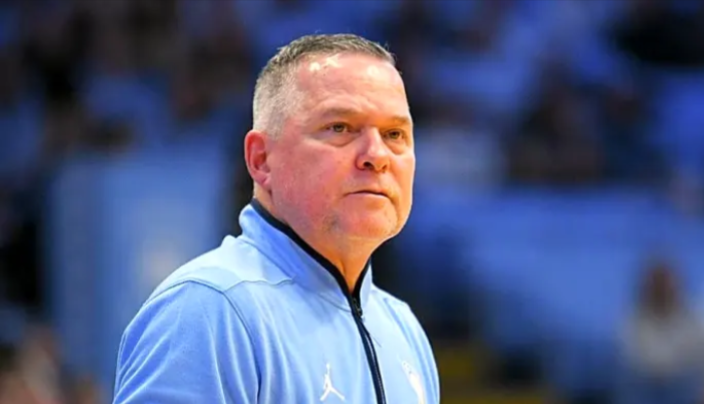
North Carolina may have walked away with a 76-63 victory over Wyoming, but head coach Michael Malone made it clear that the final score was not the only thing that mattered on Tuesday night.
Despite improving to 3-0, the Tar Heels were far from convincing during the opening half. Wyoming came into the Dean E. Smith Center with an aggressive approach, exposing one of Carolina’s biggest weaknesses and making life uncomfortable for the home team.
But what happened inside the locker room at halftime may have been just as important as anything that happened on the court.
Malone delivered a strong message to his players, challenging their toughness and demanding a completely different attitude when it came to fighting for rebounds. His words were direct, emotional, and impossible to misunderstand.
And one particular statement stood out.
“Because the streets talk, and right now the streets are talking,” Malone declared when explaining his halftime message.
It was a revealing moment that offered UNC fans a glimpse into the standards Malone expects from his team — and why he was unwilling to accept the way the Tar Heels performed during the first half.
A Slow Start Exposed a Problem Malone Refuses to Ignore
North Carolina entered Tuesday’s matchup hoping to continue its unbeaten start to the season. However, Wyoming had other ideas.
The Cowboys played with tremendous physicality, attacking the offensive glass and repeatedly creating second-chance opportunities. Carolina struggled to match that intensity, allowing Wyoming to collect 15 offensive rebounds in the first half.
That was precisely the kind of performance Malone did not want to see from his team.
Although UNC was defending reasonably well in stretches, its inability to finish defensive possessions made the job considerably harder. Every missed rebound gave Wyoming another opportunity to score, and the visitors took full advantage.
Malone explained that he decided to address the situation directly during halftime.
He revealed that he went through the roster, challenging individual players who had finished the opening half with zero rebounds or only one defensive rebound.
His message was simple: Carolina had to stop allowing opponents to push it around.
The response after halftime was exactly what Malone wanted.
The Tar Heels dramatically improved their defensive rebounding, allowing just four offensive rebounds in the second half, compared with 15 before the break.
That improvement helped Carolina regain control and eventually secure a comfortable 13-point victory.
However, Malone made it clear that his team cannot continue waiting until halftime to discover the intensity required to win.
‘We Have to Stop Getting Punked’: Malone Explains What Went Wrong
One of the most interesting parts of Malone’s postgame comments was his assessment of Wyoming’s approach.
He acknowledged that the Cowboys deserved credit for their performance, pointing out that they had entered the contest as the nation’s leading offensive-rebounding team according to the early-season rankings.
Malone noted that Wyoming was averaging 19 second-chance points per game, meaning its strength on the offensive glass was already well established.
But he also believed the visitors recognized an opportunity to exploit North Carolina’s weaknesses.
After watching Carolina’s preseason performances and its first two regular-season games, Wyoming appeared prepared to attack the Tar Heels physically.
And that is exactly what happened.
“They came in here and had us on our heels. They were hitting us first, and we were reacting,” Malone explained.
The UNC coach made it clear that he does not want his team to spend games simply responding to whatever opponents throw at them.
“I don’t want to be a counter puncher. You know, that’s not my style.”
That statement could become an important part of Carolina’s identity moving forward. Malone wants his players to establish their physical presence rather than allowing opposing teams to dictate the tone of the contest.
The second half against Wyoming provided a glimpse of what that mentality could look like.
Sayon Keita Delivers a Defensive Performance UNC Fans Will Remember
While the halftime message became one of the biggest talking points after the game, Sayon Keita also gave Carolina plenty of reasons to celebrate.
The big man delivered an outstanding all-around performance, finishing with 13 points, eight rebounds, six blocks, and three steals.
His defensive influence was particularly impressive.
Keita repeatedly disrupted Wyoming’s attempts around the basket, using his size, timing, and athleticism to make life difficult for the opposition.
Malone was clearly pleased with what he saw, especially considering the similarities between Keita’s performance against Wyoming and his earlier showing against Indiana.
The coach highlighted his shot-blocking, rebounding, and ability to operate as a dynamic roller in pick-and-roll situations.
He also pointed to Keita’s six blocks, three steals, and six deflections as evidence of how much his defensive presence affected the game.
For UNC, having a player capable of influencing the contest in so many different ways could prove extremely valuable as the season develops.
Keita’s performance was not simply about scoring points. He demonstrated that he can protect the rim, disrupt passing lanes, secure rebounds, and create opportunities for his teammates.
That is the kind of versatility Malone will undoubtedly want to see consistently.
Isaiah Denis Is Earning His Opportunity — And Malone Isn’t Giving Anything Away
Another important storyline from Tuesday’s victory was Isaiah Denis’ continued contribution.
Denis finished with 14 points, matching Terrence Brown for the team-high total.
However, his impact goes beyond the numbers.
When asked about Denis’ ability to overcome everything he experienced last season and establish himself early in the current campaign, Malone pointed to the player’s belief in himself.
The coach also explained his philosophy when he first arrived at North Carolina.
According to Malone, he met with every player and made it clear that nobody would receive guarantees about playing time or opportunities.
Some players chose to remain with the program, while others decided to pursue different opportunities.
Malone’s promise was straightforward: players would have the opportunity to come in, work, and earn their place.
And Denis has done exactly that.
“Isaiah Denis has earned this opportunity,” Malone said.
Those words should mean a great deal to a young player who has continued working toward his opportunity.
They also reinforce the competitive environment Malone wants to establish in Chapel Hill.
Maximo Adams Is Becoming an Important Weapon Off the Bench
Maximo Adams also deserves plenty of attention following the victory.
The young forward recorded his first career college double-double, delivering an impressive performance that included strong rebounding and valuable scoring contributions.
His ability to provide an immediate offensive spark was particularly noticeable.
Malone praised Adams for knocking down multiple three-pointers shortly after entering the game and highlighted his relentless approach to attacking the glass.
When asked whether he had considered moving Adams into the starting lineup, Malone made it clear that the idea had not crossed his mind.
He believes the forward is currently thriving in his role coming off the bench.
Rather than changing something that is working, Malone wants Adams to continue providing energy, scoring, and extra possessions for the Tar Heels.
The coach also gave credit to former UNC head coach Hubert Davis for recruiting Adams and convincing him to remain committed to North Carolina after the coaching change.
Malone recalled contacting Adams after taking the job and asking whether other schools were being considered.
The response was encouraging.
Adams reportedly told him that North Carolina had always been his dream school and that he was not considering another destination.
Malone expressed gratitude that the young forward decided to continue his journey in Chapel Hill, adding that he expects Adams to become a very important part of what the program is building.
Malone Wants More Than Talent — He Wants a Team That Can Finish Possessions
Another major concern Malone addressed was Carolina’s defensive rebounding.
He explained that the team’s practice drills already reward defensive stops and penalize turnovers and offensive rebounds allowed.
However, Tuesday’s performance suggested that the existing penalties might not be strong enough.
Malone admitted that he may need to introduce tougher consequences because he wants his players to understand how important finishing defensive possessions really is.
His assessment was particularly revealing.
He believes North Carolina is defending well in many situations, but the team is not consistently completing the job by securing the rebound.
That distinction matters.
A defensive possession is not truly finished when an opponent misses a shot. It is finished when Carolina secures the ball and prevents the opposition from getting another opportunity.
And once the Tar Heels collect the rebound, they can immediately look to run in transition.
Malone wants that sequence to become automatic.
A Coach Learning to Balance NBA Expectations With College Basketball
Perhaps the most revealing part of Malone’s postgame press conference came when he discussed the challenge of coaching young college players.
Having spent much of his professional coaching career in the NBA, Malone admitted that his mind is naturally wired around the demands of an 82-game season.
But North Carolina is a different environment.
He is working with young players, some of whom have only recently turned 17 or 18, and he understands that coaching them requires patience, teaching, encouragement, and accountability.
His solution?
“I pray a lot,” Malone said.
He explained that he constantly reminds himself to slow down, invest in his players, and remember that his responsibility extends beyond simply demanding results on the basketball court.
Malone also shared a lesson from his late father, who believed that the best coaches are teachers.
That philosophy is something Malone wants to bring to North Carolina.
He wants to demand excellence while also supporting his players, helping them grow, and building their confidence.
It was a thoughtful admission that revealed another side of the coach beyond the fiery halftime speeches.
Terrence Brown’s Competitive Spirit Continues to Impress
Terrence Brown also played an important role in the victory, finishing with 14 points to lead the Tar Heels alongside Denis.
But Malone believes Brown’s greatest value goes beyond his scoring ability.
The coach praised his relentless effort, competitive nature, and determination to influence games even when his shots are not falling.
“One thing I’ll never worry about with Terrence Brown, that kid plays hard,” Malone explained.
That is exactly the kind of mentality Malone wants throughout his roster.
North Carolina will inevitably encounter difficult shooting nights, challenging opponents, and moments when its offense struggles.
Having players who can still contribute through effort, energy, and competitiveness could make a significant difference.
The Bigger Picture: UNC Won, But Malone Has Delivered a Warning
North Carolina improved to 3-0 with its 76-63 victory over Wyoming, shooting 50 percent from the field and 45 percent from three-point range while committing only nine turnovers.
Brown and Denis finished with 14 points apiece, while Keita’s remarkable defensive contribution helped Carolina overcome its difficult first half.
Nevertheless, the victory also exposed an issue that Malone clearly wants addressed before the competition becomes even tougher.
The Tar Heels cannot afford to allow opponents to dominate them physically, particularly on the offensive glass.
The coach’s halftime challenge changed the energy of the game, but his message afterward suggested that he expects this team to develop a tougher identity.
The most important takeaway may not be the final score.
It may be Malone’s insistence that Carolina must start games with the same urgency and physicality it displayed after halftime.
The streets may be talking right now, but Michael Malone wants his players to make sure the conversation changes.
And if Tuesday’s second-half response is any indication, the Tar Heels have the opportunity to turn that message into something much bigger as the season progresses.