

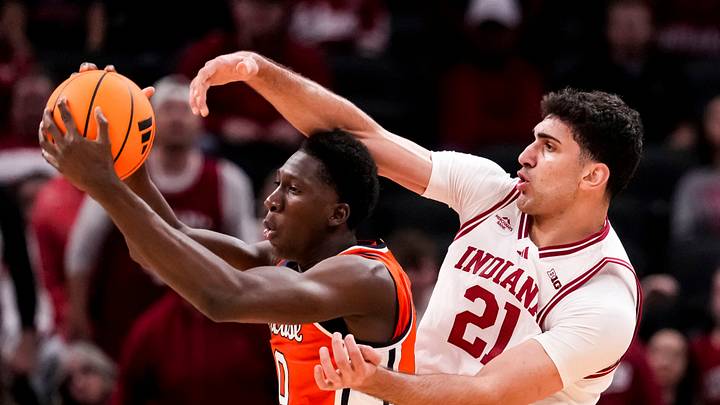
Indiana appears to have several important matchup advantages against Kentucky, but one weakness could turn Friday night’s showdown into a much tougher challenge than the Hoosiers expect.
Indiana enters its highly anticipated matchup against Kentucky with an impressive 5-0 record, while the Wildcats arrive at 4-1 looking to deliver a statement victory.
The Hoosiers have already collected two high-major wins and now have an opportunity to add another significant result to their early-season résumé. Kentucky, meanwhile, will be eager to prove that it can compete with another quality opponent after experiencing some difficult moments during the opening stretch of the campaign.
On paper, Indiana appears to have several reasons for confidence.
The Hoosiers have demonstrated an ability to shoot from beyond the arc, attack the basket, and dominate the offensive glass. Those qualities could become particularly important against a Kentucky team that has shown some concerning defensive weaknesses.
However, this matchup is not necessarily as straightforward as it might appear.
Kentucky possesses one major offensive advantage that could expose an area where Indiana has struggled defensively. If the Wildcats successfully exploit that weakness, the entire complexion of the contest could change.
Here are three major advantages Indiana has entering the matchup, along with one concern that could make the difference.
Three Major Advantages Indiana Has Over Kentucky
1. Three-Point Shooting Could Become a Major Problem for the Wildcats
One of Indiana’s biggest advantages entering this matchup is its ability to score from beyond the three-point line.
The Hoosiers have several players capable of making opponents pay from deep, particularly Darren Harris and Bryce Lindsay.
Both players provide Indiana with legitimate perimeter shooting threats, while the rest of the roster also features players capable of contributing from long range.
As a team, Indiana is shooting an impressive 35.7% from three-point territory.
That becomes especially interesting when considering Kentucky’s defensive struggles against perimeter shooting.
The Wildcats have not consistently done a good enough job preventing opponents from getting comfortable looks from beyond the arc. According to the supplied statistics, Kentucky ranks No. 332 nationally in three-point rate allowed, while opponents are shooting 34.0% from deep against the Wildcats.
Those numbers should immediately attract the attention of Indiana’s coaching staff.
Kentucky has already experienced problems against teams capable of stretching the floor.
James Madison made 15 three-pointers against the Wildcats. Kansas, despite not being a particularly high-volume three-point shooting team, connected on 10. Northern Arizona also found success from beyond the arc, knocking down 13 three-pointers.
All three opponents shot at least 33.3% from deep.
That is an encouraging sign for Indiana.
With Harris, Lindsay, and other capable perimeter shooters available, the Hoosiers could find opportunities to punish Kentucky’s defensive weaknesses.
If Indiana establishes its outside shooting early, the Wildcats could face a difficult night trying to protect the perimeter while also preventing penetration.
This is arguably one of the most important advantages Indiana must take seriously.
2. The Free-Throw Line Could Give Indiana Another Huge Advantage
Another area where Indiana appears to have an important advantage is its ability to get to the free-throw line.
The Hoosiers have shown a willingness to attack defenders physically, draw contact, and turn aggressive offensive possessions into easy scoring opportunities.
Six Indiana players have already attempted at least 15 free throws through the team’s first five games, with Harris leading the way with 37 attempts.
As a team, Indiana ranks No. 26 nationally in free-throw rate.
That is an impressive figure, and it could become particularly important against Kentucky.
The Wildcats have struggled to prevent opponents from getting to the charity stripe. Through five games, opposing teams have attempted 25 more free throws than Kentucky.
That difference is worth paying attention to.
Indiana could look to take advantage by attacking the basket, putting pressure on Kentucky’s interior defenders, and forcing the Wildcats to make difficult decisions defensively.
There are two major benefits to that approach.
First, Indiana could generate additional points without having to rely entirely on its perimeter shooting.
Second, consistently drawing fouls could place important Kentucky players in foul trouble, potentially forcing the Wildcats to adjust their rotations.
That could become especially damaging if Kentucky loses key contributors for extended stretches.
Of course, Indiana must execute its offensive approach and avoid settling for unnecessary outside shots.
But if the Hoosiers successfully establish their physical presence, the free-throw line could become one of their most valuable weapons.
3. Indiana’s Offensive Rebounding Could Create a Nightmare for Kentucky
Perhaps the most concerning matchup advantage for Kentucky is Indiana’s potential dominance on the offensive glass.
The Wildcats have struggled with rebounding consistency, and their performance against Northern Arizona offered another example of why this remains an area of concern.
Kentucky was outrebounded by 12 in that contest and managed just 20 total rebounds.
Despite having players with size, the Wildcats have not consistently demonstrated the physicality and determination needed to control the boards.
Indiana, meanwhile, appears to have made significant progress in an area that was previously considered a weakness.
Under Darian DeVries and his coaching staff, the Hoosiers have quickly developed into one of the country’s strongest offensive rebounding teams.
Indiana ranks No. 11 nationally in offensive rebounding rate.
That statistic could become extremely important against Kentucky.
Offensive rebounds create additional possessions, and additional possessions create more scoring opportunities.
Even if Indiana struggles to shoot efficiently during certain stretches, the Hoosiers could compensate by attacking the offensive glass and generating second-chance points.
That is the kind of advantage that can frustrate an opposing defense.
Kentucky cannot afford to allow Indiana multiple opportunities on the same possession. The Wildcats must be more aggressive when boxing out, locating opponents, and securing defensive rebounds.
If they fail to do that, the Hoosiers could turn missed shots into valuable scoring opportunities.
Indiana’s ability to dominate the offensive glass could ultimately become one of the biggest deciding factors in this matchup.
One Major Concern Indiana Must Address Against Kentucky
1. Kentucky’s Two-Point Offense Could Expose the Hoosiers
Despite Indiana’s three major advantages, there is one matchup that should make the Hoosiers uncomfortable.
Kentucky’s ability to score efficiently inside the three-point line could create serious problems for Indiana’s defense.
The Wildcats have been particularly effective in two-point situations, posting an impressive 61.3% two-point shooting efficiency, which ranks No. 27 nationally.
Indiana, on the other hand, has been surprisingly vulnerable defensively in that area.
The Hoosiers rank just No. 171 nationally in two-point defense.
That creates an interesting contrast.
Indiana has the perimeter shooting, free-throw production, and offensive rebounding numbers to make life difficult for Kentucky. However, the Wildcats possess an offensive strength that could expose one of Indiana’s biggest defensive weaknesses.
The question is whether Indiana can prevent Kentucky from consistently getting into the paint.
Jaeden Mustaf and the other perimeter defenders will have an important responsibility.
Can they keep Kentucky guards Zoom Diallo and Alex Wilkins from penetrating into the lane and creating easy scoring opportunities?
If those guards consistently get past their defenders, Indiana could find itself under considerable pressure.
The challenge will also extend to the Hoosiers’ interior defenders.
Samet Yigitoglu and Aiden Sherrell must be prepared to protect the rim, challenge shots, and prevent Kentucky from turning successful drives into easy baskets.
That becomes even more important when considering the presence of Malachi Moreno.
Kentucky has the personnel to make Indiana work defensively, and the Hoosiers cannot afford to focus exclusively on stopping the three-point shot while allowing the Wildcats to dominate inside.
This is the one area where Kentucky could potentially turn the matchup in its favour.
The Matchup Could Come Down to One Important Question
Indiana has plenty of reasons to enter this contest with confidence.
The Hoosiers can shoot from three-point range, generate opportunities at the free-throw line, and create additional possessions through offensive rebounding.
Those are three significant advantages against a Kentucky team that has struggled in several of those areas.
However, the Wildcats have their own weapon.
Kentucky’s two-point efficiency could become a major problem for Indiana if the Hoosiers cannot protect the paint and contain opposing guards.
Ultimately, the matchup could come down to whether Indiana can impose its strengths without allowing Kentucky to exploit its defensive weakness.
Can the Hoosiers take advantage of Kentucky’s perimeter defense and rebounding struggles?
Or will the Wildcats use their interior scoring ability to expose Indiana when it matters most?
Those questions could determine the outcome of what promises to be a fascinating basketball showdown.
Indiana may have three important advantages entering this matchup, but Kentucky’s ability to score inside could be the one factor that changes everything.