

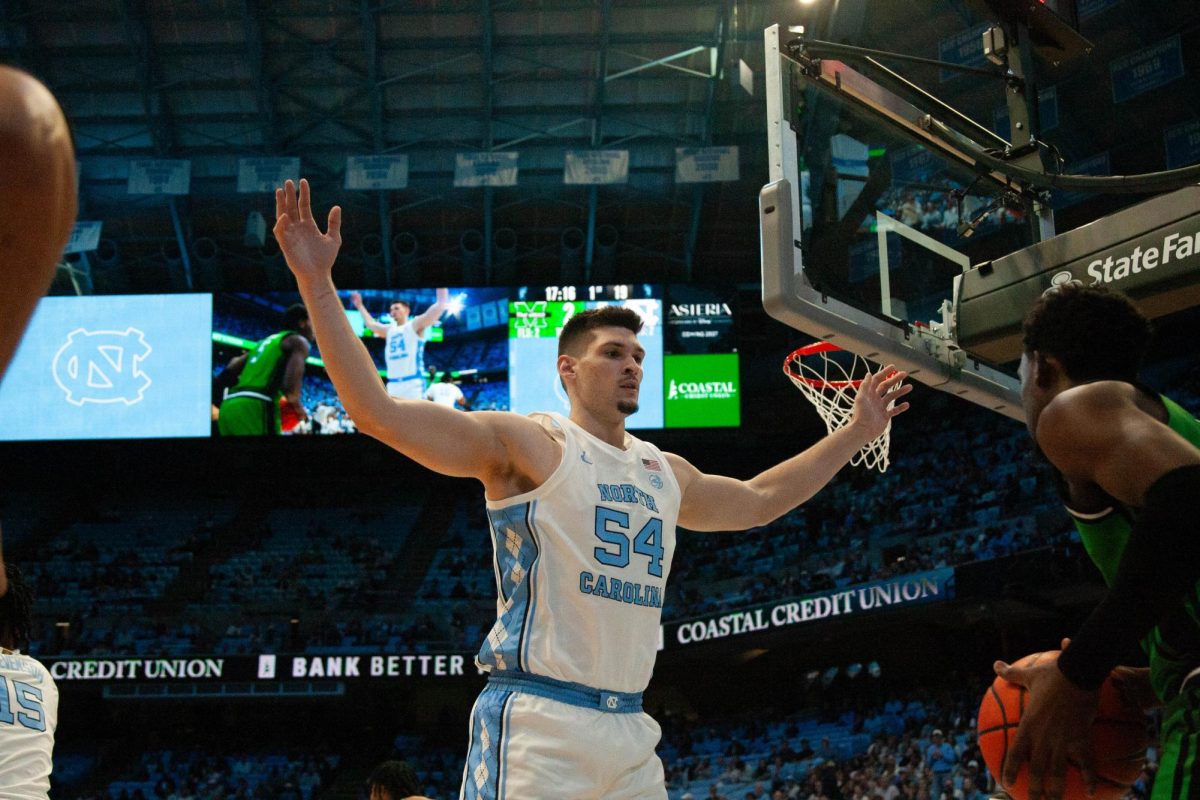
The North Carolina Tar Heels entered halftime with a 42-37 advantage over Marshall, showing flashes of offensive brilliance while also exposing several areas that head coach Michael Malone will want his team to improve. Although UNC managed to build a commanding 17-point lead during the opening half, Marshall’s timely three-point shooting and the Tar Heels’ costly turnovers allowed the visitors to work their way back into the contest.
North Carolina started aggressively, displaying the offensive energy and confidence that Malone wants to establish as the team’s identity. However, the momentum gradually shifted as Marshall found opportunities to capitalize on defensive mistakes and slow down the Tar Heels’ attacking rhythm.
With the second half approaching, three major storylines stood out from UNC’s opening-half performance.
1. MATT ABLE LEADS THE THREE-POINT ATTACK AS UNC FINDS ITS SHOOTING RHYTHM
One of the biggest positives for North Carolina was its improved performance from beyond the three-point line. The Tar Heels connected on 40 percent of their attempts from deep, making 15 attempts during the first half and demonstrating a more disciplined approach than they displayed against Georgia.
Sophomore guard Matt Able was particularly impressive, knocking down three three-pointers and providing an important scoring boost for Malone’s offense. His shooting ability helped UNC establish an early advantage and forced Marshall to respect the Tar Heels’ perimeter threat.
The difference in UNC’s shot selection was noticeable. Rather than settling for difficult, unnecessary long-range attempts, the Tar Heels appeared more deliberate about creating quality opportunities. Their ball movement and willingness to attack different areas of the floor helped generate better looks.
Senior guard Jaydon Young also attempted to build on the team’s perimeter momentum, although one of his three-point attempts bounced off the rim.
Instead of continuing to force outside shots, North Carolina adjusted by attacking the interior. Senior guard Terrence Brown, who had nine points by halftime, became an important contributor around the basket, helping UNC maintain its offensive pressure.
Graduate guard Angelo Brizzi also delivered a valuable contribution, knocking down a timely three-pointer with approximately two minutes remaining before halftime. That basket helped prevent Marshall from completely closing the gap.
If Able and the other perimeter shooters maintain this level of confidence, UNC could become considerably more dangerous offensively in the second half.
2. CAMERON FENS MAKES AN IMMEDIATE IMPACT AS UNC GAINS A REBOUNDING ADVANTAGE
Another major talking point was the introduction of fifth-year center Cameron Fens, whose eligibility situation had attracted attention ahead of the matchup.
Following a temporary restraining order issued Thursday that granted him eligibility for the time being, Fens was available to make his UNC debut against Marshall.
Although he did not enter the starting lineup, Malone wasted little time getting the experienced center involved. Fens checked into the game less than three minutes after tipoff, giving the Tar Heels another physical presence in the frontcourt.
His impact became noticeable almost immediately.
Fens recorded his first rebound approximately a minute after entering the game before scoring his first points shortly afterward on a second-chance layup. His ability to compete around the basket provided UNC with an additional dimension that could become increasingly important as the season progresses.
By halftime, Fens had collected six rebounds, leading the Tar Heels in that category.
His size, reach and presence around the rim give North Carolina another option when competing against physically demanding opponents. He also provides valuable opportunities for second-chance points, something that could help the Tar Heels when their perimeter shooting becomes inconsistent.
However, his performance was not entirely flawless.
Fens appeared to still be adjusting to his teammates and the pace of Malone’s system. One costly turnover nearly resulted in an easy opportunity for Marshall, eventually leading to an and-one play that reduced UNC’s advantage to nine points.
Despite that mistake, his rebounding contribution was encouraging. If Fens continues developing his chemistry with the team, his presence could become one of UNC’s biggest advantages.
3. UNC’S OFFENSIVE MOMENTUM DISAPPEARS AS MARSHALL CAPITALIZES ON TURNOVERS
Perhaps the biggest concern for Malone was how dramatically North Carolina’s offensive production slowed as halftime approached.
The Tar Heels scored 27 points during the opening 10 minutes, showcasing an impressive combination of shooting, ball movement and attacking aggression.
However, they managed just 15 additional points over the remainder of the first half.
That sudden decline allowed Marshall to regain confidence and turn what initially appeared to be a comfortable UNC advantage into a much tighter contest.
Turnovers were a significant part of the problem.
Marshall scored 10 points off six UNC turnovers, while the Tar Heels managed just two points off four turnovers by the Herd. That difference highlighted how effectively Marshall punished North Carolina’s mistakes.
Defensively, UNC did have some positive moments. The Tar Heels successfully forced Marshall to use much of the shot clock on several possessions, limiting the visitors’ opportunities to score quickly.
Unfortunately, defensive lapses and unnecessary shooting fouls prevented North Carolina from taking complete control.
Marshall continued finding ways to stay within reach, particularly through timely three-point shots and opportunities created by UNC’s mistakes.
For Malone, the message heading into the second half should be straightforward: protect the basketball, defend without committing unnecessary fouls and rediscover the offensive urgency that produced the early 17-point advantage.
SECOND-HALF OUTLOOK: MALONE’S TAR HEELS MUST FINISH THE JOB
North Carolina has demonstrated enough quality to suggest it can control this matchup, but the five-point halftime advantage shows that the job is far from finished.
Matt Able’s perimeter shooting, Cameron Fens’ rebounding and Terrence Brown’s offensive contributions have provided encouraging signs. Nevertheless, the turnover problem and defensive inconsistencies remain issues that Marshall could exploit.
The Tar Heels must avoid allowing their opponents to dictate the pace after halftime.
If UNC can improve its ball security, maintain its rebounding advantage and rediscover its early offensive rhythm, Malone’s team will have a strong opportunity to turn its halftime lead into a convincing victory.
For now, the Tar Heels have the advantage, but the second half will reveal whether they can deliver the complete performance their supporters are expecting.