

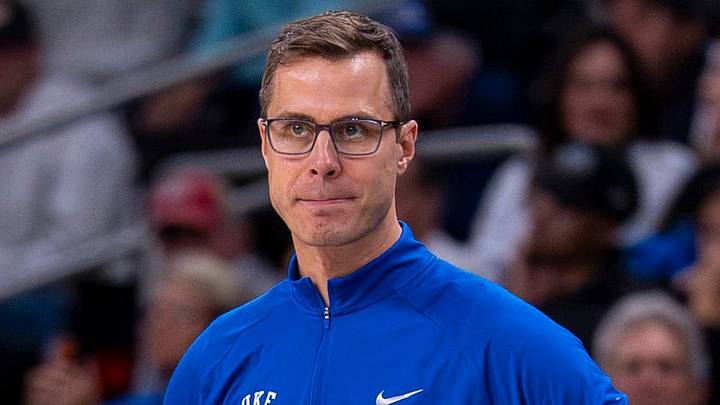
The Duke Blue Devils entered the 2026-27 college basketball season with enormous expectations. With a talented roster, impressive size, and championship ambitions, Jon Scheyer’s squad was expected to establish itself as one of the most dominant teams in the country. However, as the early portion of the season has unfolded, one particular weakness has become increasingly difficult to ignore: defensive rebounding.
Despite having the physical tools and personnel to dominate opponents around the basket, Duke has struggled to consistently secure defensive rebounds. The problem has created additional scoring opportunities for opposing teams and exposed an area that could become costly as the competition gets tougher.
For Scheyer and his coaching staff, addressing this weakness must become an immediate priority.
Duke Has the Size, But Must Show More Consistency
One of the most interesting aspects of Duke’s rebounding struggles is that the Blue Devils have the physical advantages necessary to be an elite rebounding team.
Their roster features players with impressive height, athleticism, and length. On paper, Duke should be capable of controlling the boards against most opponents.
However, having talented big men does not automatically guarantee rebounding success.
Rebounding requires positioning, anticipation, physical strength, communication, and a willingness to compete for every loose ball. These are areas where Duke must become more consistent.
The Blue Devils have demonstrated that they can attack the offensive glass effectively. Their defensive rebounding, however, has been considerably less impressive.
According to KenPom figures cited in recent coverage, Duke ranked 33rd nationally in offensive rebounding percentage but 145th in defensive rebounding percentage during the early-season stretch.
Those numbers highlight an important difference between what Duke does well and what still needs improvement.
1. Improve Defensive Positioning
The first solution begins with defensive positioning.
Duke cannot afford to allow opposing players to establish comfortable positions underneath the basket. Once an opponent gets inside position, even talented defenders can struggle to prevent offensive rebounds.
Scheyer should emphasize boxing out during practice sessions.
Every player must understand that defending a shot is only half the job. Once an opponent releases the basketball, Duke’s players must immediately identify their assignments, establish contact, and position themselves between their opponents and the basket.
This responsibility cannot fall exclusively on the centers and power forwards.
Guards must also contribute because long rebounds frequently create opportunities for perimeter players to collect the basketball.
If Duke wants to become a more complete defensive team, everyone must participate in securing possessions.
2. Demand More Physicality From the Frontcourt
Duke’s frontcourt possesses the physical tools to compete against some of the strongest teams in college basketball.
Players such as Patrick Ngongba II and JoJo Boumtje Boumtje can play important roles in improving the team’s interior presence.
However, their contributions must extend beyond scoring and protecting the rim.
They need to become more aggressive when pursuing rebounds, particularly against opponents who enjoy creating second-chance opportunities.
The recent victory over Washington State provided some encouragement. Duke secured 41 rebounds compared with Washington State’s 32, while Ngongba contributed nine rebounds alongside an impressive scoring performance. Nevertheless, Washington State still collected 15 offensive rebounds.
That demonstrates why the coaching staff cannot simply look at the overall rebounding numbers and assume everything is fixed.
Duke needs to reduce the number of offensive rebounds opponents collect.
3. Get the Guards More Involved
Another important adjustment involves Duke’s backcourt.
Rebounding should never be considered exclusively a responsibility for the tallest players on the floor.
Modern college basketball requires guards to contribute on the boards, particularly when facing athletic opponents who send multiple players toward the basket.
Cayden Boozer, Caleb Foster, Dame Sarr, and their teammates must recognize that their responsibilities do not end when a defensive possession forces an opponent into a difficult shot.
They must be willing to attack loose balls, locate opposing guards, and help finish defensive possessions.
Scheyer has also acknowledged that rebounding requires greater technique and situational awareness.
That message should be reflected in how the entire team approaches its defensive assignments.
4. Make Rebounding a Daily Practice Priority
One of the simplest ways to address Duke’s problems is through consistent repetition.
Scheyer and his assistants should dedicate more practice time to rebounding situations.
Rather than relying entirely on traditional drills, the coaching staff can introduce competitive exercises that simulate the physical demands of actual games.
For example, players can compete in controlled five-on-five situations where a defensive possession is not considered complete until the defending team secures the rebound.
This approach encourages accountability.
Players must understand that allowing an opponent to collect an offensive rebound can be almost as damaging as allowing an uncontested shot.
The coaching staff should also review game footage with individual players, identifying mistakes involving positioning, communication, and missed opportunities.
Small improvements in these areas could produce significant results over the course of the season.
5. Consider Adjustments to the Rotation
Another possible solution is adjusting the rotation to reward players who demonstrate greater defensive commitment.
Talent and reputation should not automatically guarantee playing time.
If certain players consistently demonstrate better rebounding instincts, physicality, and defensive awareness, Scheyer should be willing to reward those contributions.
This does not necessarily mean making dramatic changes to the starting lineup.
Instead, it means creating healthy competition and making it clear that every player must contribute to the team’s overall defensive performance.
Scheyer has already indicated that he is willing to examine different combinations as Duke works through its early-season difficulties.
Finding the right combination could help the Blue Devils become more balanced.
6. Prepare for UConn and Florida
Duke’s upcoming schedule makes the rebounding issue even more important.
The Blue Devils are preparing for difficult matchups against UConn and Florida, two programs known for their ability to compete physically and create second-chance opportunities.
These games will provide an important examination of Duke’s progress.
Against elite opponents, allowing multiple offensive rebounds can quickly change the momentum of a contest.
UConn presents an especially interesting challenge because it has also experienced defensive rebounding difficulties early in the season. Florida, meanwhile, has been particularly effective on the offensive glass.
Duke must approach these matchups with greater discipline and determination.
If the Blue Devils cannot consistently secure defensive rebounds, their opponents could turn missed shots into additional scoring opportunities.
Final Thoughts: Duke Must Turn Its Potential Into Production
There is no reason to believe Duke’s early rebounding problems are impossible to solve.
The team possesses the size, athleticism, and depth required to become much more effective around the basket. What remains is translating those physical advantages into consistent performances.
Jon Scheyer understands that improvement requires more than simply asking players to compete harder. Technique, communication, positioning, and individual accountability must all become part of the solution.
The encouraging sign is that Duke has already demonstrated its ability to dominate the offensive glass. The next challenge is developing the same level of consistency defensively.
With difficult games against UConn and Florida approaching, the Blue Devils have an opportunity to demonstrate that they are learning from their early-season struggles.
For a program with championship ambitions, rebounding cannot be an occasional strength. It must become a consistent identity.
If Scheyer can get his players to embrace that responsibility, Duke could transform one of its biggest early-season weaknesses into a major strength as the season progresses.