

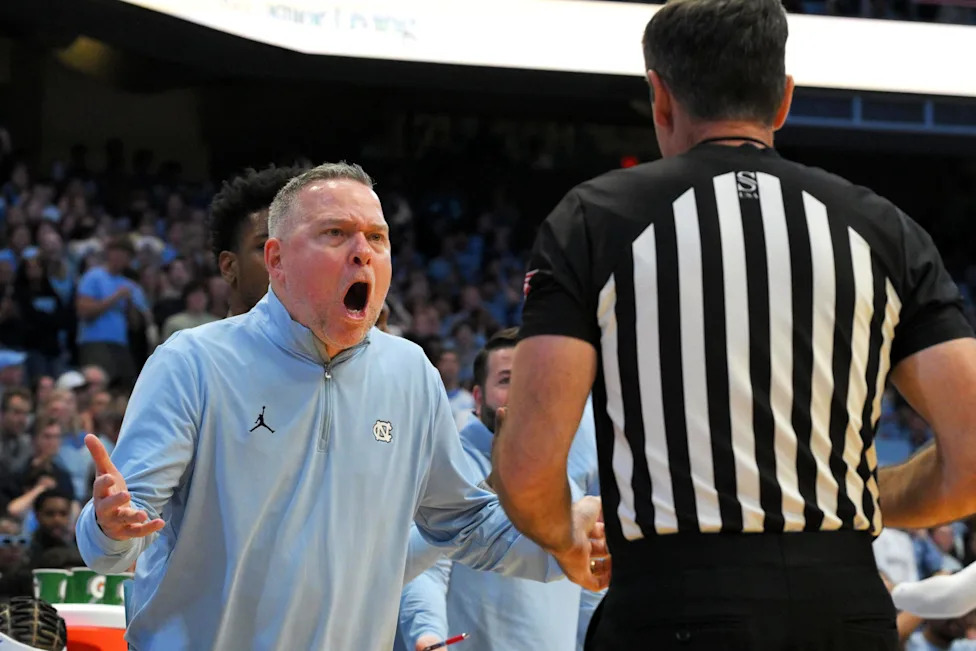
The North Carolina Tar Heels are only five games into the 2026-27 college basketball season, but questions are already beginning to emerge about the direction of Michael Malone’s program. Despite opening the campaign with a respectable 4-1 record, UNC has experienced several worrying moments that have raised concerns among supporters and national observers.
For a program with the history, expectations and championship ambitions of North Carolina, simply collecting victories is not enough. The Tar Heels are expected to compete at the highest level, establish themselves among the nation’s elite teams and demonstrate the consistency required to make a serious postseason run. So far, Malone’s squad has shown flashes of potential, but it has also exposed weaknesses that could become increasingly difficult to overcome as the schedule gets tougher.
With Monday night’s home matchup against Monmouth approaching, the Tar Heels are preparing to conclude what has been considered the more manageable portion of their non-conference schedule. Their 4-1 start looks encouraging on paper, but their only defeat, a home loss against Georgia, has already highlighted some of the problems surrounding the team.
The biggest concern has been North Carolina’s inability to consistently control the rebounding battle.
Rebounding has traditionally been an important part of successful basketball at UNC, but this season’s team has struggled to establish the physical presence necessary to dominate the glass. Opponents have found opportunities to collect offensive rebounds, extend possessions and create additional scoring chances.
Those problems have become particularly frustrating because they have frequently allowed opponents to remain competitive even when North Carolina appears to have control of the game.
The return of Cameron Fens provides some encouragement. His presence gives Malone another important option in the frontcourt, offering additional size, physicality and defensive support. Having him available through the month should help address some of the team’s interior problems.
However, one returning player cannot automatically solve every issue. The Tar Heels will need a collective improvement in positioning, physical effort, communication and defensive rebounding if they want to become a more dependable team.
Another issue attracting attention is North Carolina’s difficulty maintaining substantial leads.
On several occasions, the Tar Heels have looked capable of putting games away early, only to allow their opponents to fight their way back into contention. Instead of maintaining control and creating comfortable victories, UNC has sometimes surrendered momentum through defensive lapses, turnovers and inconsistent execution.
These situations are particularly concerning because stronger opponents are unlikely to offer the same opportunities to recover. Against nationally ranked competition, allowing an opponent to erase a significant advantage can quickly turn a comfortable evening into a damaging defeat.
Malone and his coaching staff must therefore find ways to improve the team’s concentration and composure, particularly during important stretches of the second half.
Rotational decisions have also contributed to the growing discussion surrounding the program.
With several players competing for meaningful minutes, establishing consistent combinations has not always been straightforward. Adjustments are understandable during the early stages of a season, especially for a coaching staff still evaluating its personnel. Nevertheless, the Tar Heels need to develop a dependable rotation that allows players to understand their responsibilities and build chemistry.
The challenge for Malone is finding the right balance between experimenting with different combinations and establishing the consistency necessary to compete against quality opposition.
These concerns have attracted national attention, with CBS Sports analyst Cameron Salerno recently examining the panic levels surrounding struggling programs from college basketball’s traditional Blue Blood category.
North Carolina was included in the discussion, receiving a panic meter rating of 6.5.
That assessment suggests there are legitimate reasons for concern, although it does not necessarily mean the Tar Heels’ season is heading toward disaster. A rating of 6.5 places UNC in a position where its early performances deserve serious attention, but there remains sufficient time for the coaching staff to address the problems.
Whether that rating is too high is certainly debatable.
North Carolina still has a winning record, has demonstrated the ability to compete and has opportunities to improve before the most important part of the season arrives. Five games are not enough to establish a complete picture of a team’s identity, particularly when a new coaching staff is working to implement its preferred system.
However, the warning signs cannot simply be ignored.
The upcoming schedule will provide a much clearer indication of where this team stands. After hosting Monmouth on Monday night, UNC will face West Virginia before returning home to welcome Arkansas to the Dean E. Smith Center.
Those matchups represent important opportunities for Malone’s players to demonstrate progress in the areas that have caused the most concern.
West Virginia should provide another physical examination, while Arkansas will offer a significant test against stronger competition. North Carolina cannot afford to approach those games with the same inconsistencies that have appeared during the opening weeks.
Improved rebounding, stronger defensive communication and better second-half execution must become priorities.
Ultimately, the pressure surrounding Malone is not simply about the 4-1 record or CBS Sports’ 6.5 panic meter. It is about whether North Carolina can transform its early potential into consistent performances against teams capable of exposing its weaknesses.
The Tar Heels have enough time to correct their mistakes, and the return of Cameron Fens could provide a meaningful boost. But the next few games will be important in determining whether the concerns are temporary growing pains or indications of deeper problems.
For now, there is no reason for North Carolina supporters to abandon confidence in the season. However, there are legitimate reasons to demand improvement.
The panic meter may sit at 6.5, but Malone and his players have an opportunity to bring that number down before the pressure becomes even greater.