

CHAPEL HILL — Michael Malone has made no secret of his expectations for North Carolina this season. Since taking charge of the Tar Heels, the first-year head coach has consistently emphasized accountability, physicality and the importance of correcting weaknesses before they become major problems.
Usually, Malone’s postgame news conferences involve detailed explanations of what his team must improve. However, following Monday night’s convincing 85–45 victory over Monmouth, the North Carolina coach took an unexpected moment to celebrate something that had been missing from his team’s performances.
For once, Malone wasn’t focused on criticizing his players. Instead, he wanted everyone to recognize a significant step forward.
“By the way, we [outrebounded] somebody tonight, guys,” Malone said with excitement. “Are you excited about that? I am.”
It might not sound like the kind of achievement that deserves special attention after a 40-point victory, but for North Carolina, it represented something considerably more important than the final score.
The Tar Heels had struggled to control the boards throughout the opening portion of their season. Despite possessing players with considerable size and athletic ability, UNC had been outrebounded in four of its previous five games. That weakness repeatedly created additional opportunities for opponents and prevented Malone’s team from establishing the physical identity he wants.
Against Monmouth, however, North Carolina finally showed encouraging signs of improvement.
The Tar Heels finished with a 42–36 advantage in total rebounds. Although a six-rebound difference isn’t particularly overwhelming, the result was meaningful because it demonstrated that the players were beginning to respond to the coaching staff’s demands.
North Carolina improved its record to 5–1, but the importance of Monday’s performance extends beyond another victory.
The schedule is about to become considerably more challenging. UNC’s next six games will come against power-conference opponents, beginning Friday against West Virginia in Charlotte. Those matchups will provide a much clearer indication of whether the Tar Heels have genuinely addressed their rebounding problems.
Malone understands that his team cannot afford to carry the same weaknesses into that difficult stretch.
MALONE’S PRACTICE EMPHASIS IS BEGINNING TO PAY OFF
According to Malone, North Carolina’s improvement on the boards wasn’t accidental. The coaching staff has devoted considerable time during practice to teaching players how to become more aggressive, establish better positioning and finish defensive possessions.
The head coach indicated that anyone who has watched the Tar Heels practice would immediately recognize how much attention has been given to rebounding drills.
Rather than simply telling players to collect more rebounds, Malone and his assistants have worked on developing the habits necessary to compete physically around the basket.
That includes making contact with opposing players, maintaining balance and attacking the ball instead of allowing opponents to gain advantageous positioning.
Jarin Stevenson provided an interesting explanation of one particular exercise that has become part of North Carolina’s preparation.
According to the forward, players practice by running into a coach holding a padded shield before immediately attacking the rebound. The drill is designed to teach players that making initial contact isn’t enough. They must continue pursuing the basketball after absorbing physical contact.
Stevenson believes those repetitions are beginning to produce positive results.
“We’ve been doing a lot of drills in practice where they got a pad, you hit the pad, and you go attack the rebound, so I’ve seen improvement on that,” Stevenson explained.
He also acknowledged that North Carolina still has areas requiring attention, particularly its transition defense.
“Still there are some mess-ups [in transition defense], but a little improvement on that.”
His comments reflected a team that recognizes its shortcomings but is gradually learning how to correct them.
JARIN STEVENSON PROVIDES AN ENCOURAGING EXAMPLE
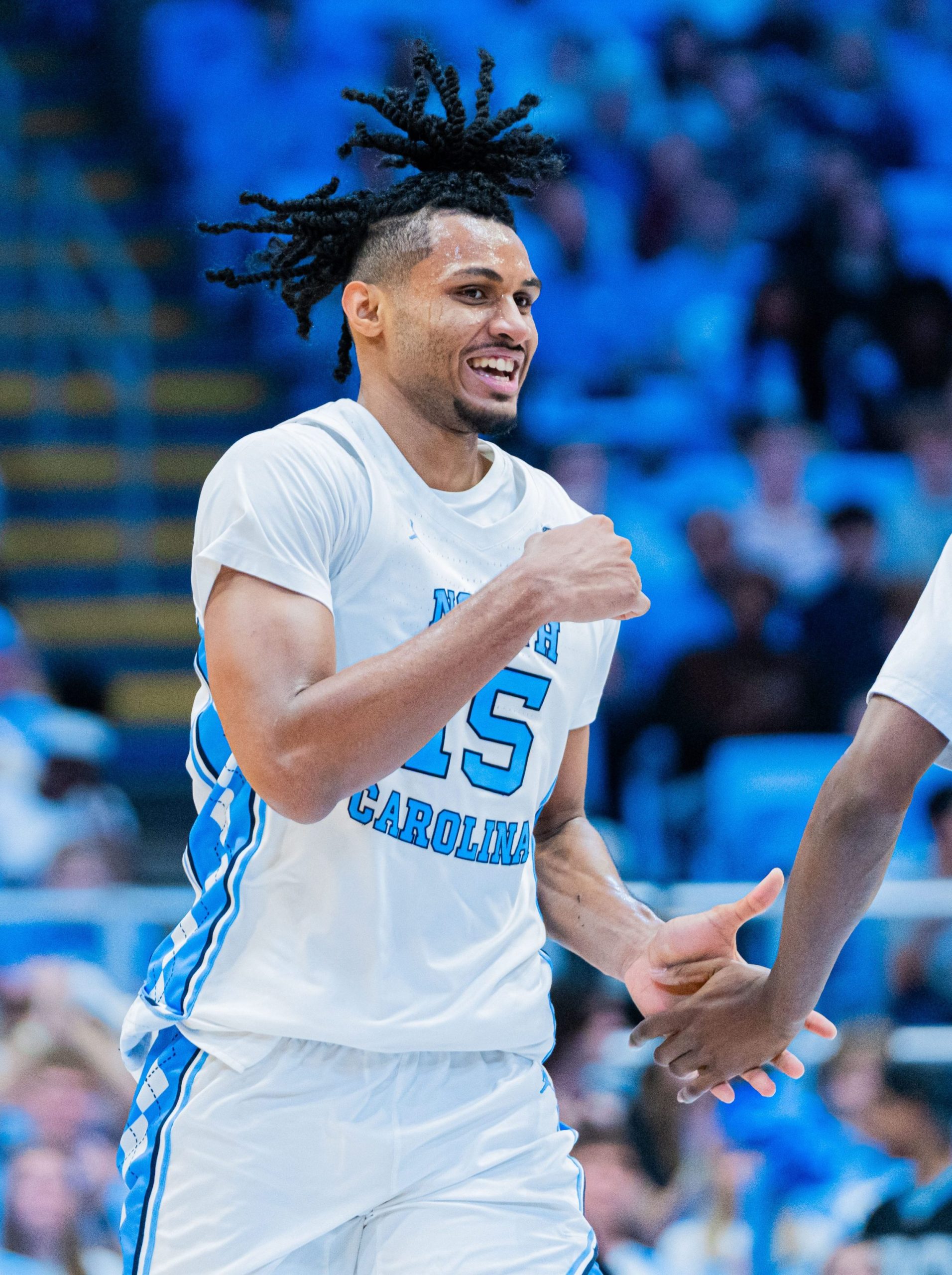
One of the most encouraging individual performances against Monmouth came from Stevenson himself.
The 6-foot-10 forward collected a season-high eight rebounds, providing exactly the kind of contribution Malone wants from his frontcourt players.
Interestingly, Stevenson initially needed a moment to confirm his rebound total when asked about his performance. However, his explanation revealed an important understanding of what the coaching staff expects from him.
His responsibility isn’t simply to use his height and athleticism to compete around the basket. He must also develop the physical instincts and consistency required to secure rebounds against determined opponents.
Eight rebounds represent a positive step, particularly for a player whose contribution in that area is becoming increasingly important to the team’s overall identity.
North Carolina needs Stevenson and its other frontcourt players to become more dependable on the glass if the Tar Heels hope to compete against stronger opposition.
THE REAL TEST IS JUST BEGINNING FOR NORTH CAROLINA
Monday’s victory offered Malone plenty of reasons to feel encouraged, but the head coach knows that beating Monmouth is only one part of a much bigger challenge.
The upcoming six-game stretch against power-conference competition will test whether North Carolina’s improved rebounding can hold up against bigger, stronger and more experienced opponents.
West Virginia represents the immediate challenge on Friday in Charlotte. The matchup will demand greater physical commitment, concentration and discipline from the Tar Heels.
If UNC returns to its previous rebounding struggles, the progress against Monmouth could quickly become irrelevant.
However, if Stevenson’s improvement and the team’s collective effort continue, North Carolina could begin developing the toughness Malone has been trying to establish since arriving in Chapel Hill.
The 85–45 victory was never going to answer every question surrounding the Tar Heels. Their transition defense still needs attention, and their ability to control the boards against quality opponents remains unproven.
Nevertheless, Malone finally had something positive to celebrate.
For a team that has spent much of its early season searching for consistency on the glass, winning the rebounding battle was an important breakthrough.
Now, the challenge is turning that encouraging performance into a regular habit. Friday’s showdown against West Virginia will offer the first major opportunity to prove that North Carolina’s improvement is real.