

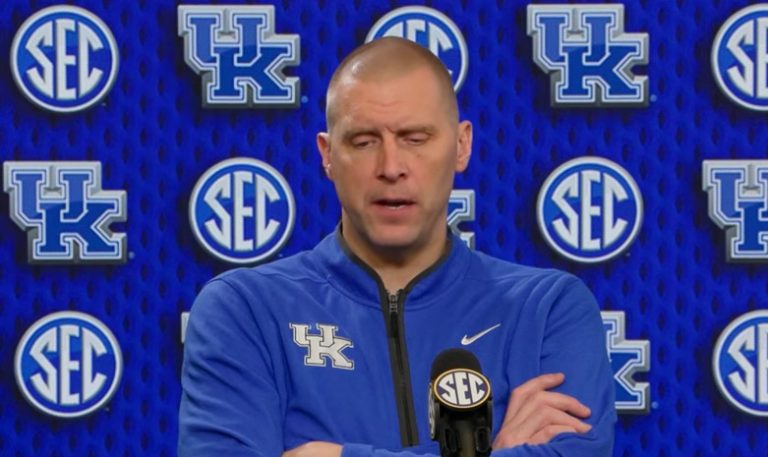
Kentucky’s defensive struggles have reached a worrying point, and Mark Pope has now introduced an unusual approach to address the problem. But one particular weakness has become so concerning that the Wildcats’ latest practices have taken a completely different direction.
After suffering another disappointing defeat against Indiana, Pope knows his team cannot afford to continue making the same mistakes. With an important matchup against Wichita State approaching, Kentucky has been using its extra preparation time to address the problems that have repeatedly hurt its performances.
And the coach’s latest explanation reveals just how serious the situation has become.
Mark Pope uses Kentucky’s unexpected break to address a major problem
The seven-day gap between games has provided Kentucky with an opportunity that Pope believes could become extremely valuable.
Rather than spending every available day preparing for another opponent, the Wildcats have been able to concentrate on improving their own weaknesses.
Speaking on his weekly radio show Wednesday night, Pope explained that the coaching staff had been using the additional time to examine the team’s performances and work on the areas where improvement was most necessary.
“We’ve had a couple days to just work on our DNA and be fully focused on us growing in the places where we’ve struggled early in the season,” Pope said.
He also described the extra practice days as valuable and satisfying.
That opportunity has been particularly important because Kentucky’s biggest problems have emerged on the defensive end.
The Wildcats have struggled against their power-conference opponents, losing both matchups by at least 14 points. Those performances have raised questions about the team’s ability to compete consistently against stronger opposition.
Pope clearly understands that the defensive issues cannot continue.
The practices leading up to the Wichita State game have therefore been particularly intense, with the coaching staff concentrating heavily on correcting the team’s defensive mistakes.
Kentucky’s defensive numbers reveal an uncomfortable reality
One of the most interesting aspects of Kentucky’s defensive struggles is that the Wildcats are not necessarily allowing opponents to attack quickly.
According to the statistics in the report, Kentucky ranks among the top 10 nationally in the average length of its opponents’ offensive possessions, at approximately 19 seconds.
That means opposing teams are generally being forced to spend considerable time working for their opportunities.
However, the Wildcats have not been receiving the benefits of that defensive effort.
Despite making opponents work in the half court, Kentucky has conceded at least 77 points in four of its first six games.
The problem, according to Pope, is what happens when those possessions approach their conclusion.
Rather than consistently securing defensive rebounds or forcing opponents into difficult shots without committing fouls, Kentucky has repeatedly allowed teams to extend possessions.
Pope offered a particularly worrying description of the situation.
“We are one of the most-dysfunctional teams in terms of finishing out the possession,” he admitted.
That statement explains why the coaching staff has made defensive rebounding and discipline two of its biggest priorities during the extended preparation period.
Kentucky must learn how to finish defensive possessions properly.
Forcing an opponent to use most of the shot clock means very little if that team eventually secures an offensive rebound or earns free throws.
Offensive rebounds are creating another problem for Pope
One of Kentucky’s most concerning weaknesses has been its inability to prevent opponents from getting second chances.
According to the supplied report, five of the six teams Kentucky had faced had collected at least 10 offensive rebounds.
That is a significant problem for a team trying to establish defensive consistency.
When an opponent misses a shot, Kentucky should be looking to secure the rebound, end the possession, and transition into offense.
Instead, the Wildcats have repeatedly allowed opponents to recover the ball and attack again.
The report also notes that Kentucky has rebounded approximately 75% of opponents’ missed shots inside the three-point arc.
Although that figure provides an indication of the problem, the larger concern is the number of additional opportunities opponents are receiving.
Pope knows his players must become more aggressive and disciplined when fighting for rebounds.
Defensive stops are not complete until Kentucky controls the ball.
If the Wildcats cannot improve in this area, even good defensive possessions could continue ending in frustration.
Pope introduces an unusual punishment to stop dangerous fouls
Perhaps the most interesting part of Kentucky’s defensive adjustments concerns the team’s tendency to foul opposing shooters.
According to Pope’s personal statistics, the Wildcats ranked 322nd among 365 Division I teams in shooting fouls.
That is an alarming position for a team attempting to build a reliable defense.
Even more concerning, Pope noted that Kentucky had committed the fourth-most fouls nationally on three-point attempts.
The Indiana defeat provided a particularly painful example, with the Wildcats committing five fouls on three-point shots during the contest.
Giving opponents opportunities to score from the free-throw line is already damaging. However, fouling three-point shooters can be especially costly because it can turn a difficult offensive possession into three free throws.
Pope and his coaching staff decided that the problem needed immediate attention.
During practice at the Joe Craft Center, Kentucky’s scout team was instructed to deliberately test the defensive players and try to draw fouls on three-point attempts.
The idea was to expose the bad habit in practice so the Wildcats could learn to avoid making the same mistakes during actual games.
Pope also introduced towel pushes as a consequence for fouling a three-point shooter during those practice drills.
It is an unusual measure, but it demonstrates how seriously the coaching staff is treating the issue.
The objective is simple: teach Kentucky’s defenders to contest shots without making unnecessary contact.
If the Wildcats can become more disciplined, they could prevent opponents from receiving easy scoring opportunities.
Forcing turnovers is another priority
Kentucky’s defensive problems do not end with rebounding and shooting fouls.
The Wildcats have also struggled to create extra possessions by forcing turnovers.
According to BartTorvik.com, Kentucky ranked 327th nationally in gaining extra possessions at the time of the report.
The individual statistics highlighted by the article also reveal difficulties in generating defensive pressure.
The Wildcats had an 8.3% steal rate, ranking 282nd nationally, while their non-steal turnover rate stood at 6.1%, ranking 311th according to KenPom.
Those numbers suggest Kentucky has not been particularly effective at disrupting opponents’ offensive rhythm.
For Pope, creating turnovers is another important part of the defensive improvement process.
The Wildcats need to become more active, anticipate passing lanes, and find ways to make opponents uncomfortable.
However, that aggression must not lead to even more unnecessary fouls.
It is a difficult balance, but one Kentucky must find if it hopes to become a more complete defensive team.
Pope explained that the central focus is learning how to finish defensive possessions.
“How do you get out of a possession? That’s where our focus is,” he said.
He also expressed confidence in his players’ ability to learn and improve.
Wichita State will provide an important examination
All the extra preparation will soon face its first major test.
Wichita State was scheduled to travel to Lexington to face Kentucky at Rupp Arena on Friday night.
For Pope, the matchup represents an opportunity to see whether the changes introduced during practice are beginning to produce results.
The Wildcats cannot afford to spend an entire week discussing defensive improvement without demonstrating progress when the next game arrives.
Their ability to secure rebounds, defend without fouling, and create turnovers will be particularly important.
The game also comes before another demanding challenge against No. 2 Virginia in the ACC-SEC Challenge the following week.
That makes the Wichita State matchup an important measuring point for Kentucky.
The coaching staff will want to see whether the players have understood the defensive lessons from their recent practices.
More importantly, Pope will want to see whether his team can maintain its discipline when the pressure of a competitive game returns.
Mark Pope remains confident Kentucky will improve
Despite the concerns surrounding the Wildcats, Pope has expressed confidence that the additional practice time will make a difference.
He believes players improve in the areas they consistently work on, and he has been encouraged by the team’s willingness to embrace the defensive emphasis.
“We’re going to see improvement because you get better at what you focus on,” Pope explained.
That confidence will now need to translate into performances.
Kentucky’s early struggles have made it clear that the team must improve in several areas if it hopes to meet expectations.
The Wildcats need stronger defensive rebounding, fewer shooting fouls, and greater ability to create turnovers.
Those are not small adjustments, but they are problems that Pope believes can be addressed through focused practice and improved execution.
For a program with Kentucky’s history, defensive consistency is essential.
The Wildcats cannot expect to compete at the highest level if opponents repeatedly receive second chances or benefit from unnecessary fouls.
Pope has identified the problems, introduced specific practice measures, and given his players additional time to work on them.
Now comes the difficult part: proving that the changes actually work.
Will Mark Pope’s unusual defensive approach finally produce the improvement Kentucky desperately needs, or will Wichita State expose the same weaknesses that haunted the Wildcats against Indiana?