LOUISVILLE, Ky.— One of the more exciting things about Duke basketball is that on any given night between October and March, there’s no telling which Blue Devil will have the most riveting court performance. The world of college basketball would be boring indeed if the likes of Cameron Boozer and Cooper Flagg dominated every game, weaving an easy but singular one-man narrative through the six months of a season. Thankfully, Duke men’s basketball doesn’t have a boredom problem.
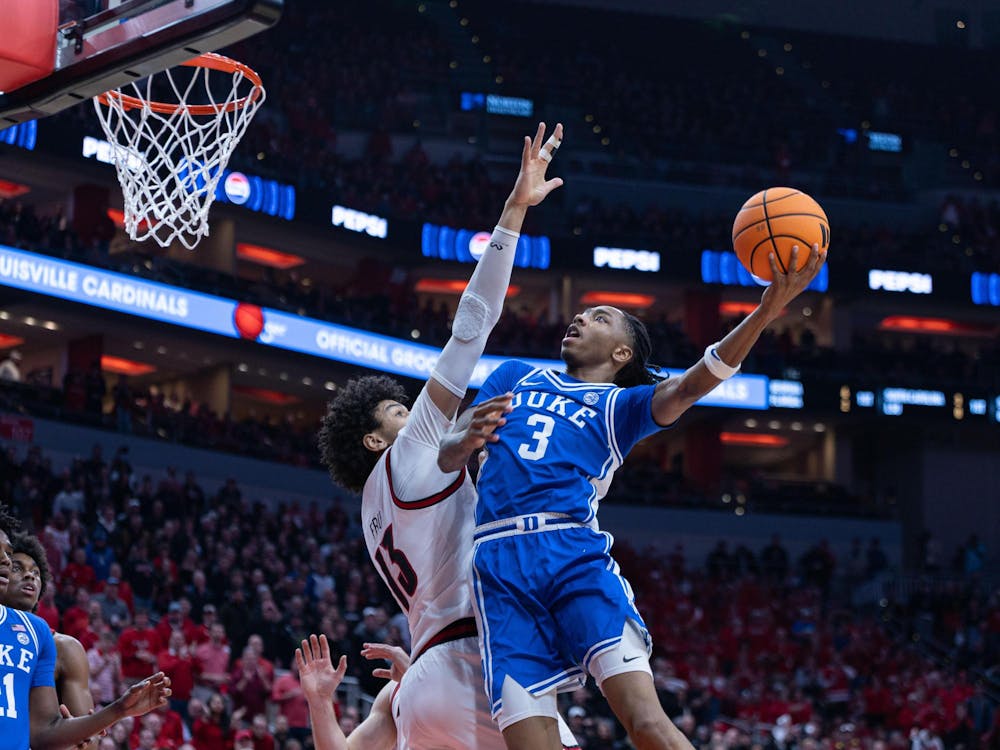
Tuesday night, that was thanks in large part to junior point guard Caleb Foster, who scored a career-high 20 points, most of them in the second half of Duke’s ACC road opener at Louisville. In his third year with head coach Jon Scheyer, Foster’s identity remains somewhat murky: After riding the bench for much of his highly-anticipated sophomore season, he entered this one as the only player on the team with two years at Duke already under his belt. In recent games, the Harrisburg, N.C., native has played more like the veteran he is, running operations from point with determination and deft, though his game has lacked the kind of consistency that makes a player like Maliq Brown so crucial to the lineup. Tuesday night, however, looked like the beginning of a Caleb Foster who has finally decided what he’s going to bring to Duke’s table.
“Some of our closest games this year, he’s put us over the hump, with really good athleticism on the floor,” Scheyer said Tuesday. “His ability to create offense for us is key. And then I thought his defense was really good, too … I think that’s really important, the fact that you have a two-way guy who’s experienced, he’s been in these moments, and he was so poised the whole way.”
Like most of his teammates, Foster played a quiet and relatively ineffective first half, amassing just two buckets with as many fouls and nothing from deep. The offense he ran faltered against a spirited Cardinal defense, while his own defensive efforts failed to curb the onslaught of threes dropping through Duke’s hoop.
As much as the Blue Devil faithful sweated through that first period, Scheyer said his team was quite unfazed at halftime, facing a completely manageable nine-point deficit. Foster contributed to the group’s sense of calm, confident in his team’s ability to out-tough its opponent in the second frame, a feat he has been part of dozens of times.
Indeed, Duke played a different game in the second half, nearly doubling its field-goal percentage while Louisville’s dropped by almost 15%. Foster led the charge with another 14 points from the field and two on the stripe, outshooting Isaiah Evans and even Cameron Boozer in the 20-minute period, though both of them had outperformed Foster in the first half. In his first play after the break, he inbounded the ball and dribbled forcefully all the way down the court for a layup, making the whole thing look as easy and routine as a layup line in practice.
Time and again, Foster muscled his way into the paint, usually completing the play with a layup but twice throwing strong chest passes to teammates waiting unguarded at the arc. He flexed his deft dribbling hands as he crossed the basketball between his legs to maneuver around the Cardinals, push through the bright red rectangle under the basket and smack just the right spot on the backboard to add two points to Duke’s climbing lead. Louisville, unprepared for Foster’s second-half renaissance, couldn’t stop him, even as the guard’s MO became clear.
“Caleb Foster was a game changer in the second half,” Louisville head coach Pat Kelsey said. “We really, really struggled to keep him out of the paint, so much of our focus was on No. 12.”
Kelsey’s mistake was understandable — it was, in fact, probably exactly what Scheyer hoped he would do. The Louisville coach focused so intently on a plan to guard Cameron Boozer that Foster, with his unpredictable performances, didn’t demand much of his attention. That’s one of the many joys of a player like Boozer, whose national renown asks coaches to devote the lion’s share of their focus to him. Those coaches forget about players like Foster — who has forged a path at his school over the course of three years — because college basketball has become more about elite one-and-done rookies and transfers than about growth and commitment. Not for Scheyer.
“This kind of ride doesn’t happen anymore in college, and it hasn’t gone smoothly or the best all the time. There have been some really great moments, though, and he believes, and I believe, that the best is yet to come,” Duke’s head coach said. “His commitment to Duke, his commitment to our team, should be really celebrated. I think it’s really what college basketball should be all about.”
Foster has never been the best player on the Blue Devil roster; he still isn’t, and he probably never will be. But if anything, that makes his place on the team more laudable, more unique — more interesting. Foster’s bold, determined performance Tuesday night showed off his grit and commitment at its best, broadcasting to the crowd that he has bought in to his role at Duke, even though, like Scheyer said, he hasn’t had the smoothest ride. What Foster has built, instead of a brief moment of excellence, is a mutually beneficial relationship with Duke basketball, wherein Scheyer has coached him to be a better player and Foster, in turn, has given back more and more to the Blue Devils.