


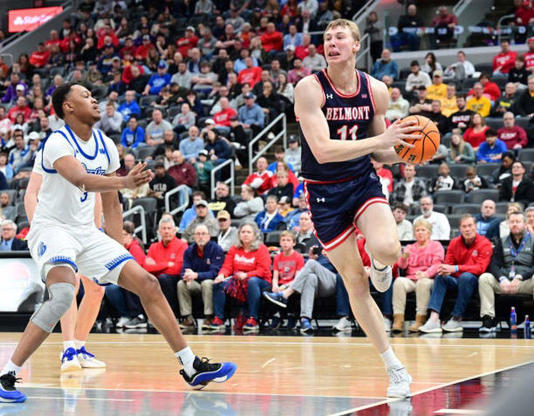
Fresh off a season that reaffirmed its status among college basketball’s elite, Duke men’s basketball is already making decisive moves to maintain its edge. Just one day after losing promising forward Nikolas Khamenia to UConn via the NCAA transfer portal, the Blue Devils have responded with authority—landing Belmont standout Drew Scharnowski as a key addition for the 2026–27 campaign.
Scharnowski, a 6-foot-9, 225-pound forward, arrives in Durham after two productive seasons with Belmont, where he steadily developed into one of the most reliable and versatile players in the Missouri Valley Conference (MVC). As a redshirt sophomore, he averaged 10.7 points, 6.1 rebounds, and 2.6 assists per game—numbers that only begin to tell the story of his impact. His presence extended far beyond the stat sheet, anchoring Belmont’s defense while also facilitating offense with a high basketball IQ.
His standout performances earned him First-Team All-MVC honors, along with a spot on the MVC All-Defensive Team for the 2025–26 season. Averaging 1.3 blocks per game, Scharnowski established himself as a formidable rim protector and a physical interior defender capable of disrupting opposing offenses. His ability to guard multiple positions, combined with his strength and instincts, made him one of the most sought-after forwards in the transfer portal—ultimately earning him a four-star transfer rating.
For Duke, this acquisition is about more than replacing a departing player—it’s about reinforcing an identity. The Blue Devils thrived last season on defensive intensity, versatility, and unselfish play en route to a remarkable 35–3 record. With Scharnowski stepping into the fold, head coach Jon Scheyer adds a player who embodies those same principles.
The timing of the move is critical. Duke has seen multiple roster changes already this offseason, with Darren Harris committing to Indiana and Khamenia heading to UConn. At the same time, the program is navigating several key decisions that will shape its roster moving forward. Guard Cayden Boozer has confirmed his return for his sophomore season, providing stability in the backcourt. However, his twin brother, Cameron Boozer, is widely expected to declare for the 2026 NBA Draft, a move that could significantly alter Duke’s offensive dynamic.
Meanwhile, players like Isaiah Evans, Patrick Ngongba, and Dame Sarr face pivotal choices regarding their futures—whether to return to Duke or explore professional opportunities. The status of guard Caleb Foster also remains uncertain, adding another layer of intrigue to the Blue Devils’ offseason outlook.
Amid all this transition, Scharnowski’s arrival offers a sense of reliability and readiness. His experience, maturity, and defensive prowess position him as an immediate contributor—particularly in filling the void left by Maliq Brown, who has exhausted his eligibility. Brown, a former Syracuse transfer, was instrumental over the past two seasons, known for his hustle plays, defensive grit, and ability to shift momentum. Scharnowski brings a similar energy, with the added benefit of continued upside.
Beyond his on-court abilities, Scharnowski also brings a strong basketball pedigree. Hailing from Burlington, Illinois, he comes from a family with Division I experience—his brother, Max, previously played at Alabama. That background, combined with his growth at Belmont, suggests he’s well-prepared for the spotlight and expectations that come with wearing a Duke uniform.
As the Blue Devils look ahead to the 2026–27 season, one thing is clear: they are not rebuilding—they are reloading. With strategic additions like Scharnowski and a core of talented returners and potential NBA prospects, Duke is positioning itself to remain firmly in the national championship conversation.
In the ever-competitive landscape of college basketball, where roster turnover is the new norm, programs that adapt quickly and effectively gain the upper hand. Duke has done exactly that. And with Drew Scharnowski now in the mix, the Blue Devils have once again proven that their pursuit of excellence never slows down—it simply evolves.




