


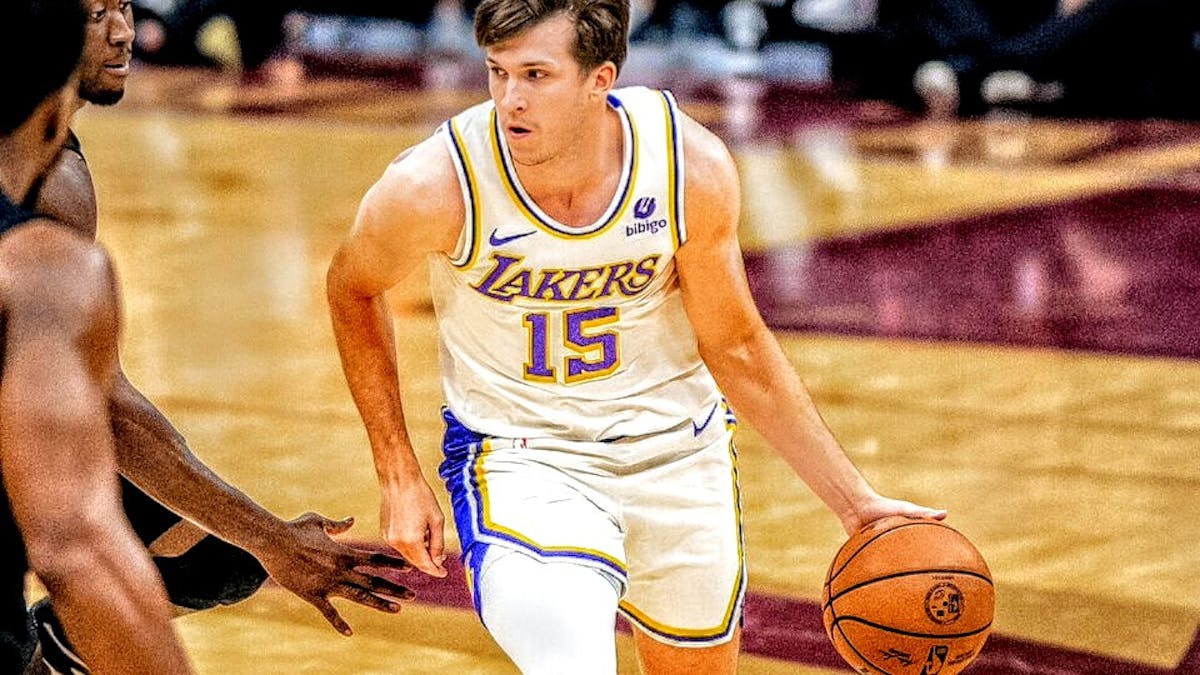
After spending several years prowling for promising young athletes with the potential to become the cornerstones of their franchise, the Los Angeles Lakers finally had their efforts rewarded with the discovery of Austin Reaves. The undrafted guard, well-respected for his tenacious ascent, has stunned all by transforming into a player capable of altering the financial outlook of any team.
However, this sudden rise in prominence forces the Lakers into an unforeseen situation: could they afford to shoulder the ever-increasing costs associated with continued employment in their iconic purple and gold uniforms?
The numbers behind a fantastic rise
Reaves’ progress has been explosive, with the 27-year-old achieving unprecedented success this season to post nightly averages of 30.3 points, 5.1 rebounds, and 9 assists, statistics that could don the resume of any All-NBA candidate, much less an undrafted player. It is abundantly clear that he has evolved from a dependable member of the team to a one-man wrecking crew. Every one of these aspects contributes to an incredibly fascinating financial game of chess.
Reaves’s much-anticipated decision to reject a four-year extension that would have increased his compensation by a total of $89 million still carries symbolic weight, with the player hoping to receive an even higher salary when free agency begins.
The financial realities behind Reaves’s stunning rise
The moment of truth will arrive during the next offseason, where it is broadly expected that Reaves will not accept his $14.9 million player option for the 26/27 season. This will provide an opportunity for negotiations that will have much more significant consequences than the comparatively modest $13.9 million salary currently included in his contract.
The Lakers remain the only team able to offer a complete five-year maximum contract, which amounts to an astounding $241 million in this situation. Any other potential suitors, including the Nets, Bulls, Jazz, or Wizards, all of which are expected to have a significant amount of flexibility, would only be able to offer four years and $178.5 million, as confirmed by ESPN.
That latter figure represents the upper-tier ceiling, but only if he satisfies the supermax criteria set forth by the league. To accomplish this, Reaves must meet requirements only historically met by a select few:
Eight years of NBA service by the time his current contract expires, and
an elite individual honour (selection to the All-NBA team, MVP award, Defensive Player of the Year) within the past three seasons.
These credentials could then facilitate a salary significantly higher than the standard maximum structures: 35% of the cap.
Reaves has been thrown into such elite circles thanks to a previous season where he averaged 20.2 points, 4.5 rebounds, and 5.8 assists while converting 46 per cent of his field shots and 37.7 per cent of his shots from beyond the arc. With these numbers, he has been able to establish himself as a dependable third wheel behind LeBron James and Luka Dončić.
Additionally, it is important to emphasise that Reaves has consistently communicated his desire to remain in Los Angeles, especially given the fact that his contract has delivered incredible value for money, a quality that has placed him in the top tier of the NBA’s most cost-effective players.
In May, he told ESPN that he prioritised comfort over chasing the highest bidder, offering some sort of optimism to Lakers fans.
The limitations restraining the Lakers
To completely understand the precarious position the Lakers find themselves in, it is necessary to investigate their present financial circumstances.
The salary cap for the 25/26 season will be established at $154,647,000, and the tax threshold will be set at $187,895,000, and the team has already exceeded both these figures [NBA]. They are ranked 25th in terms of available cap space (-$56.2 million) and have commitments totalling approximately $210.9 million, leaving them short of financial breathing room.
The situation is made even more challenging by their proximity to the “second apron”, a burdensome designation that comes into effect when the payroll of a team exceeds $207,824,000.
Breaching this barrier will invoke severe penalties established by the league’s new collective bargaining agreement (CBA).
These penalties include the denial of access to mid-level exceptions, extremely strict limitations on the execution of sign-and-trade transactions, and overall decreased flexibility when assembling a competitive roster.
The Los Angeles Lakers have found themselves in a precarious situation as a result of the long-term, high-value commitments they made to superstars LeBron James and Luka Dončić. If they have any aspirations of keeping their current roster intact and remaining truly competitive in the seasons that are to come, they will need to navigate these treacherous waters with a great deal of finesse.
The possible workarounds
Despite the grim numbers, there is a situation in which the Lakers are able to keep Reaves on their roster without sacrificing their prospects for success in the future. Bobby Marks of ESPN has outlined a feasible scenario that would provide approximately $50 million in cap space next summer, even when taking into consideration Reaves’ absorption of a maximum slot.
This potential flexibility is a result of impending decision points by a number of players on contractual arrangements.
The potential decisions made by Reaves, Deandre Ayton, and Marcus Smart regarding their player options for the 26/27 season have the potential to dramatically change the balance sheet. With room for roster adjustments in addition to these variables, the Lakers will thus be able to exert an unexpectedly high degree of agency over the way their cap picture develops.
The result is a financial landscape that, while certainly difficult, is not immune to modification. It is within the realm of possibility for Los Angeles to successfully retain its rising star and still manage to carve out enough room to strengthen the supporting cast surrounding its marquee attractions through skilful manoeuvring.
An era-defining move
The implications of the Reaves decision go far beyond merely the contract’s length and the monetary figure involved and can be viewed as a declaration of the current direction targeted by the Los Angeles Lakers.
To allow a rapidly rising star, who has publicly reaffirmed his allegiance, to leave for free would be an extremely damaging admission of poor budget management. On the other hand, acknowledging his value would be a demonstration of a commitment to both the future and the development of young talent, at a time when the team is very much looking forward to winning its first championship since 2020.
The fact that Reaves has elevated himself into rarefied territory from a financial standpoint means that the Lakers now have to make the decision of whether or not they are prepared to take a step into such realms themselves.
There are several employable strategies to keep him, and the risk of his departure—both in terms of competition and symbolism—could prove to be much more significant than the financial burden that is currently associated with him.




